Within Email triage
Where email commitments hide in plain sight
Important email commitments often hide in action verbs, dates, attachments, calendar changes, or the final sentence of the message.
On this page
- Action verbs that reveal the real request
- Deadlines and dates buried in context
- Attachments and final lines that change the task
Page outline Jump by section
Introduction
Fast email reading is not primarily about moving your eyes across text more quickly. In a busy inbox, the real challenge is spotting obligations before they disappear into background information. Many missed commitments occur because the actual request is hidden inside a long explanation, an attachment, a meeting update, or a single sentence near the end of the message.
 This matters because email overload is strongly associated with stress, workflow disruption, and reduced productivity. When inbox volume is high, readers benefit from a method that identifies commitments before investing time in every detail.[PMC]pmc.ncbi.nlm.nih.govPMCinvestigating email classes and work stressors asby M Kern · 2024 · Cited by 9 — High email load has been associated with impaired well-being because emails impose specific demands, d…
The most effective email triage systems therefore treat emails as commitment-hunting exercises. Instead of asking “What is this email about?”, they ask “What am I expected to do, and by when?”
Action verbs that reveal the real request
Many emails contain several paragraphs of context but only one sentence that actually matters. That sentence usually contains an action verb.
When scanning an email, action verbs often reveal the sender’s expectation faster than any other clue. Common examples include:
- Review
- Approve
- Confirm
- Reply
- Attend
- Submit
- Sign
- Provide
- Send
- Decide
- Schedule
- Update
Consider two versions of the same message:
We have been discussing the supplier transition for several weeks. Finance has completed its review and operations has assessed the implementation timeline. We believe the proposal is ready to move forward. Could you approve the attached plan by Thursday?
The first three sentences provide background. The final sentence creates the obligation.
This pattern appears so frequently that many professional communication guides recommend placing the requested action near the beginning of a message because readers naturally search for it. When writers fail to do that, recipients must actively hunt for the verb that identifies responsibility.[Calendar]calendar.comBetter Email to Action Game Plan For Your WorkflowsBetter Email to Action Game Plan For Your Workflows - CalendarMarch 4, 2026 — 4 Mar 2026 — Stop endless email threads with 7 acti…
A practical scanning technique is to ignore explanatory paragraphs on the first pass and look for phrases such as:
- “Could you…”
- “Please…”
- “We need…”
- “Action required”
- “Your approval is needed”
- “Can you confirm”
- “Please review”
- “Please advise”
These phrases often contain the entire task in a single line.
Distinguishing information from obligation
One reason people miss commitments is that not every email containing important information requires action.
Compare:
- “The meeting will begin at 10:00.” (information)
- “Please confirm your attendance by 10:00.” (obligation)
The second statement creates accountability. The first does not.
During rapid triage, treating action requests as a separate category from informational updates reduces the amount of detailed reading required. The reader can immediately identify messages that need follow-up and postpone lower-risk informational material.
Deadlines and dates buried in context
A date transforms information into a commitment.
Research and professional communication guidance consistently emphasise that deadlines are among the most important pieces of information in an email because they determine priority and sequencing. Yet deadlines are often buried in the middle of messages rather than highlighted clearly.[Booher Research Institute]booherresearch.comes in Emails · State Specific Due Dates · Put Action and Due Dates in the Subject Lines · Put the Request in…Read more…
Common locations where deadlines hide include:
- Mid-paragraph references to project milestones
- Meeting summaries
- Forwarded email chains
- Approval requests
- Budget and procurement discussions
- Customer or client correspondence
Examples include:
- “Before the board meeting”
- “By close of business Friday”
- “Prior to contract execution”
- “Ahead of next week’s review”
- “No later than 15 June”
These phrases may appear only once in an otherwise lengthy message.
Watch for implied deadlines
Not every deadline appears as a calendar date.
An email may say:
Could you provide comments before the presentation?
The presentation date may not even appear in the same email. The reader must recognise that a dependency exists and identify the underlying deadline.
Similarly, phrases such as:
- “Before we submit”
- “Ahead of launch”
- “Prior to renewal”
- “Before payroll closes”
often indicate hidden timing requirements. Missing them can be as costly as overlooking an explicit due date.
Calendar changes deserve special attention
Many professionals scan the text of an email but overlook associated calendar activity.
Commitments can be created by:
- New meeting invitations
- Rescheduled meetings
- Venue changes
- Updated conference links
- Modified attendee lists
A message that appears informational may effectively create a new obligation if the meeting time changes or preparation is required beforehand.
Attachments and final lines that change the task
One of the most common email-reading mistakes is assuming the email body contains the entire request.
In many organisations, the email merely introduces the real work.
Examples include:
- A contract requiring review
- A spreadsheet requiring completion
- An invoice requiring approval
- A presentation requiring feedback
- A report requiring sign-off
Government and professional communication guidance specifically advises attention to attachments because key information is frequently separated from the message body.[Communications GOV.UK]communications.gov.ukCommunications GOV.UK Writing effective emailsCommunications GOV.UKWriting effective emails - Government Communication Service29 Oct 2020 — How to communicate with colleagues and exte…
A short email saying:
Please see attached.
may contain almost no useful information on its own. The actual commitment exists inside the attachment.
The hidden request at the end
Another frequent pattern is the delayed request.
Many writers begin with history, explanation, stakeholder updates, or project context. Only after several paragraphs do they reveal the desired action.
For example:
We reviewed several vendor proposals and completed technical assessments. Finance evaluated the costs and legal reviewed the terms. The preferred option is attached. Could you approve the recommendation by Wednesday?
The approval request appears only in the final sentence.
Readers who skim the opening paragraphs and move on may leave believing they have absorbed the message while missing the only line that required action.
Communication experts often recommend placing requests early because recipients tend to prioritise based on visible actions and deadlines. The fact that many emails still place requests at the end makes final-line scanning an especially valuable triage habit.[Calendar]calendar.comBetter Email to Action Game Plan For Your WorkflowsBetter Email to Action Game Plan For Your Workflows - CalendarMarch 4, 2026 — 4 Mar 2026 — Stop endless email threads with 7 acti…
A fast scanning pattern for commitment detection
When processing large volumes of email, a structured scan is usually faster than reading sequentially.
A practical order is:
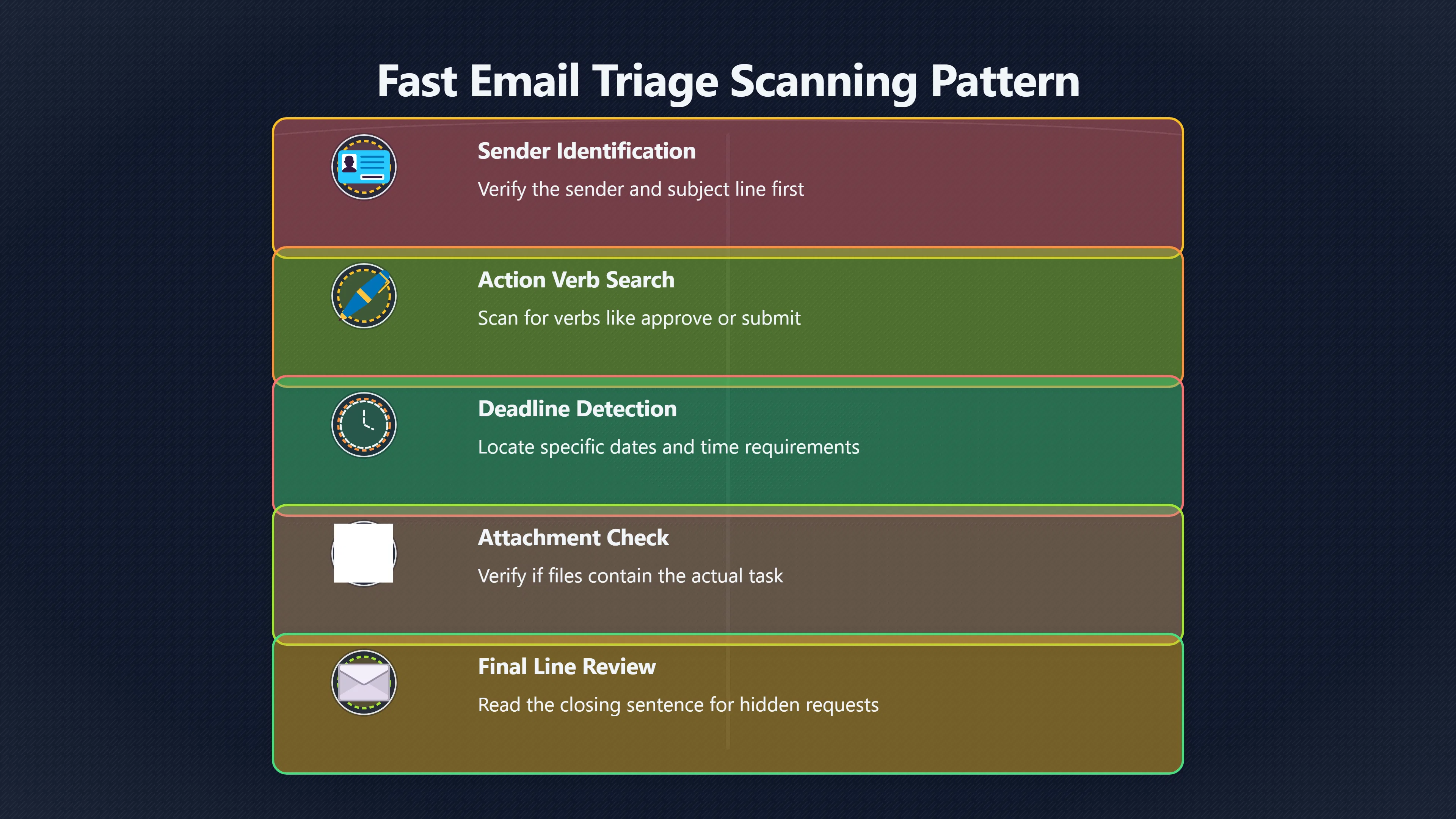
- Identify the sender and subject.
- Search for action verbs.
- Search for dates, times, and deadlines.
- Check whether an attachment is present.
- Read the final sentence or paragraph.
- Determine the next action, owner, and due date.
This approach reflects a broader productivity principle: inboxes function best as communication channels rather than storage locations for unresolved obligations. Converting requests into tasks, calendar entries, or reminders reduces the need to repeatedly reread the same messages.[Calendar]calendar.comBetter Email to Action Game Plan For Your WorkflowsBetter Email to Action Game Plan For Your Workflows - CalendarMarch 4, 2026 — 4 Mar 2026 — Stop endless email threads with 7 acti…
The question that prevents missed commitments
When finishing an email, ask a single question:
“If this email disappeared immediately, would I still know what I am expected to do and when?”
If the answer is no, the email contains a hidden commitment that has not yet been captured.
For readers trying to increase email-reading speed, this question provides a useful stopping point. Once the action, owner, and deadline are clear, further reading often becomes optional context rather than essential information. The result is faster triage without the common cost of missed approvals, forgotten deadlines, or overlooked requests.
Amazon book picks
Further Reading
Books and field guides related to Where email commitments hide in plain sight. Use these as the next step if you want deeper reading beyond the article.

Getting Things Done
Teaches capturing commitments, actions, and obligations hidden in communications.

eBay marketplace picks
Marketplace Samples
Example marketplace items related to this page. Use the search link to explore similar finds on eBay.




Endnotes
1.
Source: calendar.com
Title: Better Email to Action Game Plan For Your Workflows
Link:https://www.calendar.com/blog/email-to-action-game-plan-for-workflows/
Source snippet
Better Email to Action Game Plan For Your Workflows - CalendarMarch 4, 2026 — 4 Mar 2026 — Stop endless email threads with 7 acti...
Published: March 4, 2026
2.
Source: communications.gov.uk
Title: Communications GOV.UK Writing effective emails
Link:https://www.communications.gov.uk/guidance/digital-communication/writing-effective-emails/
Source snippet
Communications GOV.UKWriting effective emails - Government Communication Service29 Oct 2020 — How to communicate with colleagues and exte...
3.
Source: pmc.ncbi.nlm.nih.gov
Title: PMCinvestigating email classes and work stressors as
Link:https://pmc.ncbi.nlm.nih.gov/articles/PMC11484023/
Source snippet
by M Kern · 2024 · Cited by 9 — High email load has been associated with impaired well-being because emails impose specific demands, d...
4.
Source: booherresearch.com
Link:https://booherresearch.com/9-ways-to-get-people-to-take-action-and-meet-deadlines-in-your-emails/
Source snippet
es in Emails · State Specific Due Dates · Put Action and Due Dates in the Subject Lines · Put the Request in...Read more...
5.
Source: ayari.io
Title: email overload
Link:https://ayari.io/article/email-overload
Source snippet
It's about emails arriving faster than your system can process them. The fix isn't checking...
Additional References
6.
Source: linkedin.com
Link:https://www.linkedin.com/top-content/workplace-trends/digital-work-etiquette/email-communication-standards/
Source snippet
Email Communication StandardsEmail communication standards are guidelines for writing clear, respectful, and structured emails in profess...
7.
Source: engleish.com
Link:https://engleish.com/verbs-used-in-emails-and-professional-communication/
Source snippet
Verbs Used in Emails and Professional CommunicationIn this comprehensive guide, you will learn about the most effective verbs used in pro...
8.
Source: linkedin.com
Link:https://www.linkedin.com/pulse/writing-action-oriented-emails-kristina-harman
Source snippet
Writing Action-Oriented EmailsFocus your subject line on a strategic, action-oriented request to capture immediate attention. Before anyo...
9.
Source: youtube.com
Link:https://www.youtube.com/watch?v=moIucWGgvMc
Source snippet
Write Professional Emails in English | Step-by-StepI'm going to share with you seven tips plus sentence starters you can immediately begi...
10.
Source: hal.science
Title: stich et al 2018 email load workload stress desired email load
Link:https://hal.science/hal-01881947/file/stich-et-al-2018-email-load-workload-stress-desired-email-load.pdf
Source snippet
JF Stich · 2019 · Cited by 99 — Email overload has been defined as the percept...
11.
Source: mailover.ai
Title: Mail Over The True Cost of Email Overload: A Data Analysis
Link:https://mailover.ai/blog/true-cost-of-email-overload.html
Source snippet
Missed deadlines and duplicate work. When action items are buried in long email threads, they get missed. The Interact/Harris Poll found...
12.
Source: ecampusontario.pressbooks.pub
Title: pub8.1: Information Shares, Action Requests, and Replies1
Link:https://ecampusontario.pressbooks.pub/comm1062/chapter/8-1-information-shares-action-requests-and-replies/
Source snippet
Write routine message types such as information shares, requests, and replies 2. Plan, write, revise, and edit short documents and messag...
13.
Source: lawsociety.com.au
Title: 10 rules for email etiquette | The Law Society of NSW1
Link:https://www.lawsociety.com.au/resources/resources/career-hub/10-rules-email-etiquette
Source snippet
Use a clear, professional subject line. Show your recipient clearly what the email will cover. Many people will decide whether they will...
14.
Source: getinboxzero.com
Title: how to reduce email overload in organizations
Link:https://www.getinboxzero.com/blog/post/how-to-reduce-email-overload-in-organizations
Source snippet
(2026)Reduce email overload with proven strategies: cut volume, automate triage, and implement Reply Zero. Reclaim 30-60 minutes daily in...
15.
Source: karyogonaya.com
Title: This can be a specific date or a timeframe for action.Read more
Link:https://karyogonaya.com/urgent-business-email-sample/
Source snippet
Effective Communication: Crafting An Urgent Business Email...23 Feb 2026 — Following this, incorporate a deadline to provide clarity on...
Topic Tree