Within Risky texts
Tiny words that change everything
Words like unless, except, only if, may, and must can alter obligations, permissions, timing, and risk in a single sentence.
On this page
- Permission words versus obligation words
- Exception words that reverse the main claim
- A checklist for slowing down at qualifiers
Page outline Jump by section
Introduction
One of the fastest ways to increase reading speed safely is to know exactly where not to skim. In high-stakes documents, the words that matter most are often the shortest ones. A single qualifier such as unless, except, only if, may, or must can change a sentence from a permission into a prohibition, from a recommendation into a requirement, or from a general rule into a narrow exception. Readers who skim for main ideas often capture the headline claim while missing the condition attached to it. The result is not merely incomplete understanding but a different understanding altogether. In contracts, regulations, technical specifications, safety instructions, and policy documents, these qualifier words frequently carry more practical weight than the surrounding sentence.[IETF Datatracker+2Adams on Contract Drafting]datatracker.ietf.orgIETF DatatrackerKey words for use in RFCs to Indicate Requirement LevelsThe key words "MUST", "MUST NOT", "REQUIRED", "SHALL", "SHALL NOT…

Why tiny qualifiers carry so much meaning
Most readers naturally focus on nouns and verbs. We notice what can be done, what must be delivered, or what a document appears to promise. Qualifiers operate differently. They modify relationships between ideas rather than introducing new topics. Because they are short and familiar, they are easy to overlook during rapid reading.
The danger is that qualifiers often determine the actual scope of a statement. Consider the difference between:
- “Employees may work remotely.”
- “Employees may work remotely only if approved by management.”
The second sentence appears similar at a glance, but the permission exists only under a specific condition. The practical outcome is entirely different.
Research on conditional reasoning repeatedly shows that conditions and exceptions are cognitively demanding because readers must track not only the main claim but also the circumstances under which it applies. Even modern question-answering systems struggle with conditional information in long documents, illustrating how easily conditions are separated from the claims they govern.[arXiv+2Test-English]arxiv.orgConditionalQA: A Complex Reading Comprehension Dataset with Conditional AnswersOctober 13, 2021…
Permission words versus obligation words
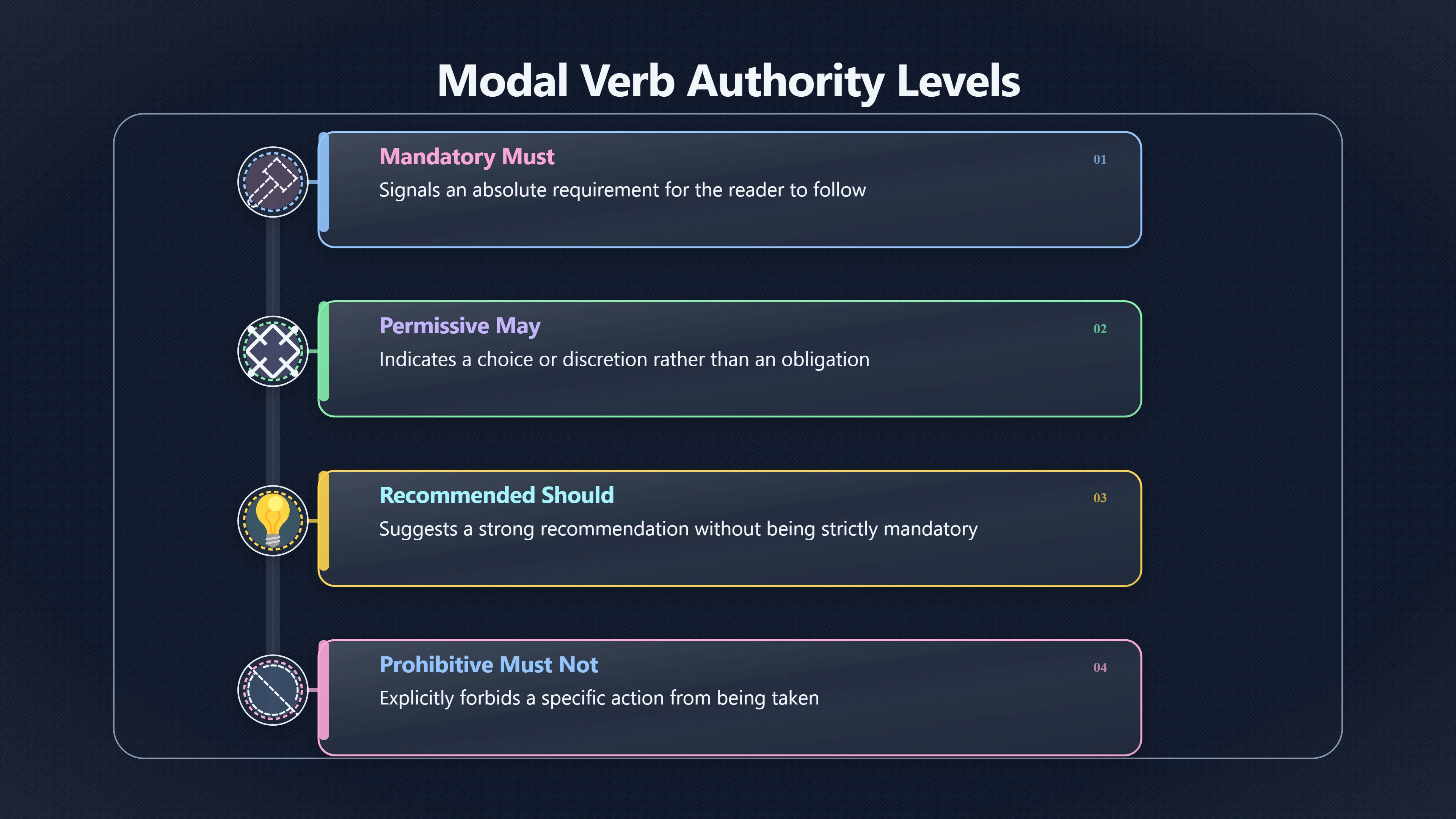
A common reading error is treating all action words as equally strong. In reality, modal verbs create very different levels of authority.
When a document says “must”
In legal, technical, and standards-writing contexts, must generally signals a mandatory requirement. Technical standards bodies such as the Internet Engineering Task Force formalise this distinction, defining MUST as an absolute requirement.[IETF Datatracker]datatracker.ietf.orgIETF DatatrackerKey words for use in RFCs to Indicate Requirement LevelsThe key words "MUST", "MUST NOT", "REQUIRED", "SHALL", "SHALL NOT…
Examples:
- “Users must change passwords every 90 days.”
- “The operator must disconnect power before maintenance.”
Ignoring the qualifier changes the meaning from requirement to suggestion.
When a document says “may”
The word may typically indicates permission or discretion rather than obligation. A person or organisation is allowed to perform an action, but is not required to do so. Many legal drafting guides specifically distinguish may from must because confusing the two changes rights and responsibilities.[Whitman Legal Solutions LLC+2flcpoland.com]whitmanlegalsolutions.comMust" is used to denoteWhitman Legal Solutions LLCWhy People “May” Incorrectly Use “Shall,” “Must,” and “Will”…11 Mar 2024 — Given the trend to write legal d…
Compare:
- “The customer may request a refund.”
- “The customer must request a refund within 30 days.”
The first creates an option. The second creates a required action if the customer wishes to preserve a right.
The middle ground: “should”
Another qualifier that deserves attention is should. Standards bodies often use it to indicate a strong recommendation rather than a mandatory rule. Failure to notice the distinction can lead readers to overestimate or underestimate requirements.[IETF Datatracker+2itsreferencehandbook.albrechtconsult.com]datatracker.ietf.orgIETF DatatrackerKey words for use in RFCs to Indicate Requirement LevelsThe key words "MUST", "MUST NOT", "REQUIRED", "SHALL", "SHALL NOT…
For high-speed reading, the key question is simple:
- Must = required.
- May = permitted.
- Should = recommended.
Treating these words as interchangeable creates immediate comprehension errors.
Exception words that reverse the main claim
Exception markers are especially dangerous because they often reverse what the reader believes they have already understood.
“Except” changes the rule
The word except creates a carve-out from a broader statement.
Example:
“Access is prohibited except for authorised personnel.”
A skimming reader may retain “access is prohibited” and miss the exception, or notice the exception and miss the prohibition. Accurate interpretation requires both pieces together.
“Unless” means the rule is conditional
The word unless often functions as “except if” or “if not”. Logic and legal-writing discussions frequently highlight that readers misinterpret unless because it reverses the expected direction of a condition.[Barbri+2Manhattan Prep]barbri.comConditional Diagramming: The Unless EquationWhatever term is modified by “unless” becomes the necessary condition. · The remaining…
Compare:
- “You may not enter unless you have a pass.”
- “You may enter if you have a pass.”
The practical result is similar, but many readers process the first sentence more slowly because the condition is embedded inside a restriction.
This is why experienced contract reviewers often search specifically for words such as unless, except, and however. These terms frequently signal where the apparent rule is being narrowed or overridden.[Reddit]reddit.comLPT When reading long documents (contracts, policiesLPT When reading long documents (contracts, policies…January 14, 2026 — LPT When reading long documents (contracts, policies, te…
“Only if” narrows permission
“Only if” is one of the strongest condition markers because it limits a right, action, or outcome to a specific circumstance.
Compare:
- “Refunds are available.”
- “Refunds are available only if proof of purchase is provided.”
The second statement appears generous at first glance, but the qualifier dramatically narrows eligibility.
Condition markers such as only if, provided that, and on condition that all perform similar narrowing functions.[Test-English]test-english.comUnless, even if, provided, as long as, etc.We can use the expressions as long as, provided/providing (that), on condition (th…
Why qualifiers are easy to miss when reading quickly
Speed-reading techniques often encourage readers to focus on content-bearing words and reduce attention to short function words. This works reasonably well for identifying topics and themes, but qualifier-heavy documents reward the opposite behaviour.
Three characteristics make qualifiers easy to overlook:
- They are short. Many consist of one or two syllables.
- They are common. Familiarity reduces attention.
- They often appear in the middle of sentences. Readers naturally focus more on sentence openings and endings.
As a result, the eye may register the main proposition while failing to process the limitation attached to it.
A sentence such as:
“Coverage applies after approval.”
and
“Coverage applies only after approval.”
can be skimmed as essentially identical even though the second imposes a strict prerequisite.
A checklist for slowing down at qualifiers
The goal is not to abandon reading speed. It is to apply precision selectively.
When reviewing contracts, policies, technical documents, safety instructions, regulations, or medical guidance, pause whenever you encounter:
- Obligation markers: must, shall, required, must not.[datatracker.ietf.org]datatracker.ietf.orgIETF DatatrackerKey words for use in RFCs to Indicate Requirement LevelsThe key words "MUST", "MUST NOT", "REQUIRED", "SHALL", "SHALL NOT…
- Permission markers: may, may not, permitted. * Recommendation markers: should, recommended.[datatracker.ietf.org]datatracker.ietf.orgIETF DatatrackerKey words for use in RFCs to Indicate Requirement LevelsThe key words "MUST", "MUST NOT", "REQUIRED", "SHALL", "SHALL NOT… * Exception markers: except, unless, however, notwithstanding.[reddit.com]reddit.comLPT When reading long documents (contracts, policiesLPT When reading long documents (contracts, policies…January 14, 2026 — LPT When reading long documents (contracts, policies, te…
- Condition markers: only if, provided that, subject to, on condition that.
- Timing markers: before, after, within, until.
For each qualifier, ask:
- Does this word create a duty, permission, or recommendation?
- Does it narrow the rule or create an exception?
- Does it attach a condition that must be satisfied first?
- Does it change when an action may occur?
- Would the sentence mean something substantially different without it?
If the answer to any of those questions is yes, that qualifier deserves slower reading than the surrounding text.
The fastest readers know when to stop skimming
Increasing reading speed is largely about allocating attention efficiently. In high-stakes documents, efficiency does not mean reading every word at the same pace. It means recognising the few words that determine how all the other words should be interpreted.
Qualifier words are often those words. They decide whether an action is mandatory or optional, whether a rule applies universally or only in special circumstances, and whether a right exists now or only after a condition is met. The time spent slowing down for may, must, unless, except, and only if is often measured in seconds. The misunderstandings they prevent can last much longer.
Amazon book picks
Further Reading
Books and field guides related to Tiny words that change everything. Use these as the next step if you want deeper reading beyond the article.
How to Read a Book
Rating: 4.0/5 from 41 Google Books ratings
Promotes careful reading of key terms and claims.
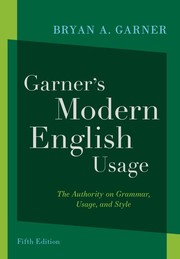

A Manual of Style for Contract Drafting
Directly examines words such as may, shall, must, and exceptions.
Endnotes
1.
Source: datatracker.ietf.org
Link:https://datatracker.ietf.org/doc/html/rfc2119
Source snippet
IETF DatatrackerKey words for use in RFCs to Indicate Requirement LevelsThe key words "MUST", "MUST NOT", "REQUIRED", "SHALL", "SHALL NOT...
2.
Source: arxiv.org
Link:https://arxiv.org/abs/2110.06884
Source snippet
ConditionalQA: A Complex Reading Comprehension Dataset with Conditional AnswersOctober 13, 2021...
Published: October 13, 2021
3.
Source: test-english.com
Link:https://test-english.com/explanation/b2/unless-even-if-provided-as-long-conditionals/
Source snippet
Unless, even if, provided, as long as, etc.We can use the expressions as long as, provided/providing (that), on condition (th...
4.
Source: whitmanlegalsolutions.com
Title: “Must” is used to denote
Link:https://whitmanlegalsolutions.com/blog/shall-may-must-will-should
Source snippet
Whitman Legal Solutions LLCWhy People “May” Incorrectly Use “Shall,” “Must,” and “Will”...11 Mar 2024 — Given the trend to write legal d...
5.
Source: flcpoland.com
Link:https://www.flcpoland.com/guides/shall-in-legal-drafting
Source snippet
May for permissions and discretions. It is one of the clearest and least contested modals in legal...
6.
Source: itsreferencehandbook.albrechtconsult.com
Link:https://itsreferencehandbook.albrechtconsult.com/?page_id=134
Source snippet
The Must, Should & May Requirement principleThe key words „MUST“, „MUST NOT“, „REQUIRED“, „SHALL“, „SHALL NOT“, „SHOULD...
7.
Source: reddit.com
Link:https://www.reddit.com/r/engineering/comments/c32shs/must_vs_shall_as_word_of_obligation_in/
Source snippet
icates a permission; "can" indicates a possibility or a...
8.
Source: barbri.com
Link:https://www.barbri.com/resources/conditional-diagramming-part-v-advantages-of-the-unless-equation
Source snippet
Conditional Diagramming: The Unless EquationWhatever term is modified by “unless” becomes the necessary condition. · The remaining...
9.
Source: reddit.com
Title: LPT When reading long documents (contracts, policies
Link:https://www.reddit.com/r/LifeProTips/comments/1qcgatr/lpt_when_reading_long_documents_contracts/
Source snippet
LPT When reading long documents (contracts, policies...January 14, 2026 — LPT When reading long documents (contracts, policies, te...
Published: January 14, 2026
10.
Source: reddit.com
Title: til about rfc 2119 that specifies how the key
Link:https://www.reddit.com/r/programming/comments/3dmu0q/til_about_rfc_2119_that_specifies_how_the_key/
Source snippet
TIL about RFC 2119, that specifies how the key words "...RFC 2119, that specifies how the key words "MUST", "MUST NOT", "REQUIRED", "SHA...
11.
Source: adamsdrafting.com
Title: Adams on Contract Drafting”Shall Not
Link:https://www.adamsdrafting.com/shall-not-unless-versus-may-only-if/
Source snippet
Unless" Versus "May... Only If" (Updated!)9 Dec 2014 — The issue was whether one of the two following alternatives was preferable to the...
12.
Source: manhattanprep.com
Title: unless statements in 2 minutes
Link:https://www.manhattanprep.com/lsat/blog/unless-statements-in-2-minutes/
Source snippet
“Unless” Statements in 2 Minutes26 Sept 2013 — The quickest way to learn how to diagram “unless” as a conditional is to translate it “if...
13.
Source: youtube.com
Link:https://www.youtube.com/watch?v=_Iy7uzYmiEk
Source snippet
nderstand the word “unless...
Additional References
14.
Source: scribd.com
Link:https://www.scribd.com/document/791618097/UNIT-41-Unless-as-long-as-and-provided-providing-that
Source snippet
Conditional Sentences: Unless & Provided | PDFThis mean: “Joe can hear only if you shout.” Unless means Except if. We use Unless to...
15.
Source: iankduncan.com
Link:https://www.iankduncan.com/projects/rfc-browser/2119
Source snippet
Key words for use in RFCs to Indicate Requirement LevelsIn many standards track documents several words are used to signify the requireme...
16.
Source: learnenglishweekly.com
Link:https://learnenglishweekly.com/grammar/conditionals-with-unless-provided-that-as-long-as
Source snippet
Conditionals with Unless, Provided That & As Long AsLearn conditionals with unless, provided that, and as long as using simple explanatio...
17.
Source: talk.typo3.org
Link:https://talk.typo3.org/t/done-introduce-rfc-2119-keywords-must-should-may-etc-in-the-documentation-where-appropriate/5480
Source snippet
typo3.org[DONE] Introduce RFC 2119 keywords MUST, SHOULD, MAY...24 Nov 2019 — The key words “MUST”, “MUST NOT”, “REQUIRED”, “SHALL”, “SH...
18.
Source: michbar.org
Link:https://www.michbar.org/file/barjournal/article/documents/pdf4article3230.pdf
Source snippet
Toedt III “Plain Language,” Legal Writing Shall Not Include “Shall” p obligation-bearing subject, use must <...
19.
Source: linkedin.com
Link:https://www.linkedin.com/pulse/using-modal-verbs-accurately-legal-english-why-shall-may-smith–ifkme
Source snippet
They are the backbone of obligation, discretion, and guidance. The difference between...Read more...
20.
Source: osbar.org
Link:https://www.osbar.org/publications/bulletin/12febmar/legalwriter.html
Source snippet
The Legal Writer The Problem with Shall By Elizabeth Ruiz...Drafters often use shall in place of other words like does, will, should, mi...
21.
Source: cba.org
Link:https://www.cba.org/resources/cba-practicelink/plain-language-legal-writing-part-ii-writing-to-be-understood/
Source snippet
fail to do just what speech has to do. Clearness is secured...Read more...
22.
Source: facebook.com
Link:https://www.facebook.com/groups/lsatstudygroup/posts/10158325417581957/
Source snippet
f negation, helping to clarify conditional statements.Read more...
23.
Source: blakemorgan.co.uk
Title: The same applies to the combination of ‘shall and may’.Read more
Link:https://www.blakemorgan.co.uk/using-will-shall-and-must-in-commercial-contracts/
Source snippet
Using 'will', 'shall' and 'must' in commercial contracts24 Mar 2016 — 'Shall', 'must' and 'will' are all modal verbs (verbs used to expre...
Topic Tree