Within Rereading
Should You Look Back or Keep Reading?
A quick question before rereading can separate useful comprehension repair from confidence-checking that slows reading down.
On this page
- The specific question test
- Useful repair versus vague checking
- Examples from definitions, pronouns, numbers, and missed details
Page outline Jump by section
Introduction
When trying to increase reading speed, the question is not whether you should ever look back. The question is whether a backward glance solves a specific comprehension problem. Skilled readers make regressions—backward eye movements—when they need to repair understanding, not merely to reassure themselves. Eye-tracking research shows that regressions are a normal part of reading and often serve a useful function when information has been missed, misinterpreted, or needs to be connected to something earlier in the text.[PubMed]pubmed.ncbi.nlm.nih.govThe function of regressions in reading: backward eye…by RW Booth · 2013 · Cited by 134 — These results suggest that readers use…
 The fastest effective readers are not necessarily the ones who never reread. They are often the ones who can quickly recognise when a regression will save time later and when it is simply a confidence-checking habit. A short pause to ask one precise question can make that distinction clear.
Should You Look Back or Keep Reading?
A useful rule is the specific-question test:
Before moving your eyes backwards, ask: “What exactly am I trying to recover?”
If you can name the missing information, a regression is often worthwhile. If you cannot identify a concrete gap and simply feel uncertain, continuing forward is usually the better choice.
This matters because comprehension problems tend to be local. A forgotten definition, an unclear reference, or a missed number can often be fixed with a brief targeted glance. By contrast, vague checking frequently leads to rereading large amounts of text that were already understood well enough the first time.
Research on reading regressions suggests that readers use these backward movements to reprocess text directly rather than merely triggering memory of what they previously saw. In other words, a regression can genuinely repair comprehension when there is something specific to repair.[PubMed]pubmed.ncbi.nlm.nih.govThe function of regressions in reading: backward eye…by RW Booth · 2013 · Cited by 134 — These results suggest that readers use…
The Specific-Question Test
The test works because it shifts attention from emotion to information.
Compare these two internal reactions:
- Useful: “Which condition applied to this rule?”
- Useful: “Who does ‘she’ refer to in this sentence?”
- Useful: “Was that figure 1.5 million or 15 million?”
- Not useful: “I don’t feel completely certain.”
- Not useful: “Maybe I should read that paragraph again.”
- Not useful: “I want to make sure I didn’t miss anything.”
The first group identifies a recoverable detail. The second group identifies a feeling.
Speed often suffers when readers respond to feelings of uncertainty as though they were evidence of misunderstanding. In many cases, later sentences resolve uncertainty naturally. Immediate rereading interrupts that process and can create a cycle of repeated checking.
Useful Repair Versus Vague Checking
Not all regressions are equal.
Useful Repair
A regression is usually worth the time when it helps answer a question that blocks understanding of what comes next.
Common examples include:
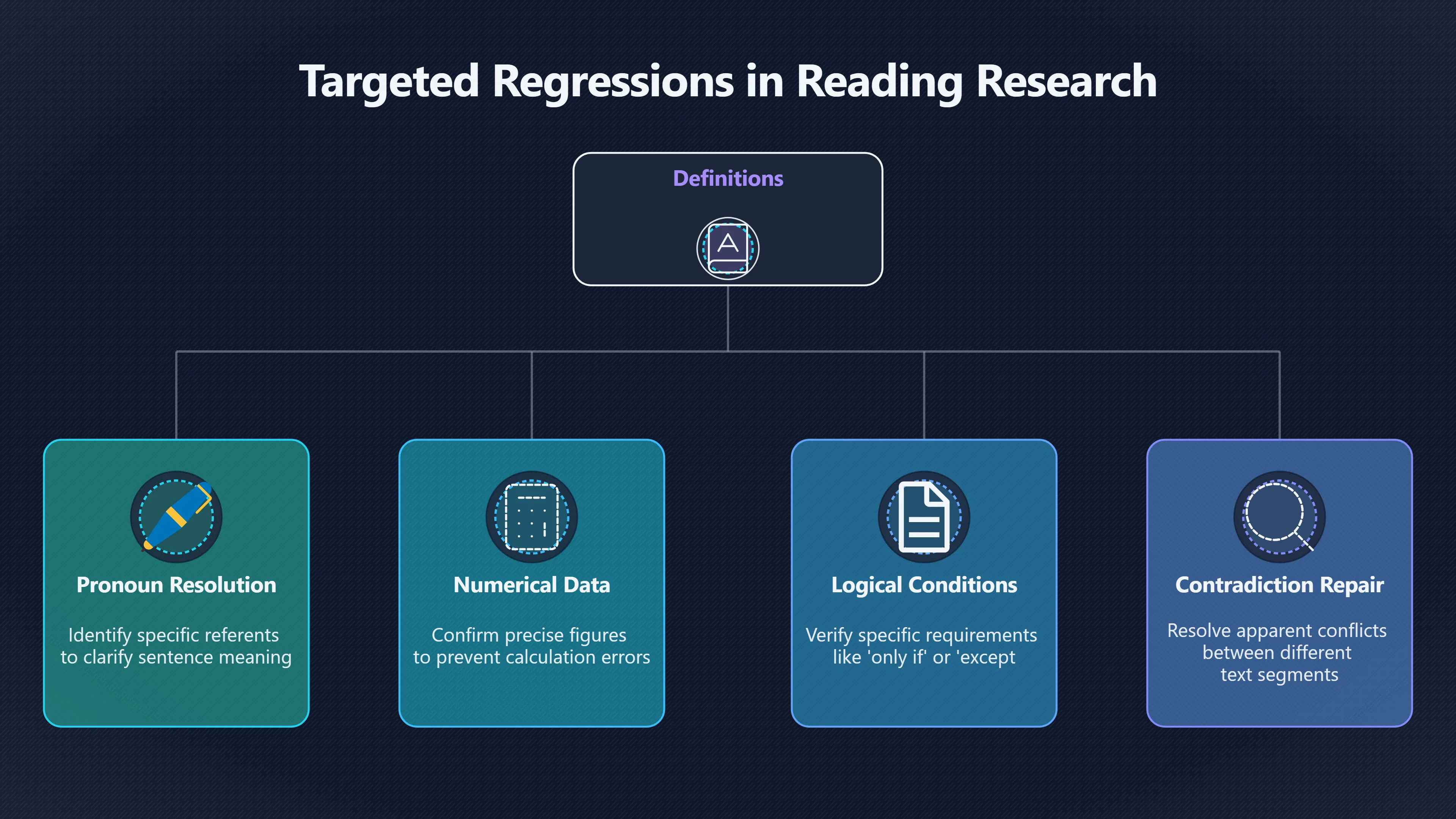
- Recovering a key definition.
- Identifying the referent of a pronoun.
- Verifying a number, date, or instruction.
- Resolving an apparent contradiction.
- Repairing understanding after a distraction.
Eye-movement research links regressions to comprehension monitoring and targeted reanalysis of text. Readers often look back when incoming information does not fit their current interpretation and they need to revise it.[Oxford University Research Archive+2PMC]ora.ox.ac.ukThis seems to reflect sensitivity to comprehension monitoringford University Research ArchiveComprehension monitoring during reading: an eye-tracking…March 27, 2020 — by AK Hessel · 2020 · Cite…
Vague Checking
A regression is usually not worth the time when the purpose is unclear.
Typical signs include:
- Immediately rereading a sentence that already made sense.
- Restarting paragraphs without identifying a missing detail.
- Rechecking every page for fear of overlooking something.
- Looking back repeatedly to feel more confident rather than more informed.
These behaviours consume reading time without necessarily improving comprehension. Because the reader is not solving a specific problem, the rereading often ends with the same uncertainty that triggered it.
When Definitions Justify Looking Back
Definitions are among the strongest reasons to regress.
Imagine reading a technical article that introduces a term such as “working memory load”. Several paragraphs later, a sentence depends on that concept. If the meaning has become fuzzy, a quick glance back to the original definition can unlock the entire section.
This type of regression is efficient because:
- The information needed is known.
- The location is usually easy to find.
- The recovered detail improves comprehension of everything that follows.
By contrast, rereading several pages because the topic feels difficult is much less targeted and often far less efficient.
When Pronouns Create Confusion
Pronouns frequently trigger worthwhile regressions.
Consider a sentence such as:
Sarah spoke to Emma before she left.
Who left?
The answer may be clarified in earlier text. Readers sometimes continue with an incorrect interpretation and become confused later. A brief regression to identify the correct referent is usually faster than continuing with a mistaken understanding.
Eye-tracking studies have long used pronoun resolution and reference tracking to examine how readers connect information across sentences. These links require readers to integrate current text with previously read material, making targeted regressions especially useful when the connection is lost.[MPG.PuRe]pure.mpg.deWe know of only one eye tracking studyrepeated name penalty effect in children's natural…February 13, 2024 — by S Eilers · 2019 · Cited by 14 — Pronouns require inferences…
When Numbers and Conditions Matter
Numbers deserve special treatment because they are difficult to reconstruct from memory.
If a paragraph states:
- a dosage,
- a date,
- a percentage,
- a sequence of steps,
- or a numerical comparison,
a quick look back is often justified.
Unlike general ideas, numbers are precise. A small error can change the meaning of an entire argument or instruction. Looking back for three seconds is often faster than carrying an incorrect figure through the next several pages and having to untangle the confusion later.
The same principle applies to conditions and exceptions. If a sentence depends on an earlier phrase such as “only if”, “except when”, or “provided that”, confirming the exact wording can prevent misunderstanding.

When It Is Better to Keep Reading
Sometimes the missing information is not actually missing.
Readers often experience temporary uncertainty because a sentence is incomplete, a paragraph is developing an argument, or a story has not yet revealed its point. In these situations, continuing forward may be the faster strategy.
Keep reading when:[cognitivetrain.com]cognitivetrain.comSome readers regress even moreRegression in Reading: Why Your Eyes Keep Going…Eye-tracking research shows that regressions account for 10-15% of all eye movements d…
- The uncertainty is broad rather than specific.
- You understand the overall direction of the passage.
- The next sentence is likely to clarify the issue.
- No decision, calculation, or interpretation depends on the missing detail.
Many comprehension problems resolve naturally as additional context arrives. Regressing too early can interrupt that process and create unnecessary friction.
A Fast Decision Rule
For readers who want greater speed without sacrificing understanding, a simple decision rule works well:
Look back only when you can finish the sentence: “I need to check _____.”
Examples:
- “I need to check who ‘they’ refers to.”
- “I need to check the definition.”
- “I need to check the percentage.”
- “I need to check which condition applies.”
If you cannot fill in the blank, keep reading.
This approach preserves the main benefit of regressions—the ability to repair comprehension—while avoiding the confidence-checking loops that often slow readers down. Research consistently shows that regressions are a normal and useful part of reading when they are tied to comprehension needs. The key is making them purposeful rather than automatic.[PubMed+2PMC]pubmed.ncbi.nlm.nih.govThe function of regressions in reading: backward eye…by RW Booth · 2013 · Cited by 134 — These results suggest that readers use…
Amazon book picks
Further Reading
Books and field guides related to Should You Look Back or Keep Reading?. Use these as the next step if you want deeper reading beyond the article.
How to Read a Book
Rating: 4.0/5 from 41 Google Books ratings
Directly supports decisions about when to reread and when to continue.

10 days to faster reading
Offers actionable methods for balancing speed and comprehension.
Breakthrough rapid reading
Teaches efficient reading while avoiding unnecessary regressions.
Reading in the Brain
Explains the mechanisms behind comprehension repair and rereading.
eBay marketplace picks
Marketplace Samples
Example marketplace items related to this page. Use the search link to explore similar finds on eBay.




Endnotes
1.
Source: pmc.ncbi.nlm.nih.gov
Title: PMCRegressions during Reading
Link:https://pmc.ncbi.nlm.nih.gov/articles/PMC6802794/
Source snippet
during Reading - PMC - NIHby AW Inhoff · 2019 · Cited by 74 — Abstract. Readers occasionally move their eyes to prior text. We distinguis...
2.
Source: pure.mpg.de
Title: We know of only one eye tracking study
Link:https://pure.mpg.de/rest/items/item_3037664_8/component/file_3569417/content
Source snippet
repeated name penalty effect in children's natural...February 13, 2024 — by S Eilers · 2019 · Cited by 14 — Pronouns require inferences...
Published: February 13, 2024
3.
Source: pmc.ncbi.nlm.nih.gov
Link:https://pmc.ncbi.nlm.nih.gov/articles/PMC2906818/
Source snippet
Eye Movements in Reading: Models and Data - PMC - NIHby K Rayner · 2009 · Cited by 298 — Models of eye movement control in reading and...
4.
Source: pubmed.ncbi.nlm.nih.gov
Link:https://pubmed.ncbi.nlm.nih.gov/22886737/
Source snippet
The function of regressions in reading: backward eye...by RW Booth · 2013 · Cited by 134 — These results suggest that readers use...
5.
Source: ora.ox.ac.uk
Title: This seems to reflect sensitivity to comprehension monitoring
Link:https://ora.ox.ac.uk/objects/uuid%3Aa16f42e2-529d-47ae-ba51-50b75dd43899/files/rkh04dp70d
Source snippet
ford University Research ArchiveComprehension monitoring during reading: an eye-tracking...March 27, 2020 — by AK Hessel · 2020 · Cite...
Published: March 27, 2020
6.
Source: Wikipedia
Link:https://en.wikipedia.org/wiki/Eye
Source snippet
EyeAn eye is a sensory organ that allows an organism to perceive visual information. It detects light and converts it into electro-che...
7.
Source: pmc.ncbi.nlm.nih.gov
Title: We presented texts that included either a personal perspective (you) or
Link:https://pmc.ncbi.nlm.nih.gov/articles/PMC7477769/
Source snippet
your emotions: An eye-tracking study on reader's...by S Child · 2020 · Cited by 19 — An eye-tracking study explored perspective effects...
8.
Source: pmc.ncbi.nlm.nih.gov
Link:https://pmc.ncbi.nlm.nih.gov/articles/PMC7888242/
Source snippet
Cognitive Model of Regressive Eye Movements during...by AF Weiss · 2020 · Cited by 9 — In this article we present a new eye movement con...
9.
Source: pmc.ncbi.nlm.nih.gov
Link:https://pmc.ncbi.nlm.nih.gov/articles/PMC12409514/
Source snippet
the rereading effect of digital reading through eye...by Y Xu · 2025 — This study aimed to investigate the differences in eye movement c...
Additional References
10.
Source: researchgate.net
Link:https://www.researchgate.net/publication/374669932_Eye_Movements_in_Reading_and_Information_Processing_20_Years_of_Research
Source snippet
Eye Movements in Reading and Information ProcessingRecent studies of eye movements in reading and other information processing tasks, suc...
11.
Source: scholarsarchive.byu.edu
Link:https://scholarsarchive.byu.edu/context/facpub/article/8947/viewcontent/5._Immediate_repeated_reading_has_positive_effects_on_reading_rate_for_English_language.pdf
Source snippet
Repeated Reading Has Positive Effects on...by JH Hansen · 2024 · Cited by 4 — The objective of this eye- tracking study was to accuratel...
12.
Source: readlite.in
Link:https://readlite.in/concepts/regressions-reading
Source snippet
These regressions aren't mistakes — they're essential comprehension repairs that skilled...Read more...
13.
Source: reunir.unir.net
Title: Eye tracking contribution on processing OF reading comprehension
Link:https://reunir.unir.net/bitstream/handle/123456789/18055/Eye-tracking%20contribution%20on%20processing%20OF%20reading%20comprehension.pdf?isAllowed=y&sequence=1
Source snippet
unir.netEye-tracking contribution on processing of (implicit)...by C de-la-Peña · 2024 · Cited by 15 — The aim is to understand the role...
14.
Source: research.reading.ac.uk
Title: 2025 03 Tromso Eye Tracking Workshop Session 1 Handout
Link:https://research.reading.ac.uk/psylinglab/wp-content/uploads/sites/25/2025/03/2025-03-Tromso-Eye-Tracking-Workshop-Session-1-Handout.pdf
Source snippet
reading.ac.ukEYE-TRACKING DURING READING IN PSYCHOLINGUISTICS28 Mar 2025 — (1) Eye-Tracking in Psycholinguistics. ➢ Introduce eye-trackin...
15.
Source: allgemeinepsychologie.uni-wuppertal.de
Title: Vorstius Radach Lonigan Silent Oral Readig VC 2014 01
Link:https://allgemeinepsychologie.uni-wuppertal.de/fileadmin/psychologie/allgemeinepsychologie/Artikel/Artikel_Radach/Vorstius_Radach_Lonigan_Silent_Oral_Readig_VC_2014_01.pdf
Source snippet
movements in developing readers: A comparison of silent...by C Vorstius · 2014 · Cited by 174 — We present sentence reading data from a...
16.
Source: utupub.fi
Link:https://www.utupub.fi/bitstream/handle/10024/190693/Reading%20Research%20Quarterly%20-%202023%20-%20M%20zi%20re%20-%20Using%20Eye%20Tracking%20Measures%20to%20Predict%20Reading%20Comprehension.pdf?sequence=1
Source snippet
We administered three widely used reading compre- hension...
17.
Source: researchgate.net
Title: 334364752 Regressions during Reading
Link:https://www.researchgate.net/publication/334364752_Regressions_during_Reading
Source snippet
(PDF) Regressions during Reading20 May 2026 — Eye Movements and Information Processing during Reading... The function of regressions in...
Published: May 2026
18.
Source: researchgate.net
Link:https://www.researchgate.net/publication/230658181_The_function_of_regressions_in_reading_Backward_eye_movements_allow_rereading
Source snippet
ue their memory for previously read words.Read more...
19.
Source: cognitivetrain.com
Title: Some readers regress even more
Link:https://cognitivetrain.com/regression-in-reading/
Source snippet
Regression in Reading: Why Your Eyes Keep Going...Eye-tracking research shows that regressions account for 10-15% of all eye movements d...
Topic Tree