Within Rereading
When one unclear word needs a second look
Ambiguous references make readers hold competing meanings in mind, and RSVP makes the quick backward check harder to perform.
On this page
- Why pronouns can stay unclear until later words appear
- How ordinary reading lets readers check names and references
- Why RSVP increases memory load during ambiguous sentences
Page outline Jump by section
Introduction
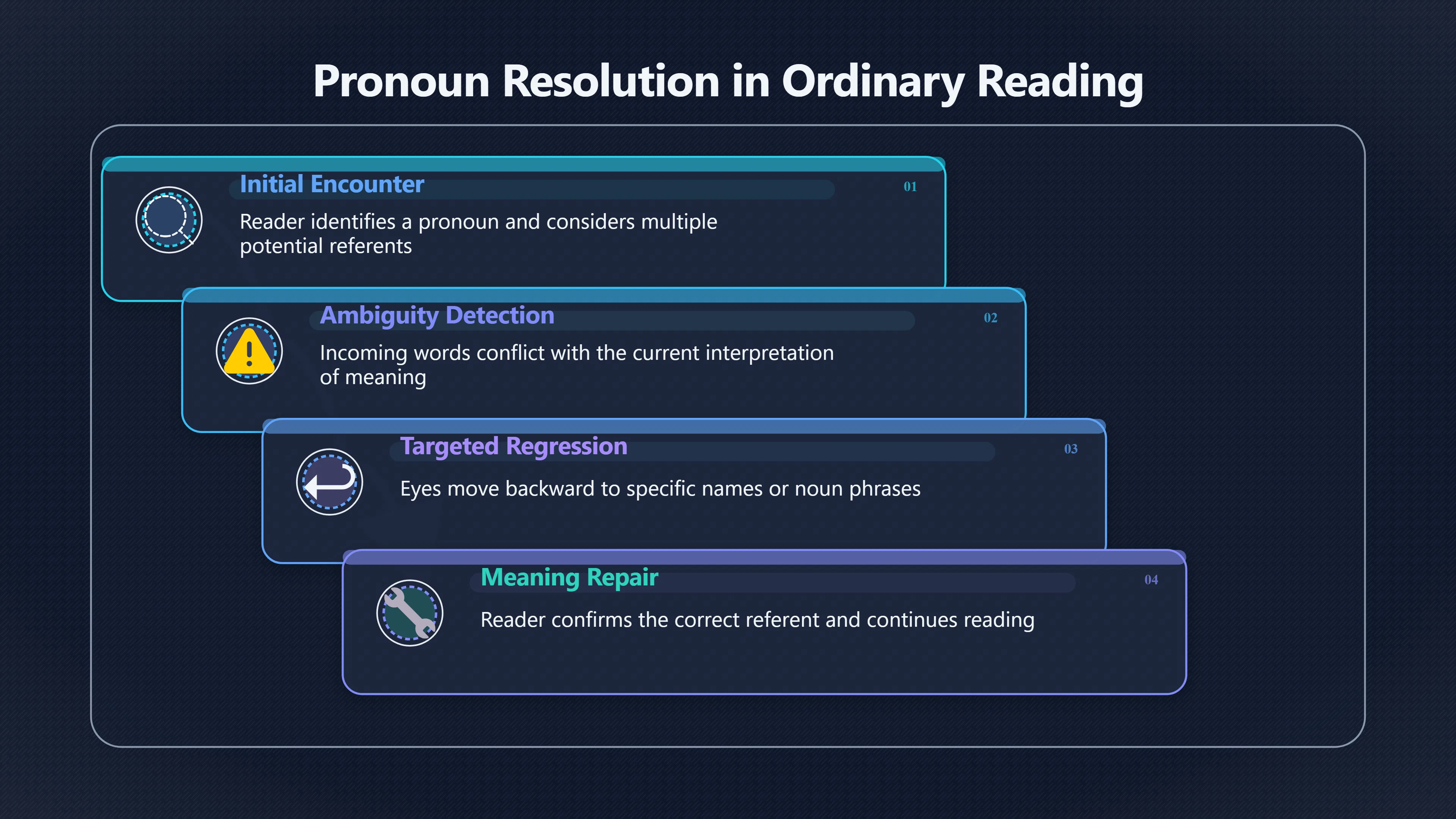
One reason rereading matters in Rapid Serial Visual Presentation (RSVP) reading is that some words cannot be fully understood when they first appear. Pronouns such as he, she, they, it, and them often depend on information that arrives earlier or later in the sentence. Readers may initially hold more than one possible interpretation in mind and then perform a quick backward glance once enough information becomes available to identify the correct referent. In ordinary reading, this repair process is usually fast and effortless. In RSVP, where words disappear as new ones arrive, the same ambiguity can force readers to rely on memory rather than direct inspection of the text. Research on eye movements, pronoun resolution, and regressions suggests that these brief returns to earlier words are a normal part of comprehension and become especially valuable when references are temporarily unclear.[PubMed+2PMC]pubmed.ncbi.nlm.nih.govThe function of regressions in reading: backward eye…by RW Booth · 2013 · Cited by 134 — The most obvious explanation is that re…
When a pronoun cannot be understood immediately
Pronouns are economical because they avoid repeating names and descriptions. The trade-off is that they require readers to identify an antecedent—the person, object, or idea to which the pronoun refers.
Consider a sentence such as:
“After Emma phoned Sarah, she realised the instructions were wrong.”
When the word she appears, more than one interpretation is possible. The reader may briefly consider both Emma and Sarah as potential referents. Only later information may make the intended meaning obvious.
This kind of temporary uncertainty is not unusual. Studies of pronoun processing show that readers continuously evaluate possible referents using cues such as grammatical role, word order, discourse prominence, and gender information. When those cues do not immediately converge on a single answer, processing becomes more demanding and reading times increase.[PMC+2eScholarship]pmc.ncbi.nlm.nih.govImmediate sensitivity to structural constraints in pronoun…by WY Chow · 2014 · Cited by 99 — A previous eye-tracking study by Ehrli…
Importantly, ambiguity is often detected only after additional words appear. A reader may think an interpretation is correct, encounter a later phrase that conflicts with it, and then need to verify an earlier reference. That is exactly the kind of situation in which regressions commonly occur during normal reading.[PubMed]pubmed.ncbi.nlm.nih.govThe function of regressions in reading: backward eye…by RW Booth · 2013 · Cited by 134 — The most obvious explanation is that re…
Why ordinary reading supports rapid reference checks
Eye-tracking research shows that reading is not a perfectly linear process. Skilled readers routinely make backward eye movements, known as regressions, when they need to confirm meaning, resolve uncertainty, or reconnect information across a sentence. These movements are typically brief and highly targeted.[PubMed]pubmed.ncbi.nlm.nih.govThe function of regressions in reading: backward eye…by RW Booth · 2013 · Cited by 134 — The most obvious explanation is that re…
When a pronoun creates uncertainty, a reader can quickly return to a nearby name, noun phrase, or earlier clause. The important feature is precision. The eyes can move directly to the suspected source of confusion rather than restarting the entire sentence.
For example, if a reader reaches the end of a sentence and becomes unsure who she refers to, a regression can land almost exactly on the relevant names. The reader does not need to reconstruct those names from memory because they remain visible on the page.
Research examining comprehension monitoring has found that regressions are often associated with targeted reanalysis. Readers use them when incoming information signals that an earlier interpretation may need revision.[ORA]ora.ox.ac.ukComprehension monitoring during reading: an eye-tracking…by AK Hessel · 2020 · Cited by 51 — We chose to use regression-in probabil…
The result is a highly efficient repair mechanism. Instead of maintaining uncertainty for several seconds, readers can resolve it almost immediately.
Why RSVP increases memory load during ambiguous sentences
RSVP changes the problem because the relevant words are no longer available when ambiguity becomes apparent.
Imagine that a sentence introduces two possible referents and then presents an ambiguous pronoun several words later. In conventional reading, the names remain visible. In RSVP, they may have disappeared long before the reader realises that clarification is needed.
The reader therefore faces a different task. Rather than checking the text, they must retrieve the earlier information from working memory while continuing to process new incoming words. This means that multiple candidate interpretations may need to be maintained simultaneously until the ambiguity is resolved.
The burden becomes greater when:
- Several names appear close together.
- Multiple pronouns occur in the same passage.
- The sentence contains interruptions or embedded clauses.
- The correct interpretation depends on information that arrives much later.
In these situations, RSVP shifts effort from visual verification to memory maintenance. The reader is no longer asking, “What did that earlier phrase say?” while looking at it. Instead, the reader must remember the phrase accurately enough to evaluate competing interpretations.[PMC+2Taylor & Francis Online]pmc.ncbi.nlm.nih.govWorking Memory and the Revision of Syntactic and Discourse…by WS Evans · 2014 · Cited by 20 — The results provide evidence that wor…
Ambiguity often emerges after the critical word has vanished
A common misconception is that readers know immediately when a sentence is confusing. In reality, comprehension problems frequently emerge after the triggering word has already been processed.
Pronoun resolution research shows that readers use expectations and predictions while reading. They often form an early guess about who a pronoun refers to and then revise that guess if later information conflicts with it. Eye-movement studies indicate that such revision can be reflected in rereading behaviour and regressions.[PMC]pmc.ncbi.nlm.nih.govPMCCan We 'Read' the Eye-Movement Patterns of Readersby A Koornneef · 2016 · Cited by 30 — In the present study readers that displayed long saccades and many regressions were more incline…
This timing matters for RSVP. If the need for correction arises only after several additional words have appeared, the critical noun or name may no longer be visible. The reader discovers the ambiguity too late to perform the quick check that ordinary reading allows.
A sentence may therefore remain unresolved for longer than it would in a conventional format, even if the reader ultimately reaches the correct interpretation.
Why a rewind control is not the same as a regression
Some RSVP systems attempt to compensate by providing rewind functions. These controls restore access to previous words, but they do not replicate the behaviour of natural regressions.
A normal regression is usually immediate, local, and highly precise. The reader’s eyes move directly to the relevant location and then continue reading. A rewind control requires the reader to recognise the problem consciously, interrupt the reading stream, activate a control, and relocate the exact point that needs inspection.
Research that experimentally restricted rereading has shown that preventing regressions can reduce comprehension, highlighting the importance of these natural corrective movements. Studies comparing RSVP-like conditions with ordinary reading similarly suggest that eliminating access to previously viewed text changes how readers resolve uncertainty.[ResearchGate+2USF Faculty]researchgate.netResearch Gate(PDF) Don't Believe What You Read (Only OnceResearchGate(PDF) Don't Believe What You Read (Only Once)April 18, 2014 — This manipulation created a scenario similar to RSVP: The reade…
For pronoun ambiguity, the difference is especially important because the reader often needs only a fraction of a second and only a few words of context. Natural regressions provide exactly that level of precision.
The broader implication for reading speed
Pronoun ambiguity illustrates a broader challenge for attempts to increase reading speed by removing eye movements. Reading is not simply the rapid intake of individual words. It is an ongoing process of building, testing, and sometimes revising interpretations.
When references become unclear, readers frequently solve the problem by glancing back at earlier text. Eye-tracking research suggests that such regressions are not merely symptoms of difficulty; they are part of the mechanism that allows comprehension to recover when uncertainty arises.[PubMed+2ORA]pubmed.ncbi.nlm.nih.govThe function of regressions in reading: backward eye…by RW Booth · 2013 · Cited by 134 — The most obvious explanation is that re…
RSVP can increase presentation speed, but ambiguous pronouns expose one of its central limitations. The faster stream may remove a behaviour that readers depend on precisely when language becomes temporarily unclear. In those moments, a brief backward glance is often not wasted effort. It is how the correct meaning is established in the first place.[PubMed+2ResearchGate]pubmed.ncbi.nlm.nih.govThe function of regressions in reading: backward eye…by RW Booth · 2013 · Cited by 134 — The most obvious explanation is that re…
Amazon book picks
Further Reading
Books and field guides related to When one unclear word needs a second look. Use these as the next step if you want deeper reading beyond the article.

The Language Instinct
Explains how humans process language, ambiguity, reference, and comprehension, providing accessible context for pronoun resolution and re...

Language in Mind
Directly addresses how readers and listeners resolve ambiguity, track references, and integrate information during comprehension.

The Stuff of Thought
Focuses on how language conveys meaning, inference, reference, and interpretation—core issues behind temporary pronoun ambiguity.
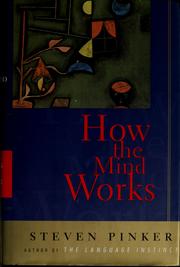
How the mind works
Provides background on attention, memory, and cognitive processing that helps explain why rereading can support comprehension under RSVP...
eBay marketplace picks
Marketplace Samples
Example marketplace items related to this page. Use the search link to explore similar finds on eBay.
Endnotes
1.
Source: pmc.ncbi.nlm.nih.gov
Link:https://pmc.ncbi.nlm.nih.gov/articles/PMC4073625/
Source snippet
Immediate sensitivity to structural constraints in pronoun...by WY Chow · 2014 · Cited by 99 — A previous eye-tracking study by Ehrli...
2.
Source: escholarship.org
Link:https://escholarship.org/uc/item/0bv8k263
Source snippet
The study quantifies evidence of...Read mo...
3.
Source: researchgate.net
Link:https://www.researchgate.net/publication/12496101_The_rapid_use_of_gender_information_Evidence_of_the_time_course_of_pronoun_resolution_from_eyetracking
Source snippet
Evidence of the time course of pronoun resolution from...Eye movements of listeners were monitored to investigate how gender information...
4.
Source: ora.ox.ac.uk
Link:https://ora.ox.ac.uk/objects/uuid%3Aa16f42e2-529d-47ae-ba51-50b75dd43899/files/rkh04dp70d
Source snippet
Comprehension monitoring during reading: an eye-tracking...by AK Hessel · 2020 · Cited by 51 — We chose to use regression-in probabil...
5.
Source: pmc.ncbi.nlm.nih.gov
Link:https://pmc.ncbi.nlm.nih.gov/articles/PMC4384810/
Source snippet
Working Memory and the Revision of Syntactic and Discourse...by WS Evans · 2014 · Cited by 20 — The results provide evidence that wor...
6.
Source: pmc.ncbi.nlm.nih.gov
Title: PMCCan We ‘Read’ the Eye-Movement Patterns of Readers
Link:https://pmc.ncbi.nlm.nih.gov/articles/PMC5290069/
Source snippet
by A Koornneef · 2016 · Cited by 30 — In the present study readers that displayed long saccades and many regressions were more incline...
7.
Source: researchgate.net
Title: Research Gate(PDF) Don’t Believe What You Read (Only Once)
Link:https://www.researchgate.net/publication/261761989_Don%27t_Believe_What_You_Read_Only_Once_Comprehension_Is_Supported_by_Regressions_During_Reading
Source snippet
ResearchGate(PDF) Don't Believe What You Read (Only Once)April 18, 2014 — This manipulation created a scenario similar to RSVP: The reade...
Published: April 18, 2014
8.
Source: faculty.cas.usf.edu
Link:https://faculty.cas.usf.edu/eschotter/papers/Schotter_Tran_Rayner_2014_PsychSci.pdf
Source snippet
USF FacultyPsychological Science-2014-Schotter-1218-26by ER Schotter · 2014 · Cited by 277 — This manipulation created a scenario similar...
9.
Source: researchgate.net
Link:https://www.researchgate.net/publication/304624103_An_investigation_into_pronoun_resolution_of_Turkish_learners_of_English_by_eye-tracking_technique
Source snippet
(PDF) An investigation into pronoun resolution of Turkish...30 Jun 2016 — In the experiments, native English speakers and EFL learners h...
10.
Source: pubmed.ncbi.nlm.nih.gov
Link:https://pubmed.ncbi.nlm.nih.gov/22886737/
Source snippet
The function of regressions in reading: backward eye...by RW Booth · 2013 · Cited by 134 — The most obvious explanation is that re...
11.
Source: tandfonline.com
Link:https://www.tandfonline.com/doi/full/10.1080/23273798.2016.1155718
Source snippet
This raises the question whether the processing of an object...Read mor...
12.
Source: ouci.dntb.gov.ua
Link:https://ouci.dntb.gov.ua/en/works/9ZLWqmr4/
Source snippet
movements and on-line comprehension processesThis article first examines the characteristics of eye movements during reading, and then lo...
13.
Source: pmc.ncbi.nlm.nih.gov
Title: We presented texts that included either a personal perspective (you) or
Link:https://pmc.ncbi.nlm.nih.gov/articles/PMC7477769/
Source snippet
your emotions: An eye-tracking study on reader's...by S Child · 2020 · Cited by 19 — An eye-tracking study explored perspective effects...
Additional References
14.
Source: sr-research.com
Link:https://www.sr-research.com/reading-language-publications/
Source snippet
Reading and Language Eye-Tracking PublicationsComprehensive list of reading and language research peer-reviewed journal article publicati...
15.
Source: tmalsburg.github.io
Link:https://tmalsburg.github.io/MeziereEtAl2021MS.pdf
Source snippet
rns and reading comprehension suggests that more efficient eye-movement...Read more...
16.
Source: allgemeinepsychologie.uni-wuppertal.de
Title: Vorstius Radach Lonigan Silent Oral Readig VC 2014 01
Link:https://allgemeinepsychologie.uni-wuppertal.de/fileadmin/psychologie/allgemeinepsychologie/Artikel/Artikel_Radach/Vorstius_Radach_Lonigan_Silent_Oral_Readig_VC_2014_01.pdf
Source snippet
movements in developing readers: A comparison of silent...by C Vorstius · 2014 · Cited by 174 — We present sentence reading data from a...
17.
Source: aclanthology.org
Title: 2024.emnlp main.198
Link:https://aclanthology.org/2024.emnlp-main.198.pdf
Source snippet
Fine-Grained Prediction of Reading Comprehension from...by O Shubi · 2024 · Cited by 12 — This line of work suggests that in some cases...
18.
Source: link.springer.com
Link:https://link.springer.com/article/10.1007/s10936-025-10189-7
Source snippet
of Null and Overt Pronouns in Catalanby A Bel · 2026 — This study investigates subject pronoun resolution in Catalan, a null-subject lang...
19.
Source: youtube.com
Title: [Speed Reading]({{ ‘myths/’ | relative_url }}) Is USELESS, [Practice]({{ ‘practice/’ | relative_url }}) This Instead
Link:https://www.youtube.com/watch?v=wQ1IVqyUjYc
Source snippet
Milliseconds Matter: Understanding How We Read with Eye-Tracking Research...
20.
Source: ila.onlinelibrary.wiley.com
Link:https://ila.onlinelibrary.wiley.com/doi/full/10.1002/rrq.70023
Source snippet
Eye Movements From a “Read‐Only” Task to Predict...by DC Mézière · 2025 · Cited by 5 — In sum, findings from the previous eye-tracking s...
21.
Source: researchers.mq.edu.au
Link:https://researchers.mq.edu.au/files/440419655/440208019.pdf
Source snippet
Eye Movements From a “Read‐Only” Task to Predict...by DC Mézière · 2025 · Cited by 4 — In this study, we examined the usefulness of eye...
22.
Source: acuresearchbank.acu.edu.au
Link:https://acuresearchbank.acu.edu.au/bitstreams/3bd4da9e-7f9c-4b18-96dd-6256ad2aab28/download
Source snippet
This study examined the potential of eye- tracking as a tool for assessing reading comprehension. We administered three widely used readi...
23.
Source: utupub.fi
Link:https://www.utupub.fi/server/api/core/bitstreams/fb7fccfb-099c-4c62-9e09-888a457aff6e/content
Source snippet
Using Eye Movements From a “Read‐Only” Task to Predict...by DC Mézière · 2025 · Cited by 5 — Using artificial neural networks, the autho...
Topic Tree