Within Faster Reading
Read Phrases, Not Just Words
Reading in meaningful phrases can make prose feel smoother without relying on unrealistic claims about seeing whole lines at once.
On this page
- What phrase reading means
- Examples of useful word groups
- Practise rhythm without rushing
Page outline Jump by section
Introduction
Phrase reading means taking in a sentence through meaningful word groups rather than treating every word as a separate stop. It is not the fantasy version of speed reading, where a reader supposedly absorbs whole lines at once. It is a more modest and more useful mechanism: the reader learns to see how words belong together, so the sentence feels smoother, easier to hold in memory, and less choppy to process.
Within the broader goal of increasing reading speed, phrase reading helps because it reduces unnecessary friction. A reader who pauses after every word has to rebuild the sentence repeatedly. A reader who groups “after the meeting”, “the project team”, and “agreed a new deadline” can carry larger units of meaning forward. The gain is not magic acceleration; it is better rhythm, clearer syntax, and fewer avoidable stalls. Research on fluency usually defines skilled reading as a combination of accuracy, automaticity, and prosody: not merely fast word calling, but smooth, expressive reading that supports understanding.[EEF]educationendowmentfoundation.org.ukeef blog shining a spotlight on reading fluencyEEFEEF blog: Shining a spotlight on reading fluency1 Dec 2021 — Reading fluency is defined as reading with accuracy (reading words correc…
What Phrase Reading Means
Phrase reading is the habit of grouping words that naturally work together in a sentence. These groups may be grammatical units, such as noun phrases, verb phrases, prepositional phrases, or clauses. They may also be meaning units that a reader can hold comfortably before moving on.
Take this sentence:[frontiersin.org]frontiersin.orgSource details in endnotes.
The tired doctor checked the notes before speaking to the family.
A word-by-word reader may experience it as a long string of small tasks: “The / tired / doctor / checked / the / notes / before / speaking / to / the / family.” A phrase reader is more likely to feel the sentence in larger pieces: “The tired doctor / checked the notes / before speaking to the family.” Nothing has been skipped. The reader has simply organised the words into units that match how the meaning unfolds.
This matters because reading fluency is not just a matter of recognising individual words. Reading Rockets describes fluent readers as people who recognise words automatically, group words quickly to gain meaning, and read with expression when reading aloud. Choppy word-by-word reading, by contrast, is a sign that fluency has not fully developed.[Reading Rockets]readingrockets.orgReading Rockets FluencyReading RocketsFluency: IntroductionFluent readers read aloud effortlessly and with expression — their reading sounds natural, as if they…
Phrase reading also explains why the advice “just move your eyes faster” is usually unhelpful. Skilled reading depends on the coordination of vision, word recognition, syntax, and meaning. Eye-movement research shows that readers do not take in an unlimited amount of text at each glance. In alphabetic writing systems, useful visual information during a fixation is limited, commonly extending only a few letters to the left and around 14–15 letter spaces to the right of fixation.[PMC]pmc.ncbi.nlm.nih.govPMCEye movements, the perceptual span, and reading speedby K Rayner · 2010 · Cited by 477 — The main findings were that fast readers (reading at about 330 wpm) had a larger perceptual span t… Phrase reading therefore should not be understood as seeing a whole line at once. It is better understood as using the words currently available to build sensible chunks of meaning.
Why Phrases Make Reading Feel Smoother
Phrase reading helps because sentences are not built as equal strings of words. They have structure. Some words lean on nearby words to make sense; others signal a turn, contrast, cause, condition, or time sequence. When a reader notices these relationships, the sentence becomes easier to process.
For example, in “Although the train was late, the meeting started on time,” the opening word “Although” prepares the reader for a contrast. The phrase “the train was late” sets up an expectation, and “the meeting started on time” resolves it. Reading the sentence as two connected chunks is more efficient than treating each word as an isolated item.
This is one reason fluency researchers often include phrasing and expression under the broader term “prosody”. Prosody is the rhythm, stress, intonation, and phrasing that make spoken reading sound natural. In reading education, it matters because it reflects whether the reader is using syntax and meaning, not merely decoding words. The Education Endowment Foundation defines reading fluency as accuracy, automaticity, and prosody, and notes that these elements work together rather than as separate skills.[EEF]educationendowmentfoundation.org.ukeef blog shining a spotlight on reading fluencyEEFEEF blog: Shining a spotlight on reading fluency1 Dec 2021 — Reading fluency is defined as reading with accuracy (reading words correc…
The effect is clearest when reading aloud, but it is not limited to oral reading. Many silent readers still experience an inner rhythm: a sense of where a phrase begins, where it closes, and which word deserves emphasis. This inner phrasing can help a reader avoid two common problems: rushing past the structure of a sentence, or reading so slowly that the beginning of the sentence fades before the end arrives.

Useful Word Groups to Notice
Phrase reading becomes easier when a reader knows what kinds of groups to look for. The goal is not to label grammar during normal reading, but to become sensitive to the places where meaning naturally clusters.
Common useful groups include:
- Who or what the sentence is about: “The committee chair”, “Several local residents”, “A sudden change in temperature”.
- What happens: “approved the plan”, “walked across the room”, “caused further delays”.
- Where, when, or why something happens: “after the final vote”, “in the narrow corridor”, “because the evidence was incomplete”.
- Linking or contrast phrases: “on the other hand”, “as a result”, “despite the warning”, “for this reason”.
- Embedded explanations: “the report, published in March, showed a decline”, where the middle phrase adds information without replacing the main sentence line.
A practical way to see the mechanism is to compare three versions of the same sentence:
Word-by-word: “During / the / first / week / of / training / the / new / staff / learnt / how / to / handle / customer / complaints.”
Over-large chunk: “During the first week of training the new staff learnt how to handle customer complaints.”
Useful phrase reading: “During the first week of training / the new staff / learnt how to handle / customer complaints.”
The useful version gives the reader enough meaning at each step without forcing the whole sentence into one visual gulp. That is the core advantage of phrase reading: it encourages smoothness without pretending that comprehension improves when the reader stops attending to structure.
Phrase-Cued Text: Training Wheels, Not a Permanent Crutch
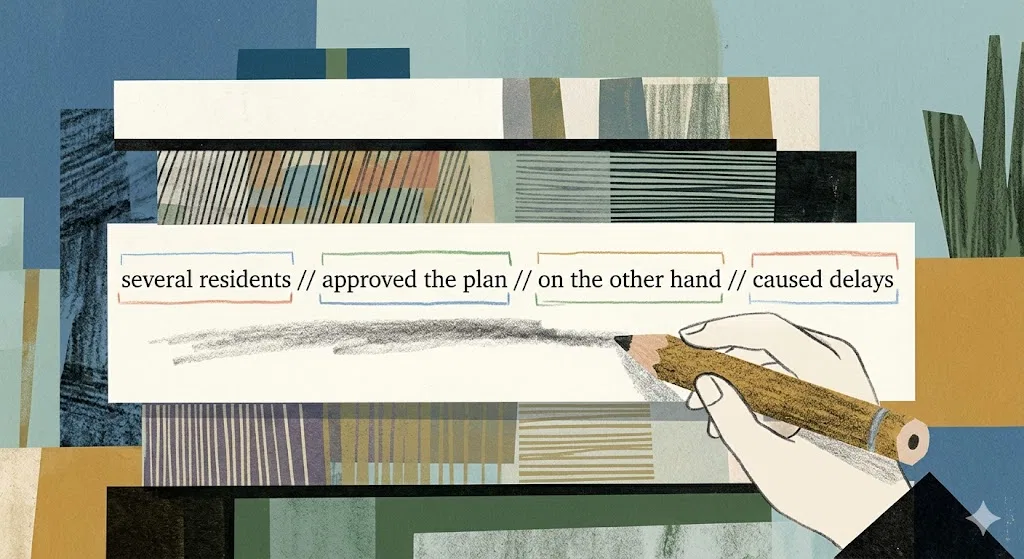
One evidence-supported way to practise phrase reading is phrase-cued text. In this approach, a passage is marked with slashes, line breaks, or spacing to show where natural phrase boundaries fall. A reader might see:
After the storm / the village roads / were covered with branches / and deep pools of water.
The marks are not meant to remain forever. They act like training wheels: they make phrasing visible until the reader starts noticing similar boundaries in ordinary text.
Phrase-cued text has been used in fluency instruction for decades. Timothy Rasinski’s work on phrase-cued texts argued that marking phrase boundaries can help readers attend to meaningful units rather than isolated words, and his ERIC report summarised studies suggesting benefits for comprehension in school-age readers and adolescents.[ERIC]files.eric.ed.govERICDOCUMENT RESUME ED 313 689 CSERICFebruary 16, 2011 — by TV Rasinski · 1990 · Cited by 16 — phrase boundaries are cued by prosody to written texts phrase- cued texts f… Later research by Levasseur, Macaruso, Palumbo, and Shankweiler found that syntactically cued text facilitated oral reading fluency in developing readers, giving support to the idea that visible phrase boundaries can help readers read more naturally.[Cambridge University Press & Assessment]cambridge.orgPublished online by Cambridge University Press: 14 July 2006.Read more…
More recent literacy resources continue to treat phrased text as a fluency scaffold rather than a speed trick. Landmark Outreach describes phrase-cued text as a way of marking phrase boundaries so readers can practise grouping words together, while also noting that cueing requires judgement rather than rigid rules.[Landmark Outreach]landmarkoutreach.orgLandmark Outreach Fluency Interventions at the Text and Passage LevelsLandmark Outreach Fluency Interventions at the Text and Passage Levels A 2025 study on pairing phrase-cued text with readers theatre similarly defines phrase-cued text as marking phrase boundaries to cue which words should be grouped together when reading.[Wiley Online Library]onlinelibrary.wiley.com1467 9817.700021467 9817.70002
The important limitation is that phrase-cued text is mainly a practice format. It can help a reader hear and feel better phrasing, especially in short passages, but it is not a guarantee of faster reading across every kind of text. The skill has to transfer from marked examples to unmarked prose.

Practise Rhythm Without Rushing
The best phrase-reading practice is short, deliberate, and comprehension-aware. The aim is not to blast through a passage faster each time. It is to make the sentence sound and feel more like meaningful speech.
A simple practice routine works well:
- Choose a short passage. Use 100–200 words of ordinary prose, not a dense legal clause or highly technical paragraph.
- Mark natural phrase breaks lightly. Use slashes after complete meaning units: “At the end of the interview / the panel thanked each candidate / and compared their notes.”
- Read once for accuracy. Make sure the words are known and the sentence is basically understood.
- Read again for phrasing. Try to move through each phrase smoothly, pausing slightly at the breaks.
- Remove the marks. Read the original passage and see whether the rhythm remains.
- Check meaning. Summarise the passage in one or two sentences. If the summary is weaker, the pace was too fast.
This kind of practice fits the wider evidence on fluency: repeated reading and guided oral reading can improve aspects of reading performance, especially when the reader receives modelling or feedback rather than simply being told to go faster. A review of fluency interventions found guided oral repeated reading with feedback to be an effective method for improving fluency and comprehension across learners, though the strength and type of evidence varies by group and intervention.[PMC]pmc.ncbi.nlm.nih.govOpen source on nih.gov. The What Works Clearinghouse review of repeated reading for students with learning disabilities found potentially positive effects on reading comprehension but a small evidence base, which is a useful reminder not to oversell any one technique.[Institute of Education Sciences]ies.ed.govInstitute of Education Sciences Repeated ReadingInstitute of Education Sciences Repeated Reading
Phrase reading is especially useful when a reader’s normal pattern is too choppy. It is less useful when the real barrier is unknown vocabulary, weak background knowledge, tiredness, or a text that genuinely needs slow analysis.
The Boundary Between Phrase Reading and Speed-Reading Myths
Phrase reading can increase reading speed indirectly, but it should not be confused with extreme speed-reading claims. The difference is simple: phrase reading keeps meaning at the centre; many speed-reading systems try to reduce or bypass normal reading processes.
A major review in Psychological Science in the Public Interest concluded that there is a speed–accuracy trade-off in reading and that readers are unlikely to double or triple their reading speed while maintaining the same level of comprehension.[PubMed]pubmed.ncbi.nlm.nih.govPub Med How Do We Read, and Can Speed Reading Help?Pub Med How Do We Read, and Can Speed Reading Help? This does not make all speed improvement impossible. It means that the realistic gains come from fluency, familiarity, vocabulary, and better reading strategy, not from forcing the eyes to behave as if language had no structure.
Phrase reading works within those limits. It does not ask the reader to suppress the inner voice completely, skip punctuation, ignore syntax, or absorb a line in one glance. It asks the reader to notice that written prose already comes in units of meaning. When those units are recognised quickly, reading becomes smoother; when they are ignored, the reader may either stumble word by word or skim too roughly.
This distinction matters for adult readers as well as children. A fluent adult may already use phrase reading unconsciously in familiar prose but lose it in academic, legal, or technical writing. In those cases, deliberately reintroducing phrase boundaries can make the text less intimidating. For instance, “The results of the second trial / after adjustment for age and prior treatment / showed no significant difference” is easier to hold than a single undifferentiated string.
When Phrase Reading Helps Most
Phrase reading is most useful in the middle zone: text that is readable but slightly effortful. If the passage is too easy, the reader may already phrase it naturally. If it is too hard, phrase grouping alone will not solve the problem.
It tends to help when:
- Reading feels choppy. The reader recognises individual words but struggles to make the sentence flow.
- Sentences are long but not conceptually impossible. Phrase breaks reveal the structure.
- The reader loses track before the end of a sentence. Grouping reduces memory load by packaging words into meaningful units.
- Oral reading sounds flat or robotic. Phrasing gives clues about stress, pause, and expression.
- Silent reading is accurate but slow. Better grouping can reduce tiny, unnecessary pauses.
It helps less when the bottleneck is somewhere else. If a reader does not know the meaning of key words, cannot decode many words accurately, or lacks the background knowledge needed for the passage, phrase reading may improve rhythm without improving understanding. The EEF’s fluency model is useful here because it treats accuracy, automaticity, and prosody as interdependent. Weakness in one area can limit the others.[EEF]educationendowmentfoundation.org.ukeef blog shining a spotlight on reading fluencyEEFEEF blog: Shining a spotlight on reading fluency1 Dec 2021 — Reading fluency is defined as reading with accuracy (reading words correc…
A good test is to ask: “After grouping the sentence into phrases, do I understand it better?” If yes, the issue was partly rhythm and syntax. If no, the issue may be vocabulary, prior knowledge, sentence complexity, or the need for closer reading.

A Practical Example of Phrase Reading in Action
Consider this sentence:[nichd.nih.gov]nichd.nih.govSource details in endnotes.
Because the first explanation was incomplete, the reviewer asked for more evidence before accepting the claim.
A rushed reader may jump from “explanation” to “reviewer” to “evidence” and get only a rough gist. A word-by-word reader may understand each word but lose the relationship between them. Phrase reading gives the sentence a clearer path:
Because the first explanation was incomplete / the reviewer asked for more evidence / before accepting the claim.
Now the logic becomes easier to follow. The first phrase gives the reason, the second gives the action, and the third gives the condition that has not yet been met. The reader is not reading less. They are reading the sentence in the shape intended by its grammar.
The same method works in narrative prose:
At the edge of the harbour / the old lamps flickered / as the fog moved in from the sea.
Here, phrase reading supports atmosphere as well as comprehension. The pauses match the scene: location, action, movement. Reading it as isolated words would flatten the effect; rushing it as one block would blur the rhythm.
This is why phrase reading belongs in a realistic approach to increasing reading speed. It does not promise spectacular numbers. It improves the smoothness of the reading act itself, which can make ordinary prose quicker to understand and more pleasant to continue.
The Takeaway for Faster, Smoother Reading
Phrase reading is a mechanism for making comprehension smoother, not a shortcut around comprehension. It helps readers move from isolated word recognition to meaningful units, making sentences easier to hold, hear, and understand. The strongest case for it comes from the broader fluency tradition: skilled reading involves accuracy, automaticity, and prosody, and phrasing is one visible part of that fluency.[EEF]educationendowmentfoundation.org.ukeef blog shining a spotlight on reading fluencyEEFEEF blog: Shining a spotlight on reading fluency1 Dec 2021 — Reading fluency is defined as reading with accuracy (reading words correc…
The most realistic benefit is a cleaner rhythm. A reader who learns to group words sensibly may read some prose faster because fewer mental pauses are wasted on rebuilding the sentence. But the reader still needs to slow down for unfamiliar ideas, dense arguments, and important details. Phrase reading is therefore best understood as a way to remove choppiness: it lets the eyes, inner voice, and meaning of the sentence work together instead of competing word by word.
Amazon book picks
Further Reading
Books and field guides related to Read Phrases, Not Just Words. Use these as the next step if you want deeper reading beyond the article.
How to Read a Book
Rating: 4.0/5 from 41 Google Books ratings
Explains reading levels and techniques for processing larger units of meaning.
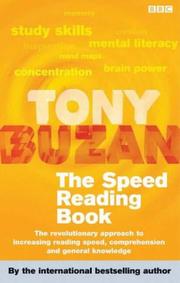
The Speed Reading Book
Covers phrase grouping, eye movement, and reading fluency techniques.

10 days to faster reading
Provides exercises that build smoother phrase-based reading.
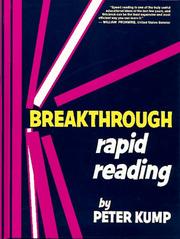
Breakthrough rapid reading
Teaches chunking words into meaningful groups rather than reading word-by-word.
eBay marketplace picks
Marketplace Samples
Example marketplace items related to this page. Use the search link to explore similar finds on eBay.
Endnotes
1.
Source: pmc.ncbi.nlm.nih.gov
Title: PMCEye movements, the perceptual span, and reading speed
Link:https://pmc.ncbi.nlm.nih.gov/articles/PMC3075059/
Source snippet
by K Rayner · 2010 · Cited by 477 — The main findings were that fast readers (reading at about 330 wpm) had a larger perceptual span t...
2.
Source: cambridge.org
Link:https://www.cambridge.org/core/journals/applied-psycholinguistics/article/syntactically-cued-text-facilitates-oral-reading-fluency-in-developing-readers/49D41A8EF948352C852B647237540E57
Source snippet
Published online by Cambridge University Press: 14 July 2006.Read more...
Published: July 2006
3.
Source: onlinelibrary.wiley.com
Title: 1467 9817.70002
Link:https://onlinelibrary.wiley.com/doi/full/10.1111/1467-9817.70002
4.
Source: pmc.ncbi.nlm.nih.gov
Link:https://pmc.ncbi.nlm.nih.gov/articles/PMC5097019/
5.
Source: onlinelibrary.wiley.com
Title: 1467 9817.70002
Link:https://onlinelibrary.wiley.com/doi/abs/10.1111/1467-9817.70002
6.
Source: phrase.com
Link:https://phrase.com/ja/
7.
Source: phrase.com
Link:https://phrase.com/
8.
Source: educationendowmentfoundation.org.uk
Title: eef blog shining a spotlight on reading fluency
Link:https://educationendowmentfoundation.org.uk/news/eef-blog-shining-a-spotlight-on-reading-fluency
Source snippet
EEFEEF blog: Shining a spotlight on reading fluency1 Dec 2021 — Reading fluency is defined as reading with accuracy (reading words correc...
9.
Source: readingrockets.org
Link:https://www.readingrockets.org/reading-101/reading-and-writing-basics/fluency
Source snippet
Reading RocketsBasics: FluencyFluency is the ability to read a text accurately, quickly, and with expression. Fluent reading builds stami...
10.
Source: readingrockets.org
Title: Reading Rockets Fluency
Link:https://www.readingrockets.org/reading-101/reading-101-learning-modules/course-modules/fluency
Source snippet
Reading RocketsFluency: IntroductionFluent readers read aloud effortlessly and with expression — their reading sounds natural, as if they...
11.
Source: files.eric.ed.gov
Title: ERICDOCUMENT RESUME ED 313 689 CS 009 882
Link:https://files.eric.ed.gov/fulltext/ED313689.pdf
Source snippet
ERICFebruary 16, 2011 — by TV Rasinski · 1990 · Cited by 16 — phrase boundaries are cued by prosody to written texts phrase- cued texts f...
Published: February 16, 2011
12.
Source: landmarkoutreach.org
Title: Landmark Outreach Fluency Interventions at the Text and Passage Levels
Link:https://www.landmarkoutreach.org/strategies/fluency-interventions-text-and-passage-level/
13.
Source: ies.ed.gov
Title: Institute of Education Sciences Repeated Reading
Link:https://ies.ed.gov/ncee/wwc/Docs/InterventionReports/wwc_repeatedreading_051314.pdf
14.
Source: pubmed.ncbi.nlm.nih.gov
Title: Pub Med How Do We Read, and Can Speed Reading Help?
Link:https://pubmed.ncbi.nlm.nih.gov/26769745/
15.
Source: readingrockets.org
Link:https://www.readingrockets.org/topics/assessment-and-evaluation/articles/understanding-and-assessing-fluency
16.
Source: readingn.com
Title: READIN G &
Link:https://www.readingn.com/
17.
Source: readingrockets.org
Link:https://www.readingrockets.org/topics/curriculum-and-instruction/articles/findings-national-reading-panel
18.
Source: readingrockets.org
Title: can we really teach prosody and why would we want
Link:https://www.readingrockets.org/blogs/shanahan-on-literacy/can-we-really-teach-prosody-and-why-would-we-want
19.
Source: pmc.ncbi.nlm.nih.gov
Link:https://pmc.ncbi.nlm.nih.gov/articles/PMC2783645/
20.
Source: pmc.ncbi.nlm.nih.gov
Link:https://pmc.ncbi.nlm.nih.gov/articles/PMC4211933/
21.
Source: nichd.nih.gov
Link:https://www.nichd.nih.gov/sites/default/files/publications/pubs/nrp/Documents/ch3.pdf
22.
Source: pubmed.ncbi.nlm.nih.gov
Link:https://pubmed.ncbi.nlm.nih.gov/21169577/
23.
Source: pmc.ncbi.nlm.nih.gov
Link:https://pmc.ncbi.nlm.nih.gov/articles/PMC2906818/
24.
Source: pmc.ncbi.nlm.nih.gov
Link:https://pmc.ncbi.nlm.nih.gov/articles/PMC2993640/
25.
Source: pmc.ncbi.nlm.nih.gov
Link:https://pmc.ncbi.nlm.nih.gov/articles/PMC5085888/
26.
Source: pmc.ncbi.nlm.nih.gov
Link:https://pmc.ncbi.nlm.nih.gov/articles/PMC2748352/
27.
Source: educationendowmentfoundation.org.uk
Title: guide to the eefs tools reading fluency
Link:https://educationendowmentfoundation.org.uk/news/guide-to-the-eefs-tools-reading-fluency
28.
Source: educationendowmentfoundation.org.uk
Title: why focus on reading fluency
Link:https://educationendowmentfoundation.org.uk/news/why-focus-on-reading-fluency
29.
Source: educationendowmentfoundation.org.uk
Link:https://educationendowmentfoundation.org.uk/reading-house/fluency
30.
Source: frontiersin.org
Link:https://www.frontiersin.org/journals/psychology/articles/10.3389/fpsyg.2016.01265/full
31.
Source: frontiersin.org
Link:https://www.frontiersin.org/journals/behavioral-neuroscience/articles/10.3389/fnbeh.2026.1775487/full
32.
Source: education.vic.gov.au
Link:https://www.education.vic.gov.au/Documents/school/teachers/teachingresources/discipline/english/literacy/Oral_Reading_Fluency_Oct2023.pdf
33.
Source: ies.ed.gov
Link:https://ies.ed.gov/use-work/awards/development-oral-and-silent-reading-fluency-and-their-relation-reading-comprehension-first-through
34.
Source: eric.ed.gov
Link:https://eric.ed.gov/?id=ED313689
Additional References
35.
Source: link.springer.com
Link:https://link.springer.com/content/pdf/10.3758/PBR.17.6.834.pdf
Source snippet
Eye movements, the perceptual span, and reading speedby K Rayner · 2010 · Cited by 477 — That is, the perceptual span for skilled...
36.
Source: researchgate.net
Link:https://www.researchgate.net/publication/289208481_The_influence_of_chunking_on_reading_comprehension_Investigating_the_acquisition_of_chunking_skill
37.
Source: linkedin.com
Link:https://www.linkedin.com/posts/jennifer-throndsen-phd-1b833261_do-your-students-struggle-with-reading-fluency-activity-7417422921456996352–T9x
38.
Source: education-progress.org
Link:https://www.education-progress.org/focus/24-readingspeed
39.
Source: scribd.com
Link:https://www.scribd.com/document/843303879/Developing-Fluent-Readers-Reading-Rockets
40.
Source: shanahanonliteracy.com
Link:https://www.shanahanonliteracy.com/blog/everything-you-wanted-to-know-about-repeated-reading
41.
Source: andreasmhallberg.github.io
Link:https://andreasmhallberg.github.io/documents/eye-movements-and-perceptual-span/eye-movements-and-perceptual-span.tex.pdf
42.
Source: scribd.com
Link:https://www.scribd.com/document/560641462/rayner2009
43.
Source: researchgate.net
Link:https://www.researchgate.net/publication/49694262_Eye_movements_the_perceptual_span_and_reading_speed
44.
Source: savvas.com
Link:https://www.savvas.com/resource-center/blogs-and-podcasts/savvas-insights/2025/strategies-to-improve-oral-reading-fluency
Topic Tree
Follow this branch
Parent topic
Faster ReadingRelated pages 11
- Benchmarks How Fast Do Adults Really Read?
- Dense Texts Why Hard Texts Need Slower Reading
- Inner Voice Should You Silence Your Inner Voice?
- Knowledge Why Familiar Topics Feel Faster to Read
- Measure The Reading Speed Test That Actually Helps
- Myths Why Speed Reading Promises Fall Apart
- Practice Can Rereading Make You Faster?
- Purpose When Should You Slow Down or Skim?
- +3 more in sidebar