Within Dense Texts
Why Legalese Slows Even Lawyers Down
Legal documents show why speed depends on sentence structure, definitions, and whether simplified wording preserves the same force.
On this page
- How legal syntax interrupts meaning
- What simplified documents can improve
- Where precision still needs slow reading
Page outline Jump by section
Introduction
Legal documents are a useful reminder that reading speed has limits. Contracts, regulations and legal notices are often difficult not because the ideas are inherently complex, but because the language is designed to preserve exact meanings, allocate risk and anticipate disputes. The challenge for readers is that the very features intended to increase legal precision can slow comprehension. Research increasingly suggests that many traditional features of legalese make documents harder to understand for both non-lawyers and lawyers, yet complete simplification is not always risk-free because some wording carries specialised legal consequences.[MIT News]news.mit.edunew study lawyers legalese 0529MIT NewsEven lawyers don't like legalese29 May 2023 — A new study shows lawyers find simplified legal documents easier to understand, mor…
 For anyone trying to increase reading speed, legal texts illustrate an important principle: faster reading comes more from recognising where careful reading is necessary than from forcing a uniform pace. Understanding the trade-offs between legalese and plain language helps readers decide when simplification aids comprehension and when precision requires deliberate attention.
Why Legalese Slows Even Lawyers Down
Traditional legal writing is often associated with long sentences, archaic vocabulary and extensive qualifications. However, evidence suggests that vocabulary is only part of the problem.
MIT researchers analysing legal texts found that one of the strongest barriers to comprehension is a structure known as centre embedding: clauses inserted into the middle of other clauses, interrupting the main sentence before it reaches its conclusion. These interruptions force readers to hold unfinished thoughts in memory while processing additional conditions and definitions. Linguists have long recognised such structures as unusually demanding to process.[MIT Brain and Cognitive Sciences+2Lexology]bcs.mit.eduobjection no one can understand what youre sayingMIT Brain and Cognitive SciencesObjection: No one can understand what you're saying7 Mar 2022 — Linguists have previously demonstrated th…
Consider the difference between these patterns:
- A direct sentence: “The tenant must obtain written consent before subletting.”
- A centre-embedded version: “The tenant, except where otherwise permitted under Section 4 and subject to the landlord’s prior written approval, which approval shall not be unreasonably withheld, must obtain written consent before subletting.”
The second version may contain valuable qualifications, but the reader must temporarily suspend the core action while navigating multiple interruptions.
Research comparing legal texts with ordinary English found that legal documents contain centre-embedded structures at rates several times higher than many other forms of writing. This increases processing difficulty even for trained readers.[PMC]pmc.ncbi.nlm.nih.govPMCEven lawyers do not like legaleseby E Martínez · 2023 · Cited by 23 — For example, on a syntactic level, the language in contracts (23) and legislation (24) has been f…
How legal syntax interrupts meaning
Dense legal syntax slows reading through several mechanisms:
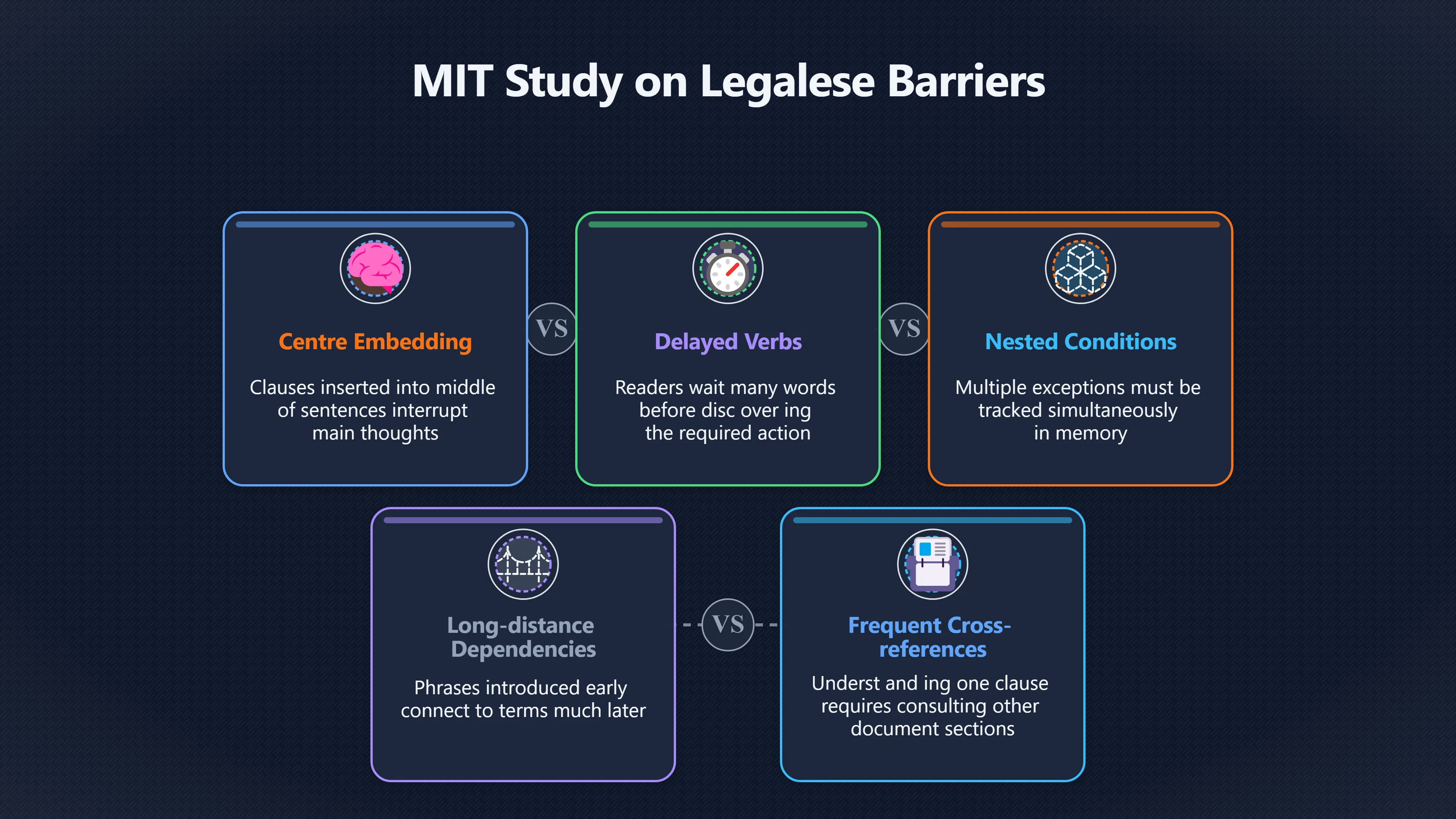
- Delayed main verbs: Readers may wait many words before discovering the action being required.
- Nested conditions: Multiple exceptions and qualifications must be mentally tracked simultaneously.
- Long-distance dependencies: A phrase introduced early may not connect with its key term until much later.
- Frequent cross-references: Understanding one clause may require consulting definitions or other sections.
Each of these features increases cognitive load. Readers spend less effort recognising words and more effort reconstructing sentence structure. The result is slower reading, more rereading and greater risk of misunderstanding.[MIT Brain and Cognitive Sciences+2PMC]bcs.mit.eduobjection no one can understand what youre sayingMIT Brain and Cognitive SciencesObjection: No one can understand what you're saying7 Mar 2022 — Linguists have previously demonstrated th…
What Simplified Documents Can Improve
The plain-language movement argues that many legal documents can become substantially easier to understand without losing legal force. The strongest evidence comes from studies comparing traditional legalese with rewritten versions expressing the same legal content more directly.
In a widely discussed MIT study, lawyers and non-lawyers read both conventional legal documents and simplified equivalents. Lawyers performed better than non-lawyers overall, but they still found the plain-language versions easier to understand. They also rated those versions as higher quality, more appealing and no less enforceable than the traditional documents.[MIT News+2PNAS]news.mit.edunew study lawyers legalese 0529MIT NewsEven lawyers don't like legalese29 May 2023 — A new study shows lawyers find simplified legal documents easier to understand, mor…
This finding is significant because it challenges a common assumption that complexity itself creates legal validity. The evidence suggests that many drafting habits persist because of convention, precedent and copying from older documents rather than because readers prefer them or because courts require them.[SSRN]papers.ssrn.comEven Lawyers Don't Like Legaleseby E Martínez · 2023 · Cited by 29 — These results suggest that lawyers who write in a convoluted man…
Plain-language revisions commonly improve comprehension by:
- Breaking long sentences into shorter units.
- Moving definitions out of the middle of clauses.
- Replacing archaic expressions with ordinary words.
- Using clearer document structure and headings.
- Presenting obligations, rights and exceptions in a more visible format.
Studies and reviews of plain-language initiatives consistently report better reader comprehension and easier navigation of legal information after such revisions. Advocates also argue that clearer documents can reduce confusion, improve informed consent and decrease disputes arising from misunderstanding.[SciSpace+2repository.law.miami.edu]scispace.comImplementing Plain Language Into Legal DocumentsTo demonstrate how plain language can improve legal writing, this thesis reviews…
For readers seeking greater speed, simplified legal writing offers an important lesson: comprehension often improves not because readers become faster processors, but because the text removes obstacles that previously demanded extra mental effort.
Where Precision Still Needs Slow Reading
The success of plain-language initiatives does not mean every legal document can be simplified without consequences.
Many legal terms have accumulated meanings through legislation, regulation or court decisions. Replacing a specialised term with a seemingly equivalent everyday phrase can sometimes change interpretation. A word that appears redundant to a general reader may have a history of judicial interpretation attached to it.[Georgetown Law]law.georgetown.eduLaw Plain Language in the Written LawGeorgetown LawPlain Language in the Written LawMarch 13, 2024 — by L VAN BESIEN · Cited by 2 — This Note argues that lawyers should be us…
This creates a genuine trade-off. Simplification can improve accessibility, but excessive simplification may introduce ambiguity. Contracts often depend on precise allocation of rights, duties and remedies. If a rewritten clause broadens or narrows a meaning unintentionally, the document may become easier to read yet less predictable in legal application.[arXiv]arxiv.orgarXiv Ambiguity is the last thing you needarXiv Ambiguity is the last thing you need
Several parts of legal documents therefore still reward slow reading:
- Definitions sections, where ordinary words may receive specialised meanings.
- Exceptions and carve-outs, which often determine the practical effect of a rule.
- Liability limitations, where a few words can significantly shift risk.
- Conditions precedent, which determine when obligations arise.
- Cross-referenced clauses, where meaning depends on material elsewhere in the document.
A reader skimming these sections may understand the general idea while missing the legally significant detail.

What This Means for Faster Reading
Legalese demonstrates that reading speed and comprehension are not independent goals. Some forms of complexity are unnecessary and can be reduced through better drafting. Other forms arise because legal systems require exactness, consistency and defensibility.
The evidence suggests that many traditional features of legal language—especially centre-embedded clauses and inherited drafting conventions—slow comprehension without delivering corresponding benefits. Simplified versions often help both experts and non-experts understand documents more accurately.[MIT News+2PNAS]news.mit.edunew study lawyers legalese 0529MIT NewsEven lawyers don't like legalese29 May 2023 — A new study shows lawyers find simplified legal documents easier to understand, mor…
At the same time, legal documents remain examples of texts where selective slowing down is often rational. A reader trying to increase reading speed gains more by identifying definitions, exceptions and risk-bearing clauses than by maintaining maximum pace throughout. In dense legal material, effective reading is less about moving the eyes faster and more about knowing which sentences deserve extra time because a single phrase can change the meaning of the whole document.
Amazon book picks
Further Reading
Books and field guides related to Why Legalese Slows Even Lawyers Down. Use these as the next step if you want deeper reading beyond the article.
Legal writing in plain English
Directly addresses how legal language affects comprehension and how clearer drafting can improve understanding.
Thinking, Fast and Slow
Provides a framework for understanding cognitive load and why dense, interruption-heavy text slows readers.

The Redbook: A Manual on Legal Style
Explains legal drafting conventions, sentence structure, and readability issues in legal documents.

Style: Lessons in Clarity and Grace
Focuses on sentence structure and clarity principles that help explain the costs of complex legal prose.
eBay marketplace picks
Marketplace Samples
Example marketplace items related to this page. Use the search link to explore similar finds on eBay.

Endnotes
1.
Source: news.mit.edu
Title: new study lawyers legalese 0529
Link:https://news.mit.edu/2023/new-study-lawyers-legalese-0529
Source snippet
MIT NewsEven lawyers don't like legalese29 May 2023 — A new study shows lawyers find simplified legal documents easier to understand, mor...
Published: May 2023
2.
Source: pnas.org
Link:https://www.pnas.org/doi/10.1073/pnas.2302672120
Source snippet
Even lawyers do not like legaleseby E Martínez · 2023 · Cited by 24 — Experiment 1 revealed that lawyers, like laypeople, were less able...
3.
Source: bcs.mit.edu
Title: objection no one can understand what youre saying
Link:https://bcs.mit.edu/news/objection-no-one-can-understand-what-youre-saying
Source snippet
MIT Brain and Cognitive SciencesObjection: No one can understand what you're saying7 Mar 2022 — Linguists have previously demonstrated th...
4.
Source: lexology.com
Link:https://www.lexology.com/library/detail.aspx?g=4d082c82-7914-4760-a8f7-1c8c9b073dd4
Source snippet
Limit the Legalese, and 'Legalese' Isn't Just Jargon10 Mar 2022 — One of the biggest culprits, it turns out, was “center embedded clauses...
5.
Source: pmc.ncbi.nlm.nih.gov
Title: PMCEven lawyers do not like legalese
Link:https://pmc.ncbi.nlm.nih.gov/articles/PMC10266064/
Source snippet
by E Martínez · 2023 · Cited by 23 — For example, on a syntactic level, the language in contracts (23) and legislation (24) has been f...
6.
Source: news.mit.edu
Title: mit study explains laws incomprehensible writing style 0819
Link:https://news.mit.edu/2024/mit-study-explains-laws-incomprehensible-writing-style-0819
Source snippet
MIT NewsMIT study explains why laws are written in an...19 Aug 2024 — Lawyers tended to prefer plain English versions of documents, and...
7.
Source: papers.ssrn.com
Link:https://papers.ssrn.com/sol3/papers.cfm?abstract_id=4462766
Source snippet
Even Lawyers Don't Like Legaleseby E Martínez · 2023 · Cited by 29 — These results suggest that lawyers who write in a convoluted man...
8.
Source: scispace.com
Link:https://scispace.com/pdf/implementing-plain-language-into-legal-documents-the-53cn5nalkj.pdf
Source snippet
Implementing Plain Language Into Legal DocumentsTo demonstrate how plain language can improve legal writing, this thesis reviews...
9.
Source: repository.law.miami.edu
Link:https://repository.law.miami.edu/cgi/viewcontent.cgi?params=%2Fcontext%2Fumlr%2Farticle%2F4673&path_info=UMLR_20vol_2076_20no_202_20447_524_Blasie_Plain_20Language.pdf
Source snippet
tracts, im- proving market efficiency, decreasing litigation...Read more...
10.
Source: law.georgetown.edu
Title: Law Plain Language in the Written Law
Link:https://www.law.georgetown.edu/legal-ethics-journal/wp-content/uploads/sites/24/2024/03/GT-GJLE230044.pdf
Source snippet
Georgetown LawPlain Language in the Written LawMarch 13, 2024 — by L VAN BESIEN · Cited by 2 — This Note argues that lawyers should be us...
Published: March 13, 2024
11.
Source: arxiv.org
Title: arXiv Ambiguity is the last thing you need
Link:https://arxiv.org/abs/2410.20222
12.
Source: pnas.org
Link:https://www.pnas.org/doi/10.1073/pnas.2405564121
Source snippet
Even laypeople use legalese19 Aug 2024 — The increased processing difficulty associated with center-embedded syntax in legal texts and no...
Additional References
13.
Source: johnjohnw.github.io
Link:https://johnjohnw.github.io/center_embedding_in_legalese/
Source snippet
Center Embedding in LegaleseResearch indicates that legal documents are laden with center-embedded clauses at a rate several times higher...
14.
Source: reddit.com
Link:https://www.reddit.com/r/law/comments/1exczrk/mit_study_explains_why_laws_are_written_in_an/
Source snippet
MIT study explains why laws are written in an...Lawyers tended to prefer plain English versions of documents, and they rated those versi...
15.
Source: ciaj-icaj.ca
Link:https://ciaj-icaj.ca/wp-content/uploads/documents/import/LD/LD1987/LD87-9.pdf?1759938629=&id=1120
Source snippet
PLAIN LANGUAGE, LEGAL DOCUMENTS AND FORMSThis paper has been divided into three sections. In the first section, the need for plain langua...
16.
Source: reddit.com
Link:https://www.reddit.com/r/law/comments/1hgc35i/mit_study_explains_why_laws_are_written_in_an/
Source snippet
The convoluted “legalese” used in legal documents...MIT study explains why laws are written in an incomprehensible style - The convolute...
17.
Source: facebook.com
Link:https://www.facebook.com/ScientificAmerican/posts/lawyers-and-nonlawyers-alike-prefer-contracts-written-in-plain-english/679480314050244/
Source snippet
This study also finds that people create legalese by copying and pasting from old-fashioned...Read more...
18.
Source: news.slashdot.org
Title: legal language is deliberately arcane to signal power study finds
Link:https://news.slashdot.org/story/24/12/18/1317249/legal-language-is-deliberately-arcane-to-signal-power-study-finds
Source snippet
Language Is Deliberately Arcane To Signal Power...18 Dec 2024 — A new MIT study reveals why legal documents are so hard to read: Both la...
19.
Source: gizmodo.com
Title: lawyers better reading plain english not legal jargon 1850488365
Link:https://gizmodo.com/lawyers-better-reading-plain-english-not-legal-jargon-1850488365
Source snippet
Lawyers Hate Legal Jargon, Too30 May 2023 — A new study has found that lawyers have an easier time remembering legal documents written in...
Published: May 2023
20.
Source: labrujulaverde.com
Title: study explains why laws are written in an incomprehensible style
Link:https://www.labrujulaverde.com/en/2024/08/study-explains-why-laws-are-written-in-an-incomprehensible-style/
Source snippet
Study explains why laws are written in an...21 Aug 2024 — In a follow-up study conducted in 2023, the researchers found that lawyers the...
21.
Source: capstan.be
Link:https://www.capstan.be/research-by-mit-cognitive-scientists-sheds-light-on-the-features-that-make-legalese-so-difficult-to-understand-for-lay-people/
Source snippet
23 Nov 2022 — Their research has pinpointed several features that distinguish legal from nonlegal texts, including unnecessary jar...
22.
Source: nationalmagazine.ca
Link:https://nationalmagazine.ca/fr-ca/articles/the-[practice
Source snippet
Plain Language Legal Writing: Part I – Writing as a ProcessWith plain language, you can eliminate the many variables in document packages...
Topic Tree