Within Transfer
Why Rereading Gains Do Not Fully Travel
Rereading can make one passage feel easy, but new texts still demand fresh word recognition, sentence parsing, and meaning-making.
On this page
- What improves on the practised passage
- Why new passages reintroduce reading load
- How to spot real transfer rather than memorised fluency
Page outline Jump by section
Introduction
Rereading can create the impression that reading speed has improved dramatically. A passage that felt slow and effortful on the first encounter may become smooth and almost effortless after several repetitions. The catch is that much of that gain is tied to the specific text. When readers move to an unfamiliar article, chapter, or report, a substantial part of the reading load returns because the new text contains different words, sentence patterns, and ideas that must be processed afresh. Research on repeated reading consistently finds larger improvements on practised passages than on unpractised ones, even when some broader fluency benefits carry over.[ResearchGate+2PMC]researchgate.netThe author conducted a meta-analysis…Read more…
 Understanding why this happens is important for anyone trying to increase reading speed. The issue is not that rereading is ineffective. Rather, it improves some skills that transfer and some advantages that remain tied to the exact passage. The shrinking of gains on unfamiliar texts reveals the difference between genuine reading skill and familiarity with a specific piece of writing.
What Improves on the Practised Passage
[Repeated Reading]teachingbyscience.comTeaching By Science Repeated Reading | Teaching By ScienceRepeated Reading | Teaching By Science20 May 2022 — Repeated Reading specifically, works by having students read the same text, (typicall… removes many of the processing demands that normally slow reading.
During the first reading, the brain must identify words, interpret sentence structure, connect ideas, and build an understanding of the text. On subsequent readings, much of that work has already been completed. Readers often remember vocabulary, anticipate sentence patterns, and know where the argument or narrative is heading. As a result, they spend less effort solving problems and more time moving through material they already recognise.[Shanahan on Literacy+2Teaching By Science]shanahanonliteracy.comShanahan on LiteracyEverything You Wanted to Know about Repeated ReadingRepeated reading usually leads to better oral reading performance…
Several specific improvements contribute to this effect:
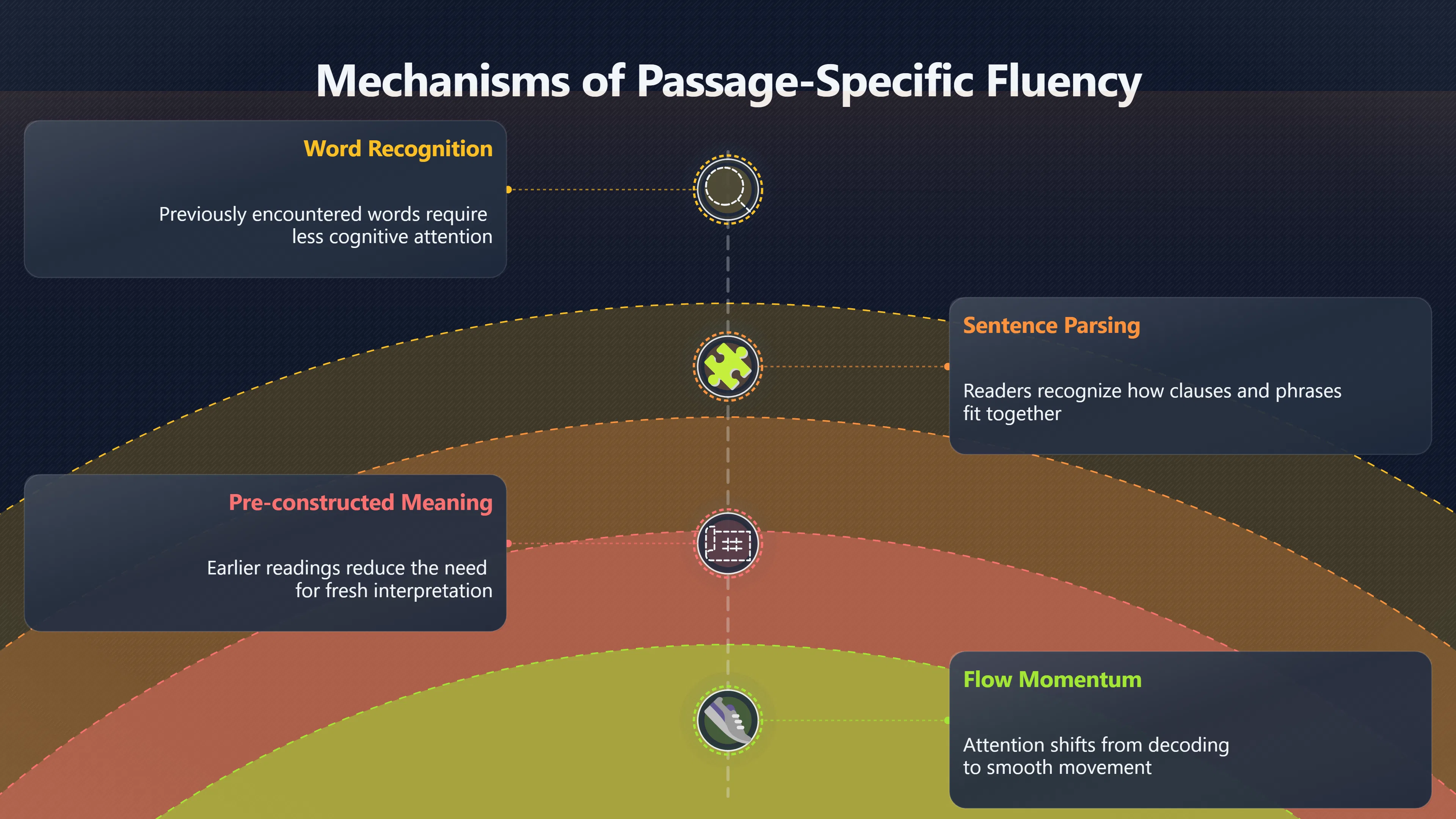
- Word recognition becomes faster. Previously encountered words require less attention.
- Sentence parsing becomes easier. Readers already know how clauses and phrases fit together.
- Meaning is partly pre-constructed. Understanding from earlier readings reduces the need for fresh interpretation.
- Attention shifts from decoding to flow. Readers can maintain momentum because fewer surprises appear in the text.
This combination creates what can be called passage-specific fluency. Reading becomes faster because many decisions have already been made. Studies of repeated reading repeatedly show strong gains in fluency and comprehension on familiar passages, which is exactly what would be expected if processing demands are steadily removed with each rereading.[ResearchGate+2ONlit.org]researchgate.netThe author conducted a meta-analysis…Read more…
Why New Passages Reintroduce Reading Load
The moment a reader opens an unfamiliar text, many of the shortcuts created by rereading disappear.
A new passage introduces fresh vocabulary, new sentence constructions, different topics, and unfamiliar relationships between ideas. Even a skilled reader must perform word recognition, syntactic analysis, and meaning construction again. The brain cannot simply replay the processing work completed on the previous passage because the material has changed.
This explains why transfer gains are typically smaller than practice gains. Research syntheses have repeatedly emphasised the importance of testing fluency on unpractised passages precisely because familiar-text performance can overestimate real-world reading improvement.[PMC]pmc.ncbi.nlm.nih.govfluency intervention are transferrable and generalizable to unpracticed passages and have a positive effect for comprehension and word re…
The mechanism can be understood through three layers of reading:
Familiarity Does Not Equal Automaticity
Repeated reading can increase automaticity—the rapid and effortless recognition of words—but automaticity develops at the level of reading skills, not entire passages. When a new text contains different vocabulary, readers must still identify many words that have not been reinforced through repetition.[Phonics Hero+2Reading Rockets]phonicshero.comPhonics HeroDeveloping Automaticity in ReadingJune 15, 2021 — Automaticity is the ability to rapidly, effortlessly and accurately recogni…
A reader who has reread a science paragraph ten times may fly through that paragraph yet still slow down when encountering unfamiliar terminology in a new science article.
Syntax Must Be Processed Again
Every text organises language differently. New sentences introduce new grammatical structures, clause arrangements, and rhetorical patterns. Prior familiarity with one passage does not eliminate the need to analyse these structures in another passage.
The result is that readers regain some, but not all, of the effort they had previously eliminated through repetition.
Meaning-Making Starts Over
Comprehension depends on constructing meaning from the current text. Knowing one article well does not automatically provide understanding of another article, even on a related topic.
Reading researchers often describe fluency as a bridge between decoding and comprehension. When readers face a new passage, that bridge must support fresh comprehension work rather than simply revisiting information already understood.[Sage Journals+2EEF]journals.sagepub.comSage JournalsThe Effects of Repeated Reading Interventions on the Oral…8 Jan 2026 — Findings demonstrated that repeated reading interv…

Why Transfer Is Partial Rather Than Zero
If rereading benefits were entirely passage-bound, there would be no reason to use repeated reading as a training method. Yet studies do find transfer effects. The question is why transfer exists at all if new texts restore so much processing demand.
The answer is that repeated reading strengthens some underlying skills while also creating passage-specific advantages.
The transferable components include:
- Faster recognition of common words.
- Greater reading confidence.[flowfluency.com]flowfluency.comhey make greater gains in fluency than peers who practice with new text each time.Read more…
- Improved phrasing and expression.
- Better coordination of decoding and comprehension processes.
- Increased ability to sustain attention while reading.[EEF+3ResearchGate+3Shanahan on Literacy]researchgate.netThe author conducted a meta-analysis…Read more…
These gains can help readers perform better on unfamiliar texts. However, the transferable improvements are generally smaller than the benefits created by knowing a specific passage in advance. This is why meta-analyses and intervention reviews often report strong familiar-text gains alongside more modest transfer effects.[ResearchGate+2PMC]researchgate.netThe author conducted a meta-analysis…Read more…
An analogy is practising a piano piece. Repetition improves both general musicianship and performance of that particular piece. The largest improvement appears in the exact composition that was rehearsed, while the broader skill gains transfer only partially to other music.
How to Spot Real Transfer Rather Than Memorised Fluency
For readers interested in increasing reading speed, distinguishing genuine improvement from text familiarity is essential.
A useful test is simple: measure performance on material that has never been seen before.
Signs of genuine transfer include:
- Faster reading across multiple new passages.
- Reduced hesitation on unfamiliar vocabulary.
- Better maintenance of comprehension while reading quickly.
- Similar improvements across different topics and genres.
Signs that gains are largely passage-specific include:
- Large speed increases on reread material but little change on new texts.
- Strong recall of the practised passage without corresponding improvement elsewhere.
- Fluency that collapses when vocabulary or subject matter changes.
Researchers frequently recommend assessing unfamiliar passages because this provides a more realistic picture of whether an intervention has strengthened underlying reading ability rather than merely increasing familiarity with a single text.[PMC]pmc.ncbi.nlm.nih.govfluency intervention are transferrable and generalizable to unpracticed passages and have a positive effect for comprehension and word re…

What This Means for Increasing Reading Speed
The shrinking of rereading gains on unfamiliar passages is not evidence that rereading fails. It is evidence that reading speed depends on more than familiarity. Repetition removes the burdens of uncertainty, allowing a practised passage to feel increasingly easy. New texts restore many of those burdens because readers must once again recognise words, interpret sentences, and construct meaning.
For that reason, the largest improvements from rereading are usually tied to the text that was practised, while lasting increases in reading speed depend on strengthening skills that can operate across many different texts. The closer a gain is to memorised familiarity, the less it travels. The closer it is to automatic word recognition and efficient language processing, the more likely it is to appear when the next unfamiliar page is opened.[AIM Nexus+3ResearchGate+3Phonics Hero]researchgate.netThe author conducted a meta-analysis…Read more…


eBay marketplace picks
Marketplace Samples
Example marketplace items related to this page. Use the search link to explore similar finds on eBay.
Endnotes
1.
Source: researchgate.net
Link:https://www.researchgate.net/publication/249835323_Fluency_and_Comprehension_Gains_as_a_Result_of_Repeated_Reading_A_Meta-Analysis
Source snippet
The author conducted a meta-analysis...Read more...
2.
Source: pmc.ncbi.nlm.nih.gov
Link:https://pmc.ncbi.nlm.nih.gov/articles/PMC5097019/
Source snippet
by EA Stevens · 2016 · Cited by 379 — RR improves fluency and comprehension of familiar texts and may improve fluency and comprehensio...
3.
Source: onlit.org
Link:https://onlit.org/wp-content/uploads/2024/03/Stollar-Repeated-Reading.pdf
Source snippet
Repeated Reading Implementation GuideResults suggested that repeated reading improves fluency and comprehension of familiar texts and may...
4.
Source: educationendowmentfoundation.org.uk
Title: why focus on reading fluency
Link:https://educationendowmentfoundation.org.uk/news/why-focus-on-reading-fluency
Source snippet
EEFWhy focus on reading fluency? | EEF23 Mar 2022 — Readers who read with high levels of word recognition automaticity and with good pros...
5.
Source: pmc.ncbi.nlm.nih.gov
Link:https://pmc.ncbi.nlm.nih.gov/articles/PMC8559868/
Source snippet
Automaticity as an Independent Trait in Predicting Reading...by TC Roembke · 2021 · Cited by 28 — Thus, automaticity should be consid...
6.
Source: researchgate.net
Link:https://www.researchgate.net/publication/398253041_Effect_of_Repeated_Reading_for_Developing_Reading_Fluency_and_Reading_Comprehension_in_EFL_Students_Pre_Experimental_Study
Source snippet
(PDF) Effect of Repeated Reading for Developing...29 May 2026 — Based on the results of the study, it was found that repeated reading wa...
Published: May 2026
7.
Source: researchgate.net
Link:https://www.researchgate.net/post/What-is-the-the-effect-of-fluency-and-reading-comprehension-gains-as-a-result-of-repeated-reading
8.
Source: youtube.com
Link:https://www.youtube.com/watch?v=Enfmry96tdI
Source snippet
Repeated Reading for Early Readers...
9.
Source: youtube.com
Title: Repeated Reading for Early Readers
Link:https://www.youtube.com/watch?v=ruR-WST8gnc
10.
Source: pmc.ncbi.nlm.nih.gov
Link:https://pmc.ncbi.nlm.nih.gov/articles/PMC3320221/
Source snippet
fluency intervention are transferrable and generalizable to unpracticed passages and have a positive effect for comprehension and word re...
11.
Source: shanahanonliteracy.com
Link:https://www.shanahanonliteracy.com/blog/everything-you-wanted-to-know-about-repeated-reading
Source snippet
Shanahan on LiteracyEverything You Wanted to Know about Repeated ReadingRepeated reading usually leads to better [oral reading]({{ 'reading-aloud/' | relative_url }}) performance...
12.
Source: teachingbyscience.com
Title: Teaching By Science Repeated Reading | Teaching By Science
Link:https://www.teachingbyscience.com/repeated-reading
Source snippet
Repeated Reading | Teaching By Science20 May 2022 — Repeated Reading specifically, works by having students read the same text, (typicall...
Published: May 2022
13.
Source: readingrockets.org
Link:https://www.readingrockets.org/topics/fluency/articles/developing-fluent-readers
Source snippet
Developing Fluent ReadersResearch over the past two decades has identified repeated reading as the key strategy for improving students' f...
14.
Source: phonicshero.com
Link:https://phonicshero.com/automaticity-in-reading/
Source snippet
Phonics HeroDeveloping Automaticity in ReadingJune 15, 2021 — Automaticity is the ability to rapidly, effortlessly and accurately recogni...
Published: June 15, 2021
15.
Source: readingrockets.org
Link:https://www.readingrockets.org/reading-101/reading-101-learning-modules/course-modules/fluency/depth
Source snippet
Fluency: In DepthAutomaticity refers only to accurate, speedy word recognition, not to reading passages or connected text with ease and g...
16.
Source: nexus.aimpa.org
Title: AIM Nexus Automaticity & Fluency
Link:https://nexus.aimpa.org/skill-overviews/automaticity-and-fluency/
Source snippet
AIM NexusAutomaticity & Fluency - AIM NexusAutomaticity is the ability to implement a skill not only accurately, but with quick, effortle...
17.
Source: journals.sagepub.com
Link:https://journals.sagepub.com/doi/10.1177/00222194251404534
Source snippet
Sage JournalsThe Effects of Repeated Reading Interventions on the Oral...8 Jan 2026 — Findings demonstrated that repeated reading interv...
18.
Source: journals.sagepub.com
Link:https://journals.sagepub.com/doi/10.1177/01632787241257450
Source snippet
the Effects of a Repeated Reading Intervention...Dec 11, 2024 — Previous research, including systematic literature reviews and meta-anal...
19.
Source: ies.ed.gov
Title: wwc repeatedreading 051314
Link:https://ies.ed.gov/ncee/wwc/Docs/InterventionReports/wwc_repeatedreading_051314.pdf
Source snippet
Reading - Institute of Education SciencesProgram Description1. Repeated reading is an academic practice that aims to increase oral readin...
20.
Source: pmc.ncbi.nlm.nih.gov
Link:https://pmc.ncbi.nlm.nih.gov/articles/PMC11219671/
Source snippet
of Repeated Reading on Reading Fluency for Adults...by M Halkowski · 2024 · Cited by 4 — In a meta-analysis, Lee and Yoon (2017) assesse...
21.
Source: pmc.ncbi.nlm.nih.gov
Link:https://pmc.ncbi.nlm.nih.gov/articles/PMC7644885/
Source snippet
meta-analysis of single-subject reading intervention studies...by D Kim · 2020 · Cited by 22 — The [purpose]({{ 'purpose/' | relative_url }}) of this study is to examine a...
22.
Source: pmc.ncbi.nlm.nih.gov
Link:https://pmc.ncbi.nlm.nih.gov/articles/PMC8500173/
Source snippet
Interventions for Struggling Readers in Grades 6 to 12by PK Steinle · 2021 · Cited by 46 — In 2017, Lee and Yoon conducted a meta-analysi...
23.
Source: dictionary.cambridge.org
Link:https://dictionary.cambridge.org/ja/dictionary/english/repeated
Source snippet
意味, Cambridge 英語辞書での定義Mar 25, 2026 — REPEATED 意味, 定義, REPEATED は何か: 1. happening again and again: 2. happening again and again: 3. happ...
24.
Source: scribd.com
Link:https://www.scribd.com/document/583877594/repetead-reading
Source snippet
at improving reading fluency and comprehension.Read more...
25.
Source: irrc.education.uiowa.edu
Link:https://irrc.education.uiowa.edu/blog/2019/02/repeated-reading-goal-setting-reading-fluency-focusing-reading-quality-rather-reading
Source snippet
Reading with Goal Setting for Reading Fluency5 Feb 2019 — Repeated Reading is one type of reading fluency instruction that has evidence o...
Additional References
26.
Source: publications.waset.org
Link:https://publications.waset.org/15850/the-effect-of-repeated-reading-on-student-fluency-does-practice-always-make-perfect
Source snippet
Effect of Repeated Reading on Student FluencyWe found that, on average, the use of repeated reading strategies increased students- fluenc...
27.
Source: flowfluency.com
Link:https://flowfluency.com/blog/automaticity-and-repeated-reading-unlocking-the-key-to-fluency/
Source snippet
hey make greater gains in fluency than peers who practice with new text each time.Read more...
28.
Source: americanenglish.state.gov
Link:https://americanenglish.state.gov/files/ae/resource_files/63_3_p02-08.pdf
Source snippet
Reading with Retelling: A Multi-Skilled Fluency...by TIM STOECKEL — Learners “talk to a partner about a familiar topic for four minutes...
29.
Source: qiita.com
Link:https://qiita.com/satken2/items/4ac81a16bbca164cfa7f
Source snippet
gRPCにおけるrepeatedとstreamの使い分けApr 30, 2022 — repeated を使用すべきシチュエーション · 比較的短時間でデータを返すことができる場合 · データの量が決まっている場合. サーバー側であらかじめ...Read more...
30.
Source: youtube.com
Title: Discovering the Path to Reading Fluency with Timothy Rasinski, Ph.D
Link:https://www.youtube.com/watch?v=oh0xdnND4JY
Source snippet
Revisiting Fluency Assessment and Instruction with Jan Hasbrouck...
31.
Source: files.eric.ed.gov
Link:https://files.eric.ed.gov/fulltext/EJ1254864.pdf
Source snippet
Impact of Repeated Reading Intervention on Improving...by H Elhoweris · 2017 · Cited by 27 — The purpose of this study was to examine th...
32.
Source: youtube.com
Title: Revisiting Fluency Assessment and Instruction with Jan Hasbrouck
Link:https://www.youtube.com/watch?v=fRmAbiKnm40
Source snippet
Ep. 62: Effective Fluency Instruction with Tim Rasinski...
33.
Source: link.springer.com
Link:https://link.springer.com/article/10.1007/s11145-025-10744-7
Source snippet
Springer Natureby F Zourou · 2025 — Several meta-analyses and syntheses confirm RR's positive effects on RF and reading comprehension in...
34.
Source: youtube.com
Title: Ep. 62: Effective Fluency Instruction with Tim Rasinski
Link:https://www.youtube.com/watch?v=el4f-fMcRuc
Source snippet
NES 104 Study Guide | Word Analysis & Fluency | Exam Prep 2026...
35.
Source: ila.onlinelibrary.wiley.com
Link:https://ila.onlinelibrary.wiley.com/doi/full/10.1002/trtr.70024
Source snippet
Fluency Through Challenge: Repeated Reading...by J Downs · 2025 · Cited by 2 — Recent evidence indicates that prosody is moderately corr...
Topic Tree