Within Worth It
Do You Know What You Need to Check?
A backward glance is fastest when the reader can name the exact missing detail before moving their eyes back.
On this page
- The specific question test in practice
- Useful repair questions versus vague uncertainty
- How to decide in one pause
Page outline Jump by section
Introduction
Increasing reading speed is not about eliminating every backward glance. It is about making sure each regression serves a purpose. A look back is usually worth the time when you can state a precise question that blocks understanding of what comes next. If you know exactly what information is missing, a short targeted reread can repair comprehension quickly. If you only feel uncertain, rereading often becomes a slow habit that adds little value.
 Research on eye movements shows that regressions are a normal part of reading and frequently support comprehension when readers need to reanalyse earlier text, resolve inconsistencies, or recover specific information. The key distinction is whether the regression answers a defined question or merely responds to a feeling of doubt.[PubMed]pubmed.ncbi.nlm.nih.govThe function of these "regressions" is still largely unknownThe function of regressions in reading: backward eye…by RW Booth · 2013 · Cited by 132 — Standard text reading involves frequent…
Do You Know What You Need to Check?
The fastest useful regression begins before the eyes move. It begins with a question.
Instead of immediately looking back, pause for a second and ask: What exactly am I trying to recover?
If you can answer that question, the regression is likely justified. If you cannot, continuing forward is often the better choice.
This matters because comprehension failures are usually local. A reader may have lost track of a definition, missed a condition in an argument, forgotten which person a pronoun refers to, or become unsure about a number. These are specific gaps. They can often be repaired with a brief glance at a small portion of text rather than a broad rereading of entire paragraphs. Research on reading regressions suggests that readers use many backward eye movements to reprocess text directly when comprehension requires it.[Springer+2CORE]link.springer.comThe function of regressions in reading: Backward eye…by RW Booth · 2013 · Cited by 132 — These results suggest that readers us…
A useful mental distinction is:
- Information problem: “Which exception applied here?”
- Confidence problem: “I do not feel certain.”
Only the first clearly identifies what must be checked.
The Specific-Question Test in Practice
A specific question typically has a clear destination. You know where in the text the answer probably lives.
Examples that usually justify looking back include:
- “Who is being discussed in this sentence?”
- “What definition was introduced earlier?”
- “Which step came before this instruction?”
- “Was the figure 15,000 or 150,000?”
- “What assumption did the author make before reaching this conclusion?”
In each case, the reader can point to a missing piece of information.
Notice how different this is from broad uncertainty. A reader who thinks, “Something feels unclear,” has not yet identified the problem. Looking back at that stage often triggers unfocused rereading. The eyes move backwards, but the mind is still searching for the question.
Eye-tracking research consistently links regressions with comprehension monitoring—the process of noticing that understanding has broken down and attempting to repair it. When readers encounter information that conflicts with their current interpretation, they often return to earlier text to revise that interpretation.[Oxford University Research Archive+2PMC]ora.ox.ac.ukford University Research ArchiveComprehension monitoring during reading: an eye-tracking…by AK Hessel · 2020 · Cited by 50 — We chos…
Useful Repair Questions Versus Vague Uncertainty
The practical challenge is distinguishing a genuine repair need from a general sense of discomfort.
Questions that usually earn a regression
These questions have a narrow target and an obvious payoff:
- “What does this technical term mean?”
- “Which condition limits this rule?”
- “What event happened first?”
- “Which variable changed in the experiment?”
- “What was the author’s main claim in the previous paragraph?”
The answer will directly improve understanding of the current sentence or section.
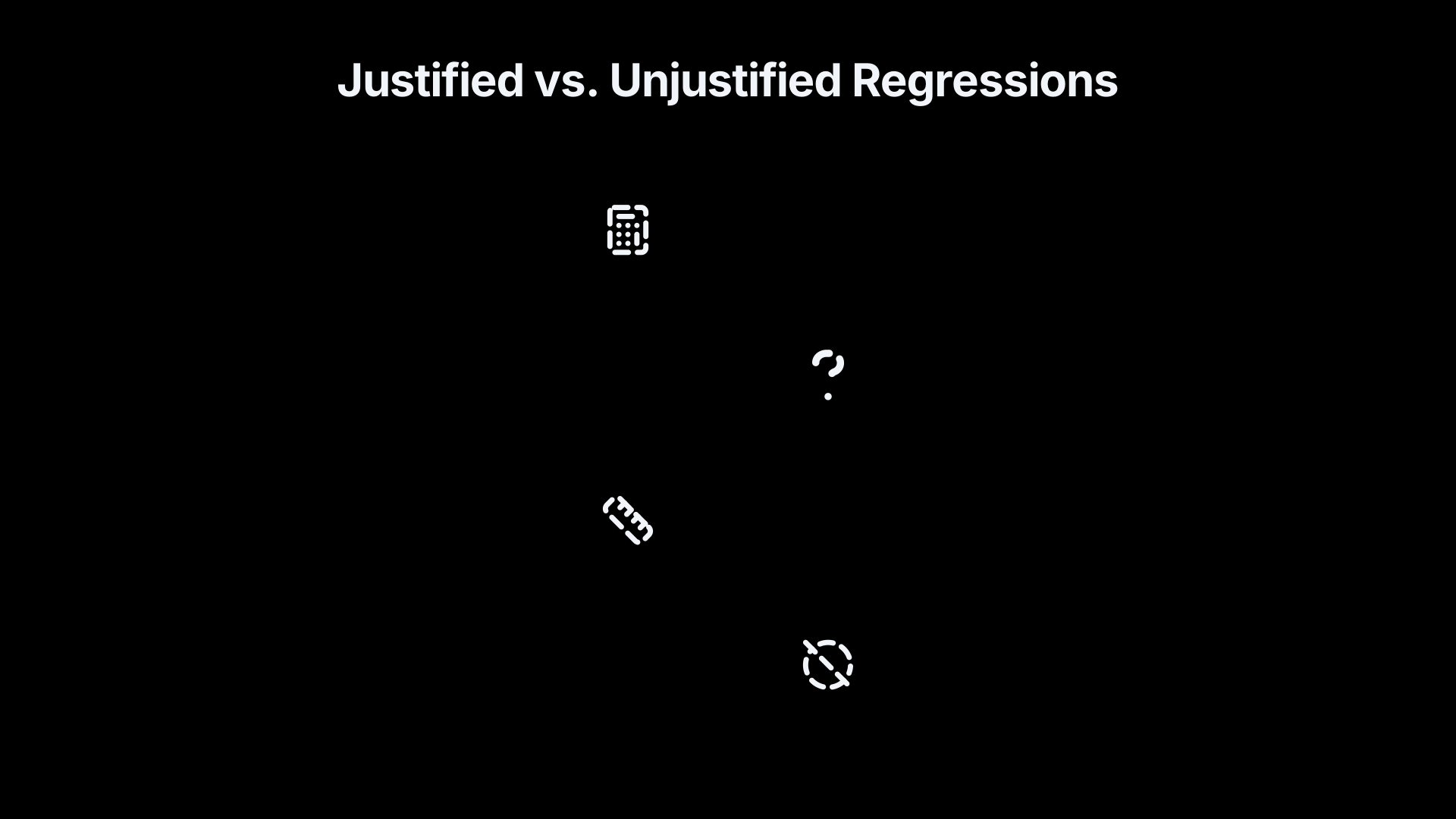
Questions that usually do not
These reactions often lead to unnecessary rereading:
- “Maybe I missed something.”
- “I want to be completely sure.”
- “That felt difficult.”
- “Perhaps I should start the paragraph again.”
- “I am not confident enough yet.”
The problem here is not necessarily comprehension. It is the inability to identify a missing fact.
Many readers lose speed because they treat uncertainty itself as evidence that understanding has failed. Yet comprehension frequently develops over several sentences. Information that seems incomplete at one point is often clarified naturally by what follows. Interrupting that process too early can create a cycle of repeated checking and reduced reading flow.[PubMed]pubmed.ncbi.nlm.nih.govPub Med How Do We Read, and Can Speed Reading Help?by K Rayner · 2016 · Cited by 531 — The research shows that there is a trade-off between speed and accuracy. It is unlikely that re…
How to Decide in One Pause
A simple decision rule can prevent many unnecessary regressions.
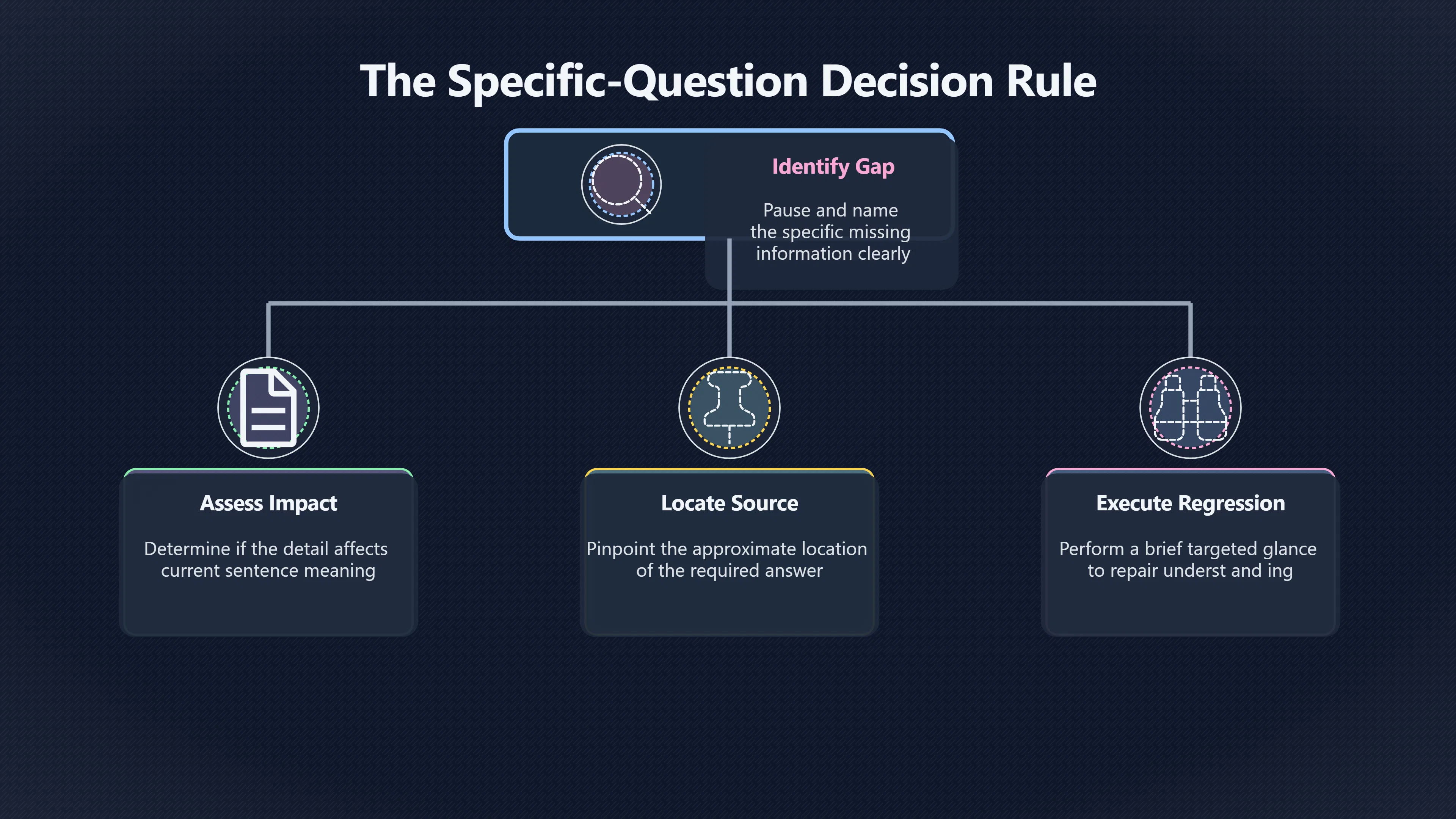
Before looking back, take a brief pause and ask three questions:
- Can I name the missing information?
- Will that information affect what I am reading now?
- Do I know roughly where to find it?
If the answer to all three is yes, look back.
If the answer to the first question is no, continue reading for a short distance before deciding again.
This approach keeps regressions purposeful. Instead of rereading from anxiety, you reread to answer a defined question.
For example, imagine reading a scientific article and reaching a sentence that refers to “the control condition”. If you cannot remember which group was the control group, the missing detail affects the current argument and can probably be recovered quickly. A targeted glance is efficient.
By contrast, if the sentence feels dense but you cannot identify what is missing, rereading immediately may not help. The next few sentences may supply the context needed to make sense of it.
Why Targeted Regressions Can Be Faster Than Pushing Forward
At first glance, any backward movement appears to slow reading. In reality, a well-chosen regression can save time.
When a critical misunderstanding remains unresolved, the reader often carries confusion forward. Subsequent sentences become harder to interpret because they depend on information that was missed earlier. A short corrective glance may prevent a much larger breakdown later.
Research distinguishes regressions that support comprehension from those that merely correct eye-movement positioning. Larger regressions often occur when readers need to revisit earlier text and revise their understanding. These movements are part of normal skilled reading rather than evidence of failure.[PMC+2PubMed]pmc.ncbi.nlm.nih.govPMCRegressions during ReadingNIHby AW Inhoff · 2019 · Cited by 62 — Abstract. Readers occasionally move their eyes to prior text. We distinguish two types of th…
The goal, therefore, is not zero regressions. The goal is high-value regressions: brief returns that answer a specific question and immediately allow forward progress.
A Practical Standard for Faster Reading
When deciding whether to look back, replace the question “Should I reread this?” with a more precise one:
“What exact information am I trying to recover?”
If you can answer that immediately, the regression is usually justified. If you cannot, the fastest choice is often to keep moving and allow the text to provide more context.
In speed-conscious reading, clarity of purpose matters more than the number of backward eye movements. A regression with a specific target repairs understanding. A regression driven only by uncertainty often repeats work that was already good enough. The difference between the two can have a noticeable effect on both reading speed and comprehension.[PubMed+2Springer]pubmed.ncbi.nlm.nih.govThe function of these "regressions" is still largely unknownThe function of regressions in reading: backward eye…by RW Booth · 2013 · Cited by 132 — Standard text reading involves frequent…
Amazon book picks
Further Reading
Books and field guides related to Do You Know What You Need to Check?. Use these as the next step if you want deeper reading beyond the article.
How to Read a Book
Rating: 4.0/5 from 41 Google Books ratings
Encourages readers to ask precise questions and identify exact comprehension gaps.

The Only Skill that Matters
Focuses on intentional reading and targeted comprehension strategies.
eBay marketplace picks
Marketplace Samples
Example marketplace items related to this page. Use the search link to explore similar finds on eBay.

Endnotes
1.
Source: pmc.ncbi.nlm.nih.gov
Title: PMCRegressions during Reading
Link:https://pmc.ncbi.nlm.nih.gov/articles/PMC6802794/
Source snippet
NIHby AW Inhoff · 2019 · Cited by 62 — Abstract. Readers occasionally move their eyes to prior text. We distinguish two types of th...
2.
Source: link.springer.com
Link:https://link.springer.com/article/10.3758/s13421-012-0244-y
Source snippet
The function of regressions in reading: Backward eye...by RW Booth · 2013 · Cited by 132 — These results suggest that readers us...
3.
Source: core.ac.uk
Link:https://core.ac.uk/download/pdf/52172007.pdf
Source snippet
Keywords Eye movements...Read more...
4.
Source: pmc.ncbi.nlm.nih.gov
Link:https://pmc.ncbi.nlm.nih.gov/articles/PMC5604484/
Source snippet
Alternatively, the regression may reflect self-monitoring during the...
5.
Source: pmc.ncbi.nlm.nih.gov
Link:https://pmc.ncbi.nlm.nih.gov/articles/PMC6071415/
Source snippet
The goal was to investigate the nature of online comprehension monitoring, its predictors, and its relation to reading comprehension.Read...
6.
Source: pmc.ncbi.nlm.nih.gov
Link:https://pmc.ncbi.nlm.nih.gov/articles/PMC6235565/
Source snippet
by JR Folk · 2018 · Cited by 8 — This paper describes how to design materials to distinguish between regressions caused by comprehensi...
7.
Source: link.springer.com
Link:https://link.springer.com/article/10.1007/s11409-025-09440-2
Source snippet
behavior as an indicator of comprehension...by C Tibken · 2025 · Cited by 2 — In the following section, we discuss how eye movement meas...
8.
Source: pubmed.ncbi.nlm.nih.gov
Title: The function of these “regressions” is still largely unknown
Link:https://pubmed.ncbi.nlm.nih.gov/22886737/
Source snippet
The function of regressions in reading: backward eye...by RW Booth · 2013 · Cited by 132 — Standard text reading involves frequent...
9.
Source: ora.ox.ac.uk
Link:https://ora.ox.ac.uk/objects/uuid%3Aa16f42e2-529d-47ae-ba51-50b75dd43899/files/rkh04dp70d
Source snippet
ford University Research ArchiveComprehension monitoring during reading: an eye-tracking...by AK Hessel · 2020 · Cited by 50 — We chos...
10.
Source: pubmed.ncbi.nlm.nih.gov
Title: Pub Med How Do We Read, and Can [Speed Reading]({{ ‘myths/’ | relative_url }}) Help?
Link:https://pubmed.ncbi.nlm.nih.gov/26769745/
Source snippet
by K Rayner · 2016 · Cited by 531 — The research shows that there is a trade-off between speed and accuracy. It is unlikely that re...
11.
Source: pubmed.ncbi.nlm.nih.gov
Link:https://pubmed.ncbi.nlm.nih.gov/27873185/
Source snippet
Regressions during reading: The cost depends on the causeby MA Eskenazi · 2017 · Cited by 31 — The purpose of the current study was...
12.
Source: pmc.ncbi.nlm.nih.gov
Link:https://pmc.ncbi.nlm.nih.gov/articles/PMC7888242/
Source snippet
Cognitive Model of Regressive Eye Movements during...by AF Weiss · 2020 · Cited by 7 — In this article we present a new eye movement con...
13.
Source: pmc.ncbi.nlm.nih.gov
Link:https://pmc.ncbi.nlm.nih.gov/articles/PMC6234076/
Source snippet
of reader- and text-level characteristics to eye...by V Kuperman · 2018 · Cited by 75 — Eye-movements during passage reading are suscept...
14.
Source: pmc.ncbi.nlm.nih.gov
Link:https://pmc.ncbi.nlm.nih.gov/articles/PMC12409514/
Source snippet
the rereading effect of digital reading through eye...by Y Xu · 2025 — This study aimed to investigate the differences in eye movement c...
15.
Source: pubmed.ncbi.nlm.nih.gov
Link:https://pubmed.ncbi.nlm.nih.gov/31735836/
Source snippet
during Readingby AW Inhoff · 2019 · Cited by 70 — Readers occasionally move their eyes to prior text. We distinguish two types of these m...
16.
Source: pubmed.ncbi.nlm.nih.gov
Link:https://pubmed.ncbi.nlm.nih.gov/33029808/
Source snippet
Eye Movements Reveal About Later Comprehension...by R Southwell · 2020 · Cited by 48 — Using a predictive modeling approach, we trained...
17.
Source: pmc.ncbi.nlm.nih.gov
Link:https://pmc.ncbi.nlm.nih.gov/articles/PMC12769648/
Source snippet
by A Friede · 2026 · Cited by 1 — The function of regressions in reading: Backward eye movements allow rereading.... Comprehension is...
18.
Source: pubmed.ncbi.nlm.nih.gov
Link:https://pubmed.ncbi.nlm.nih.gov/15468029/
Source snippet
rehabilitation in acquired brain injury: a case...by N Kapoor · 2004 · Cited by 115 — This case series provides objective documentation...
19.
Source: pubmed.ncbi.nlm.nih.gov
Link:https://pubmed.ncbi.nlm.nih.gov/29461715/
Source snippet
Speed-[Reading Apps]({{ 'reading-apps/' | relative_url }}) Do Not Foster...by D Acklin · 2017 · Cited by 25 — This is done using rapid serial visual presentation (RSVP), where...
20.
Source: pubmed.ncbi.nlm.nih.gov
Link:https://pubmed.ncbi.nlm.nih.gov/35321590/
Source snippet
Struggling Adult Readers Monitor Their Reading...by EL Tighe · 2023 · Cited by 23 — This study used a comprehension monitoring task with...
21.
Source: pubmed.ncbi.nlm.nih.gov
Link:https://pubmed.ncbi.nlm.nih.gov/16390289/
Source snippet
development of language by hand: composing, reading...by VW Berninger · 2006 · Cited by 485 — Results showed that individual differences...
22.
Source: pmc.ncbi.nlm.nih.gov
Title: Differences between the EZ Reader model and the SWIFT model are reviewed.Read
Link:https://pmc.ncbi.nlm.nih.gov/articles/PMC2906818/
Source snippet
Movements in Reading: Models and Data - PMCby K Rayner · 2009 · Cited by 285 — Models of eye movement control in reading and their impact...
23.
Source: Wikipedia
Link:https://en.wikipedia.org/wiki/Eye
Source snippet
EyeAn eye is a sensory organ that allows an organism to perceive visual information. It detects light and converts it into electro-che...
Additional References
24.
Source: studenttheses.universiteitleiden.nl
Link:https://studenttheses.universiteitleiden.nl/access/item%3A2629036/view
Source snippet
Relatively little research has been conducted to study eye movements in children. However, early eye tracking...Read more...
25.
Source: researchgate.net
Link:https://www.researchgate.net/publication/353910349_Metacomprehension_and_regressions_during_reading_and_rereading
Source snippet
etacomprehension judgments and accuracy in order to further understand the...Read more...
26.
Source: researchgate.net
Title: Comprehension monitoring during reading
Link:https://www.researchgate.net/publication/335844637_Comprehension_monitoring_during_reading_an_eye-tracking_study_with_children_learning_English_as_an_additional_language
Source snippet
ChildrenThis experiment investigated comprehension monitoring in children learning English as an additional language (EAL) compared to mo...
27.
Source: d-nb.info
Link:https://d-nb.info/1227301006/34
Source snippet
Comprehension demands modulate re-reading, but not first...by AF Weiss · Cited by 58 — Abstract: Several studies have examined effec...
28.
Source: researchgate.net
Link:https://www.researchgate.net/publication/230658181_The_function_of_regressions_in_reading_Backward_eye_movements_allow_rereading
Source snippet
ue their memory for previously read words.Read more...
29.
Source: youtube.com
Title: GMAT Reading Comprehension #4: Function & Role Questions in RC | GMAT Ninja
Link:https://www.youtube.com/watch?v=ScheNGvItlI
Source snippet
Reading Comprehension Tricks for NIFT, NID, UCEED & NATA 2027 | Improve RC Speed & Accuracy...
30.
Source: assets.cambridge.org
Title: 9781108415354 excerpt
Link:https://assets.cambridge.org/97811084/15354/excerpt/9781108415354_excerpt.pdf
Source snippet
1 Introduction to Eye-TrackingIn reading, saccades do not always move the eye forward in a text. About 10–15 per cent of the time, reader...
31.
Source: cognitivetrain.com
Link:https://cognitivetrain.com/regression-in-reading/
Source snippet
Regression in Reading: Why Your Eyes Keep Going...Eye-tracking research shows that regressions account for 10-15% of all eye movements d...
32.
Source: eric.ed.gov
Link:https://eric.ed.gov/?id=EJ1288982
Source snippet
Eye-Tracking Study with Children Learning English as...by AK Hessel · 2021 · Cited by 46 — This experiment investigated comprehension mo...
33.
Source: youtube.com
Title: Re-reading and Comprehension | Things About Speed-Reading People Often Miss
Link:https://www.youtube.com/watch?v=fx1a6Dm64kA
Source snippet
Common Reading Mistakes and How to Fix Them...
Topic Tree