Within Dense Texts
Why Rereading Is Not Wasted Time
Looking back is often a repair strategy, not a bad habit, when a sentence has not yet fitted the meaning.
On this page
- What regressions reveal about understanding
- When rereading catches contradictions
- How to use layered passes efficiently
Page outline Jump by section
Introduction
Rereading is often portrayed as a sign that reading has gone wrong. In dense material, the opposite is frequently true. Research on eye movements and comprehension shows that skilled readers regularly move backwards through a text when meaning has not yet stabilised. These return movements, known as regressions, are not random interruptions. They are part of the mind’s repair system: a way of checking earlier words, resolving ambiguity and integrating new information with what has already been read.[Springer]link.springer.comThe function of regressions in reading: Backward eye…by RW Booth · 2013 · Cited by 134 — These results suggest that readers us…
 For readers trying to increase reading speed, this distinction matters. Productive rereading is different from repeatedly starting over because attention has drifted. A brief return to a key phrase can prevent a much larger misunderstanding later. In difficult texts, selective rereading often improves overall efficiency because it helps comprehension become accurate sooner rather than forcing multiple incomplete passes through the same material.[PMC]pmc.ncbi.nlm.nih.govReading and skimming clinical information: insights from…by MA Soltan · 2025 — Reading times are shorter and comprehension is poore…
What Regressions Reveal About Understanding
When people read, their eyes do not move smoothly from left to right. Eye-tracking studies consistently show that readers make backward movements through text. These regressions become more common when a sentence is complex, unexpected or difficult to interpret. Rather than indicating failure, they often reveal active comprehension work.[MDPI]mdpi.comSeveral findings indicate that the…Read more…
Consider a sentence such as:
“The committee that the reviewers appointed after the audit recommended changes.”
Many readers initially form the wrong interpretation. When later words make that interpretation impossible, the brain must revise its understanding. Eye-tracking research shows that readers frequently return to earlier parts of the sentence during this process. The rereading is not wasted effort; it allows the sentence structure to be rebuilt correctly.[tmalsburg.github.io]tmalsburg.github.ioEyetracking research has addressed a wide range of questions…
This helps explain why dense academic writing often feels slow. A reader may understand every individual word while still lacking a coherent interpretation of the sentence as a whole. The return to earlier text is a mechanism for assembling meaning, not merely recovering forgotten information.
Research on the function of regressions suggests that readers use these backward eye movements primarily to reread and reanalyse text rather than simply to trigger memory through location cues. When regressions were experimentally disrupted, comprehension suffered, supporting the idea that rereading serves a genuine interpretive function.[Springer+2PubMed]link.springer.comThe function of regressions in reading: Backward eye…by RW Booth · 2013 · Cited by 134 — These results suggest that readers us…
When Rereading Catches Contradictions
Dense texts often delay crucial information. A scientific paper may introduce technical details before explaining their significance. A legal clause may place an exception near the end of a long sentence. A philosophy text may define a term differently from everyday usage.
In these situations, understanding develops gradually. Early interpretations are provisional. As new information arrives, the reader continuously tests whether the emerging interpretation still fits.
Studies of comprehension monitoring suggest that increased rereading occurs when readers encounter semantic inconsistencies or contradictions. Extra time spent revisiting earlier words appears to reflect attempts to identify and repair a mismatch between the text and the reader’s developing understanding.[PMC]pmc.ncbi.nlm.nih.govDoes Online Comprehension Monitoring Make a Unique…by YSG Kim · 2018 · Cited by 51 — When using eye-tracking technology, time spent…
A practical example appears in research on medical reading. When medical students encountered information that conflicted with detailed prior knowledge, rereading times increased during careful reading. The additional rereading appeared to support evaluation and integration of the conflicting information. During skimming, this repair process was weaker and comprehension suffered.[PMC]pmc.ncbi.nlm.nih.govReading and skimming clinical information: insights from…by MA Soltan · 2025 — Reading times are shorter and comprehension is poore…
This is one reason why difficult passages sometimes become clearer only after reaching the end of a paragraph. Later sentences provide context that allows earlier statements to be interpreted correctly. Returning briefly to those earlier statements can reveal relationships that were invisible during the first pass.
The key point is that comprehension is not always immediate. Meaning often emerges through interaction between earlier and later parts of a text. Rereading allows those pieces to be connected.
Why Hard Texts Create Delayed Understanding
Not all texts place the same demands on comprehension. A straightforward news article usually presents information in a predictable order. Dense material often does not.
Research papers, technical manuals and theoretical works commonly require readers to hold several ideas in working memory at once. Definitions, assumptions, qualifications and references to earlier concepts must be maintained while new information arrives. When cognitive load increases, readers are more likely to revisit previous text to refresh or refine their interpretation.[MDPI]mdpi.com2226 471XTracking Adults' Eye Movements to Study Text…by G Andreou · 2024 · Cited by 7 — The aim of this review is to examine and analyze t…
This creates a pattern familiar to experienced readers:
- An unfamiliar term appears.
- The reader forms a tentative interpretation.
- Additional context arrives later.
- The original interpretation requires adjustment.
- A short rereading pass resolves the confusion.
Seen from the outside, this looks like slower reading. In reality, it is often the mechanism that prevents misunderstanding from accumulating.

How to Use Layered Passes Efficiently
The goal is not to eliminate rereading. The goal is to make rereading purposeful.
A useful approach for dense material is to separate orientation from detailed analysis.
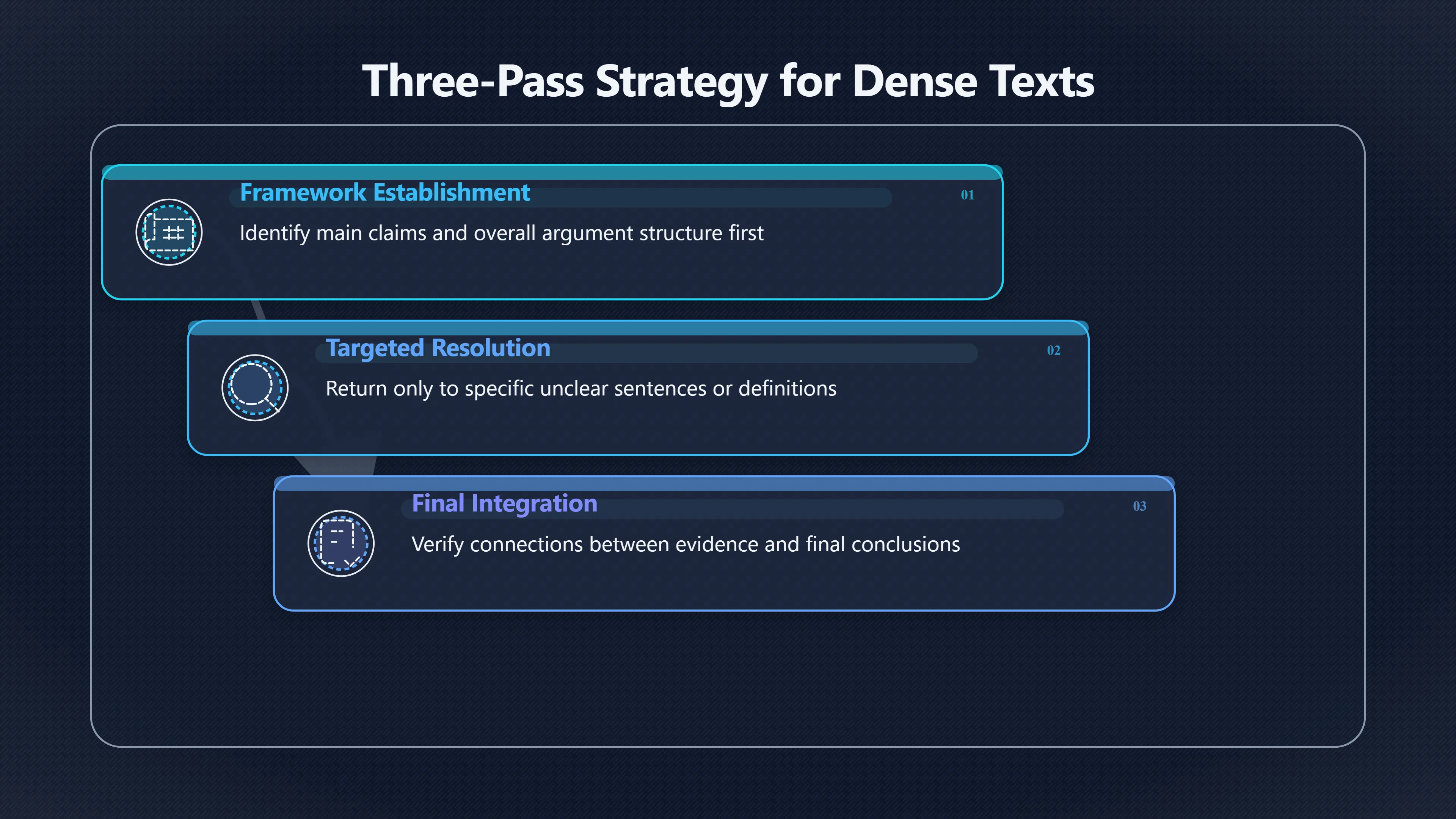
First pass: establish the framework
Read to identify:
- The main question or claim.
- The structure of the argument.
- The major sections.
- The overall conclusion.
This creates a mental framework that reduces the number of future regressions caused by uncertainty about where the text is heading.
Second pass: resolve difficult points
During closer reading, return only to the specific sentence, definition or paragraph that remains unclear. Avoid restarting entire chapters when a targeted check will solve the problem.
Research comparing thorough reading with skimming shows that more rereading is associated with better comprehension, whereas skim reading involves less rereading and lower understanding. The difference is not simply time spent reading but the quality of processing taking place during that time.[PMC+2BOP Serials]pmc.ncbi.nlm.nih.govreading, thorough reading, skimming, and spell checking. Below follows a short…
Third pass: integrate and verify
For particularly technical material, a final review can focus on connections:
- Does the conclusion follow from the evidence?
- Do definitions remain consistent throughout the text?
- Do examples support the stated claim?
At this stage, rereading serves integration rather than repair.

Why Rereading Can Support Faster Reading Over Time
A common misconception is that every regression represents lost speed. In the short term, rereading certainly adds seconds or minutes. Over the longer term, however, strategic rereading can reduce total reading time.
When a difficult sentence is repaired immediately, the reader avoids carrying a faulty interpretation through the rest of the document. Without that repair, confusion often accumulates until a much larger section must be reread later.
Studies of digital and traditional reading alike have found that rereading can improve comprehension, memory and reading efficiency when used as part of understanding rather than as a response to distraction.[PMC]pmc.ncbi.nlm.nih.govAssessing the rereading effect of digital reading through eye…by Y Xu · 2025 — Rereading can help students read more quickly, bette…
For readers interested in increasing reading speed, the practical lesson is simple: not every backward glance is an obstacle. In hard texts, rereading is often the mechanism that turns partial understanding into stable understanding. A short, well-timed return to a crucial sentence can be the fastest route to getting the meaning right the first time.[Springer+2PMC]link.springer.comThe function of regressions in reading: Backward eye…by RW Booth · 2013 · Cited by 134 — These results suggest that readers us…
Amazon book picks
Further Reading
Books and field guides related to Why Rereading Is Not Wasted Time. Use these as the next step if you want deeper reading beyond the article.
How to Read a Book
Rating: 4.0/5 from 41 Google Books ratings
Directly addresses rereading, inspectional reading, analytical reading, and extracting deeper understanding from difficult texts.
Deep Work
Supports the idea that careful engagement with demanding material produces better comprehension than superficial speed.
Make It Stick
Explains how revisiting material strengthens understanding and long-term retention.

How to Take Smart Notes
Shows how repeated interaction with ideas improves understanding and synthesis.
eBay marketplace picks
Marketplace Samples
Example marketplace items related to this page. Use the search link to explore similar finds on eBay.



Endnotes
1.
Source: link.springer.com
Link:https://link.springer.com/article/10.3758/s13421-012-0244-y
Source snippet
The function of regressions in reading: Backward eye...by RW Booth · 2013 · Cited by 134 — These results suggest that readers us...
2.
Source: pmc.ncbi.nlm.nih.gov
Link:https://pmc.ncbi.nlm.nih.gov/articles/PMC12801452/
Source snippet
Reading and skimming clinical information: insights from...by MA Soltan · 2025 — Reading times are shorter and comprehension is poore...
3.
Source: pmc.ncbi.nlm.nih.gov
Link:https://pmc.ncbi.nlm.nih.gov/articles/PMC7198234/
Source snippet
reading, thorough reading, skimming, and spell checking. Below follows a short...
4.
Source: mdpi.com
Link:https://www.mdpi.com/2411-5150/3/3/35
Source snippet
Several findings indicate that the...Read more...
5.
Source: tmalsburg.github.io
Link:https://tmalsburg.github.io/VasishthEtAl2013.pdf
Source snippet
Eyetracking research has addressed a wide range of questions...
6.
Source: pmc.ncbi.nlm.nih.gov
Link:https://pmc.ncbi.nlm.nih.gov/articles/PMC6071415/
Source snippet
Does Online Comprehension Monitoring Make a Unique...by YSG Kim · 2018 · Cited by 51 — When using eye-tracking technology, time spent...
7.
Source: pmc.ncbi.nlm.nih.gov
Title: PMCWhat Can Eye Movements Tell Us about Higher Level
Link:https://pmc.ncbi.nlm.nih.gov/articles/PMC6802807/
Source snippet
Can Eye Movements Tell Us about Higher Level... - PMCby AE Cook · 2019 · Cited by 44 — The majority of eye tracking studies in reading a...
8.
Source: mdpi.com
Title: 2226 471X
Link:https://www.mdpi.com/2226-471X/9/12/360
Source snippet
Tracking Adults' Eye Movements to Study Text...by G Andreou · 2024 · Cited by 7 — The aim of this review is to examine and analyze t...
9.
Source: pmc.ncbi.nlm.nih.gov
Link:https://pmc.ncbi.nlm.nih.gov/articles/PMC12409514/
Source snippet
Assessing the rereading effect of digital reading through eye...by Y Xu · 2025 — Rereading can help students read more quickly, bette...
10.
Source: tmalsburg.github.io
Link:https://tmalsburg.github.io/MeziereEtAl2021MS.pdf
Source snippet
accades are regressions, which move the eyes back to a previous part of the...Read more...
11.
Source: pubmed.ncbi.nlm.nih.gov
Link:https://pubmed.ncbi.nlm.nih.gov/22886737/
Source snippet
The function of regressions in reading: backward eye...by RW Booth · 2013 · Cited by 134 — The most obvious explanation is that re...
12.
Source: bop.unibe.ch
Link:https://bop.unibe.ch/JEMR/article/view/Strukelj
Source snippet
BOP SerialsEye movements during regular and thorough reading...by A Strukelj · 2018 · Cited by 87 — Thorough reading involved longer tot...
13.
Source: pmc.ncbi.nlm.nih.gov
Link:https://pmc.ncbi.nlm.nih.gov/articles/PMC9775498/
Source snippet
nih.govReading: From the Simple to the Complex - PMCDecember 5, 2022 — The aim of this article was to present an important perspective on...
Published: December 5, 2022
14.
Source: pmc.ncbi.nlm.nih.gov
Link:https://pmc.ncbi.nlm.nih.gov/articles/PMC7497986/
Source snippet
impact of skim reading and navigation when reading hyperlinks...September 17, 2020 — It has been shown that readers spend a great deal o...
Published: September 17, 2020
15.
Source: pmc.ncbi.nlm.nih.gov
Link:https://pmc.ncbi.nlm.nih.gov/articles/PMC8827473/
Source snippet
impact of hyperlinks, skim reading and perceived importance...Across two experiments, we examine how hyperlinks influence perceived impo...
16.
Source: pmc.ncbi.nlm.nih.gov
Link:https://pmc.ncbi.nlm.nih.gov/articles/PMC5604484/
Source snippet
What differs is whether the movement is back from a fixation beyond the current target word to a...
17.
Source: pmc.ncbi.nlm.nih.gov
Link:https://pmc.ncbi.nlm.nih.gov/articles/PMC10147347/
Source snippet
OF A COMBINED [MEASURE]({{ 'measure/' | relative_url }}) OF READING AND...The goal of the present study is to evaluate the properties of a novel measure, the Assessment of...
18.
Source: pmc.ncbi.nlm.nih.gov
Link:https://pmc.ncbi.nlm.nih.gov/articles/PMC12488015/
Source snippet
by B Koparan · 2025 · Cited by 1 — This study is a quasi-experimental research that aims to compare the reading comprehension levels o...
Additional References
19.
Source: academia.edu
Link:https://www.academia.edu/10029844/A_theory_of_reading_From_eye_fixations_to_comprehension
Source snippet
A theory of reading: From eye fixations to comprehensionThis article presents a model of reading comprehension that accounts for the allo...
20.
Source: researchgate.net
Link:https://www.researchgate.net/publication/228625379_Eye_Movements_as_Reflections_of_Comprehension_Processes_in_Reading
Source snippet
(PDF) Eye Movements as Reflections of Comprehension...In this article, we discuss the use of eye movement data to assess moment-to-momen...
21.
Source: shanahanonliteracy.com
Link:https://www.shanahanonliteracy.com/blog/dont-confuse-reading-comprehension-and-learning-to-read-and-to-reread
Source snippet
Don't Confuse Reading Comprehension and Learning to...When understanding doesn't come automatically from a single read, it makes great s...
22.
Source: library.kab.ac.ug
Link:https://www.library.kab.ac.ug/Record/doaj-art-0cbb2f1020304318b95830fa625fe371?sid=28859948
Source snippet
page of text: Eye movements during regular and...Eye movements during regular and thorough reading, skimming, and spell checking. Eye mo...
23.
Source: open.library.ubc.ca
Title: ca Skimming strategy in reading as a function of familiarity with content
Link:https://open.library.ubc.ca/soa/cIRcle/collections/ubctheses/831/items/1.0104082
Source snippet
The validity of the theory of skimming as a process of looking only at the key words in continuous discourse was investigated in the pres...
24.
Source: readlite.in
Link:https://readlite.in/concepts/regressions-reading
Source snippet
Regressions are triggered by comprehension difficulties: encountering an unexpected word, realizing a sentence...
25.
Source: researchgate.net
Title: (PDF) Interpreting Secondary Students’ Performance on a Timed
Link:https://www.researchgate.net/publication/273208876_Interpreting_Secondary_Students%27_Performance_on_a_Timed_Multiple-Choice_Reading_Comprehension_Assessment_The_Prevalence_and_Impact_of_Non-Attempted_Items
Source snippet
September 1, 2014 — This study examined secondary-level students' patterns of responding and the prevalence and impact of non-attempted i...
Published: September 1, 2014
26.
Source: allgemeinepsychologie.uni-wuppertal.de
Title: Vorstius Radach Lonigan Silent Oral Readig VC 2014 01
Link:https://allgemeinepsychologie.uni-wuppertal.de/fileadmin/psychologie/allgemeinepsychologie/Artikel/Artikel_Radach/Vorstius_Radach_Lonigan_Silent_Oral_Readig_VC_2014_01.pdf
Source snippet
movements in developing readers: A comparison of silent...by C Vorstius · 2014 · Cited by 174 — We present sentence reading data from a...
27.
Source: europepmc.org
Link:https://europepmc.org/article/pmc/4313766
Source snippet
reading fluency, listening comprehension, and text reading fluency to reading...
28.
Source: semanticscholar.org
Title: How much do we understand when skim reading?
Link:https://www.semanticscholar.org/paper/How-much-do-we-understand-when-skim-reading-Duggan-Payne/13dd973fc0e9616eeed1822b819c8278986b0c96
Source snippet
Semantic Scholar1982. Abstract: This research investigated comprehension processes and memory representations involved in skimming stori...
Topic Tree