Within Faster Reading
How to Skim Without Fooling Yourself
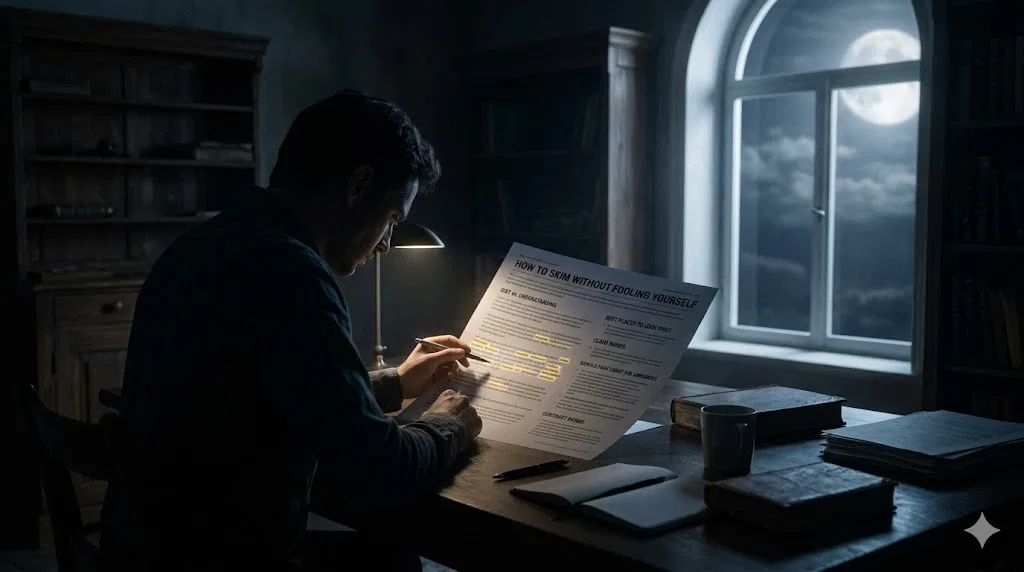
Skimming is valuable when the goal is gist, selection, or orientation, but it should not be mistaken for full comprehension.
On this page
- Best places to look first
- Signals that carry the argument
- When skimming is enough
Page outline Jump by section
Introduction
Skimming is not a trick for reading everything at full depth in less time. It is a way to move quickly through a text when the goal is limited: to get the gist, decide whether something deserves closer reading, find the shape of an argument, or orient yourself before study. Used honestly, skimming increases useful reading speed because it stops you giving equal attention to material that does not need it. Used dishonestly, it becomes a way of mistaking familiarity with understanding.
The research warning is clear: faster reading normally trades off against comprehension. A major review of speed-reading evidence found that skimming can be useful when thorough understanding is not the goal, but that very large speed gains come with reduced accuracy and understanding.[PubMed]pubmed.ncbi.nlm.nih.govPub Med How Do We Read, and Can Speed Reading Help?by K Rayner · 2016 · Cited by 536 — The research shows that there is a trade-off between speed and accuracy. It is unlikely that re… The honest version of skimming therefore starts with a purpose, looks in high-yield places first, and ends with a check: “What do I actually know now, and what still needs proper reading?”


Best places to look first
Good skimming is selective, not random. The first pass should use the parts of a text that were designed to carry structure: titles, headings, introductions, conclusions, summaries, topic sentences, captions, tables, figures, highlighted terms, and signposting phrases. University learning guides commonly describe skimming as a strategic method for extracting main ideas rather than details, with attention to introductions, summaries, first and last sentences, bold terms, and other text features.[The Learning Center]learningcenter.unc.eduThe Learning Center SkimmingThe Learning CenterSkimming - The Learning CenterSkimming is a strategic, selective reading method in which you focus on the main ideas o…
A useful order is:
- Title and subtitle: Ask what the text claims to be about, and what kind of text it is: explanation, argument, report, review, instruction, narrative, or warning.
-
Headings and subheadings: Build a rough map before reading sentence by sentence. In academic texts, headings can reveal method, evidence, results, limitations, and discussion, though their conventions vary by discipline. arXiv
- Introduction and conclusion: These often state the problem, position, scope, and final claim. In many articles, the conclusion is the quickest way to test whether the text is relevant.
- Topic sentences: The first sentence of a paragraph often announces the point; the final sentence may state the consequence, contrast, or transition.
- Figures, tables, captions, and examples: These show what the author treats as concrete evidence rather than decorative prose.
- Definitions, numbers, names, dates, and repeated terms: These are anchors. They help distinguish a vague impression from a usable summary.
This sequence matters because it gives skimming a job: build a mental outline before deciding where to slow down. It also prevents a common failure mode: reading the first page quickly, losing the argument, and still claiming to have “read” the piece.
Signals that carry the argument
An honest skim pays special attention to the parts of a text that reveal how the argument moves. The most useful signals are not always the loudest or most visually prominent. A hyperlink, bold term, or highlighted box may attract the eye, but that does not automatically make it central. A 2022 eye-tracking study on web reading found that hyperlinks can affect perceived sentence importance and reading behaviour, reinforcing the need to notice when design features are steering attention rather than simply revealing meaning. PMC
Look for argument signals such as:
- Claim words: “therefore”, “suggests”, “shows”, “argues”, “means”, “indicates”.
- Contrast words: “however”, “although”, “despite”, “on the other hand”.
- Scope words: “usually”, “in this case”, “among adults”, “in laboratory studies”, “for short texts”.
- Evidence markers: “data”, “trial”, “survey”, “review”, “case study”, “meta-analysis”.
- Limitation markers: “small sample”, “uncertain”, “not measured”, “correlational”, “preliminary”.
- Action markers: “should”, “must”, “avoid”, “recommended”, “not suitable”.
These words are useful because they show the difference between a topic and a claim. A paragraph about reading on screens, for example, might not simply say “screens are bad”. It might say that some forms of screen reading encourage shallow scanning, while narrative comprehension findings are more mixed. Reviews of digital versus paper reading show that the medium question is not settled by one slogan; effects vary by text type, reader, task, and study design. PMC Honest skimming protects that nuance by noticing qualifiers rather than stripping them away.
Name the job before you skim
The most important skimming strategy is to decide what success looks like before starting. “I need to understand this” is too vague. Better goals are narrower:
- Gist: “What is the central point?”
- Selection: “Is this worth reading fully?”
- Orientation: “How is this organised?”
- Evidence check: “What kind of support does the author use?”
- Exam review: “Which parts do I not yet know?”
- Problem solving: “Where is the answer to my question likely to be?”
This purpose-setting is not just a productivity preference. Reading strategies work best when readers apply them deliberately rather than mechanically. The National Reading Panel’s work on reading instruction emphasised that skilled reading involves conscious comprehension strategies, not only speed or word recognition. Reading Rockets Previewing guides likewise describe skimming as a way to activate prior knowledge, set a purpose, and prepare for more detailed reading where needed. Humanities LibreTexts
A practical rule is to write a one-line target before beginning: “After five minutes, I want to know the author’s main claim and whether the source is relevant.” That sentence keeps the skim honest. It stops the reader silently upgrading a limited reconnaissance pass into a claim of full comprehension.
The three-pass skim
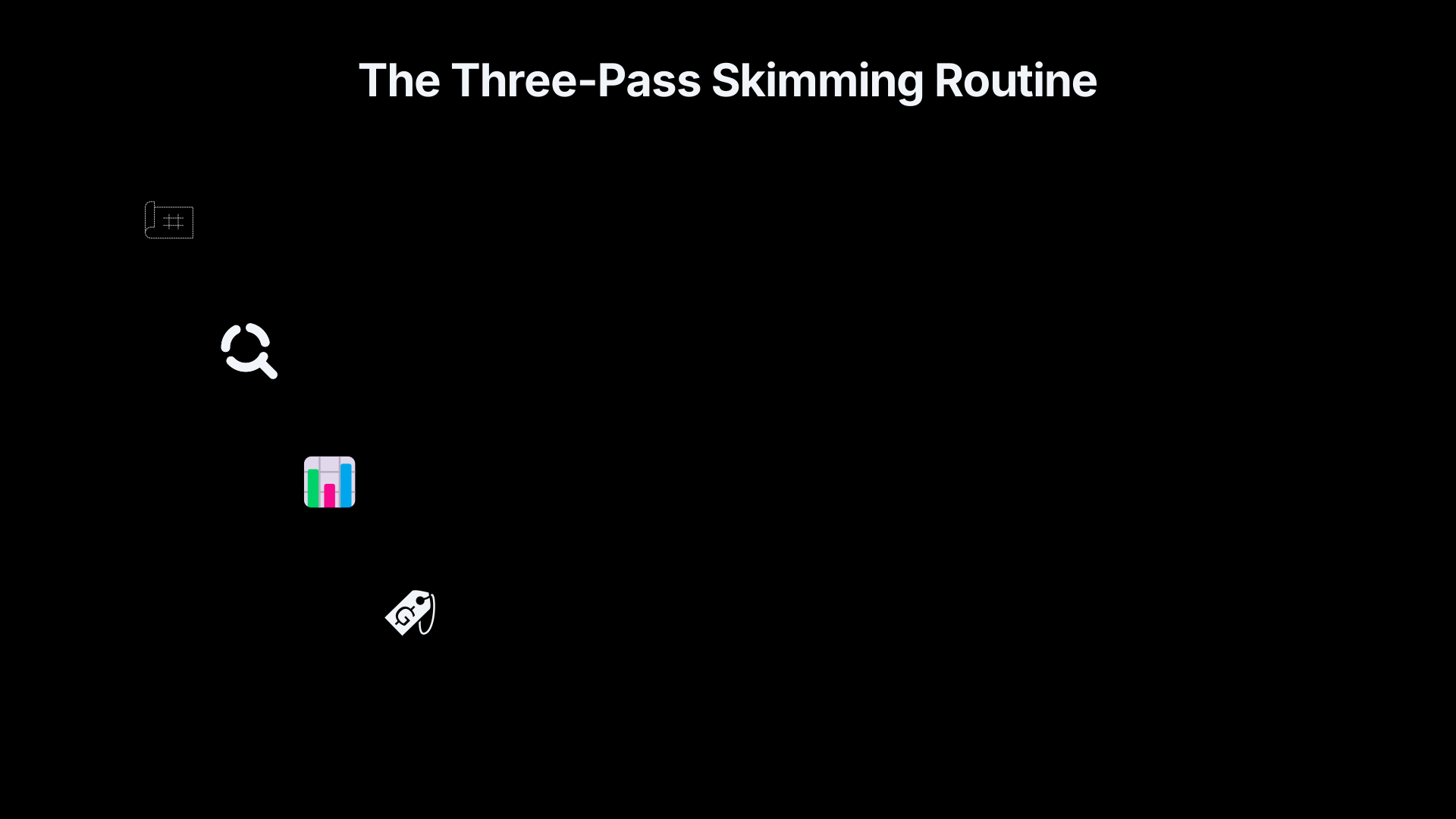
For most non-fiction, a three-pass skim is more reliable than one fast sweep.
First pass: map the structure. Read the title, subtitle, headings, opening paragraph, conclusion, and any summary boxes. The aim is not to collect details but to know what kind of terrain you are in.
Second pass: sample the argument. Read the first sentence of each major paragraph or section, then slow down where the text changes direction: contrast, evidence, definition, exception, or conclusion. This is where you begin to see what the author is actually doing.
Third pass: inspect the evidence. Look at the examples, data, tables, citations, and limitations. Ask whether the text supports its main claim with evidence, authority, anecdote, interpretation, or assertion.
This approach is especially useful for academic articles, policy reports, long essays, and technical material. It is also compatible with the design principle behind research tools built to support paper skimming: the strongest skimming aids try to surface important content from across the whole document rather than merely highlighting the opening paragraphs. One paper on intelligent skimming support for scientific papers argues that good skimming support should highlight content that is important, diverse, and evenly distributed across the text. arXiv
When skimming is enough
Skimming is enough when the decision you need to make does not require detailed comprehension. It is a good fit when you are sorting sources, choosing what to read next, reviewing familiar material, checking whether a document contains relevant sections, or getting a first orientation before slower reading. Learning support guides often recommend skimming for non-fiction, time-limited review, and locating material that deserves closer attention. University of Tennessee at Chattanooga
Skimming is also enough when the cost of being wrong is low. For example, it is reasonable to skim a newsletter to decide which article to open, skim a textbook chapter before class to see the structure, or skim a report to identify the pages that need careful reading later. In these cases, skimming is not pretending to replace reading; it is triage.
It is not enough when the task requires precision, memory, judgement, or responsibility. Do not rely on skimming alone for contracts, medical instructions, exam answers, safety procedures, legal obligations, unfamiliar technical work, or any text where small qualifiers change the meaning. Recent eye-tracking work on medical students found that skim-reading clinical information produced shorter reading times but poorer comprehension than careful reading for comprehension. PMC That is exactly the boundary: skimming may orient you, but it should not be treated as a substitute for careful reading where the consequences matter.
How to check what you actually learned
The final step of honest skimming is a brief retrieval check. Close the document or look away and answer three questions:
1.
Source: What is the main claim or purpose?
2.
Source: What are the two or three main supporting points?
3.
Source: What would I need to read closely before relying on this?
If those answers are vague, the skim did not produce usable understanding. That does not mean it failed; it may have succeeded in showing that the text needs slower reading. The danger is not partial understanding. The danger is unlabelled partial understanding.
A good skim should leave behind one of three outcomes: “not relevant”, “relevant but needs close reading”, or “enough for my limited purpose”. This is much more honest than simply marking something as “read”. It also fits the broader evidence on reading speed: genuine fluency includes accuracy and comprehension, not speed alone. NICHD
Common ways skimming fools readers
Skimming goes wrong when the reader confuses recognition with understanding. Seeing familiar words can create a feeling of mastery, especially when a topic is already partly known. But recognising terms is not the same as following the author’s claim, evidence, qualification, and conclusion.
The most common traps are:
- The headline trap: assuming the title captures the whole argument.
- The first-page trap: reading the opening quickly and missing later qualifications.
- The highlight trap: following bold text, hyperlinks, pull quotes, or search snippets instead of the argument.
- The agreement trap: skimming faster when the text seems to confirm what you already believe.
- The vocabulary trap: mistaking familiar technical terms for actual comprehension.
- The completion trap: recording a skimmed document as if it had been read carefully.
These traps matter because skimming often feels more successful than it is. The reader has touched the text, gathered some cues, and formed an impression. Without a check, that impression can harden into a false memory of understanding. The speed-reading literature’s central caution applies here: as reading becomes more like skimming, comprehension accuracy tends to fall. PubMed
A practical honest-skimming routine
For a five-to-ten-minute skim of a chapter, report, article, or long webpage, use this routine:
- State the purpose: “I am skimming to decide relevance”, or “I am skimming for the main argument.”
- Map the structure: title, headings, introduction, conclusion, figures, summaries.
- Sample the argument: first and last sentences of key paragraphs, especially around contrast and evidence.
- Inspect proof points: data, examples, references, limitations, definitions.
- Mark uncertainty: note sections that would need close reading before quoting, applying, or trusting the claim.
- Summarise from memory: write two or three sentences without looking.
- Label the result: “gist only”, “needs full reading”, or “sufficient for selection”.
This routine keeps skimming inside its proper role in increasing reading speed. It saves time not by pretending that every text can be consumed faster, but by matching attention to purpose. The reader moves quickly when only orientation is needed, slows down when the argument or evidence matters, and remains clear about the difference.
Amazon book picks
Further Reading
Books and field guides related to How to Skim Without Fooling Yourself. Use these as the next step if you want deeper reading beyond the article.
How to Read a Book
Rating: 4.0/5 from 41 Google Books ratings
Contains one of the best-known frameworks for skimming without sacrificing understanding.
Thinking, Fast and Slow
Explains cognitive shortcuts that can create false confidence after skimming.

The Only Skill that Matters
Discusses reading, learning, memory, and extracting value efficiently.
eBay marketplace picks
Marketplace Samples
Example marketplace items related to this page. Use the search link to explore similar finds on eBay.


Endnotes
3.
Source: pmc.ncbi.nlm.nih.gov
Link:https://pmc.ncbi.nlm.nih.gov/articles/PMC10606230/
4.
Source: nichd.nih.gov
Title: NICHDNational Reading Panel
Link:https://www.nichd.nih.gov/sites/default/files/publications/pubs/nrp/Documents/ch3.pdf
5.
Source: human.libretexts.org
Title: Humanities Libre Texts3.3: Reading Strategies
Link:https://human.libretexts.org/Courses/City_College_of_San_Francisco/Writing_Reading_and_College_Success%3A_A_First-Year_Composition_Course_for_All_Learners_%28Kashyap_and_Dyquisto%29/03%3A_The_Reading-Writing_Connection/3.03%3A_Reading_Strategies_-_Previewing
6.
Source: arxiv.org
Title: arXiv Scim: Intelligent Skimming Support for Scientific Papers
Link:https://arxiv.org/abs/2205.04561
7.
Source: pmc.ncbi.nlm.nih.gov
Link:https://pmc.ncbi.nlm.nih.gov/articles/PMC12801452/
8.
Source: medium.com
Link:https://medium.com/change-your-mind/stop-skimming-start-thinking-the-lost-art-of-deep-reading-501a3c381a33
9.
Source: human.libretexts.org
Title: 3.02: Reading Skills Skimming Scanning and Careful Reading
Link:https://human.libretexts.org/Bookshelves/Composition/Introductory_Composition/College_Skills%3A_Intermediate_English_%28Canadian%29/03%3A_Work/3.02%3A_Reading_Skills-_Skimming_Scanning_and_Careful_Reading
10.
Source: pubmed.ncbi.nlm.nih.gov
Title: Pub Med How Do We Read, and Can Speed Reading Help?
Link:https://pubmed.ncbi.nlm.nih.gov/26769745/
Source snippet
by K Rayner · 2016 · Cited by 536 — The research shows that there is a trade-off between speed and accuracy. It is unlikely that re...
11.
Source: learningcenter.unc.edu
Title: The Learning Center Skimming
Link:https://learningcenter.unc.edu/tips-and-tools/skimming/
Source snippet
The Learning CenterSkimming - The Learning CenterSkimming is a strategic, selective reading method in which you focus on the main ideas o...
12.
Source: uniskills.library.curtin.edu.au
Title: Uni Skills Reading strategies
Link:https://uniskills.library.curtin.edu.au/academic-writing/reading-and-note-taking/reading-strategies
Source snippet
It's a technique used in speed reading that requires the...Read more...
13.
Source: readingrockets.org
Link:https://www.readingrockets.org/topics/curriculum-and-instruction/articles/findings-national-reading-panel
14.
Source: utc.edu
Link:https://www.utc.edu/enrollment-management-and-student-affairs/center-for-academic-support-and-advisement/tips-for-academic-success/skimming
15.
Source: www1.nichd.nih.gov
Link:https://www1.nichd.nih.gov/publications/pubs/nrp/Documents/report.pdf
16.
Source: dictionary.cambridge.org
Link:https://dictionary.cambridge.org/dictionary/english/honest
17.
Source: nnkt.ueh.edu.vn
Link:https://nnkt.ueh.edu.vn/wp-content/uploads/2015/12/13-2015.pdf
18.
Source: find-and-update.company-information.service.gov.uk
Title: company-information.service.gov.ukhonest mobile limited
Link:https://find-and-update.company-information.service.gov.uk/company/11466899
19.
Source: yorku.ca
Title: Reading Strategies
Link:https://www.yorku.ca/scld/learning-skills/reading-and-notes/reading/
Additional References
20.
Source: journals.sagepub.com
Title: Where does speed
Link:https://journals.sagepub.com/doi/10.1177/1529100615623267
Source snippet
Sage JournalsSo Much to Read, So Little Time - Keith Rayner, Elizabeth...by K Rayner · 2016 · Cited by 537 — Comprehension rates, howeve...
21.
Source: youtube.com
Title: IELTS Reading Tips: How to Skim Read Smarter and Faster!
Link:https://www.youtube.com/watch?v=VoNCuex3l2s
Source snippet
The BEST Skimming Techniques for the OET Reading Test...
22.
Source: journals.plos.org
Link:https://journals.plos.org/plosone/article?id=10.1371%2Fjournal.pone.0263669
Source snippet
The impact of hyperlinks, skim reading and perceived...by LT Jayes · 2022 · Cited by 16 — Across two experiments, we examine how hyp...
23.
Source: researchgate.net
Link:https://www.researchgate.net/publication/381339621_The_Effectiveness_of_Using_Skimming_and_Scanning_Techniques_in_Improving_Reading_Comprehension_A_Systematic_Literature_Review
24.
Source: researchgate.net
Link:https://www.researchgate.net/publication/337256453_THE_ANALYSIS_OF_SKIMMING_AND_SCANNING_TECHNIQUE_TO_IMPROVE_STUDENTS_IN_TEACHING_READING_COMPREHENSION
25.
Source: researchgate.net
Link:https://www.researchgate.net/publication/358389476_The_impact_of_hyperlinks_skim_reading_and_perceived_importance_when_reading_on_the_Web
26.
Source: researchgate.net
Link:https://www.researchgate.net/publication/394623215_The_Impact_of_Skimming_and_Scanning_Technique_Toward_Students%27_Reading_Comprehension_Meta-analysis
27.
Source: researchgate.net
Link:https://www.researchgate.net/publication/395119024_The_effectiveness_of_skimming_and_scanning_strategies_in_improving_reading_comprehension_among_EFL_learners
28.
Source: researchgate.net
Link:https://www.researchgate.net/publication/398535596_Reading_and_skimming_clinical_information_insights_from_experiments_examining_medical_students%27_eye_movement_behaviour
29.
Source: researchgate.net
Link:https://www.researchgate.net/publication/249134643_A_Review_of_the_National_Reading_Panel%27s_Studies_on_Fluency_The_Role_of_Text
Topic Tree
Follow this branch
Parent topic
Faster ReadingRelated pages 11
- Benchmarks How Fast Do Adults Really Read?
- Dense Texts Why Hard Texts Need Slower Reading
- Inner Voice Should You Silence Your Inner Voice?
- Knowledge Why Familiar Topics Feel Faster to Read
- Measure The Reading Speed Test That Actually Helps
- Myths Why Speed Reading Promises Fall Apart
- Phrases Read Phrases, Not Just Words
- Practice Can Rereading Make You Faster?
- +3 more in sidebar