Within Rereading
Are Backward Eye Movements Actually Bad?
Backward eye movements are a normal part of skilled reading, especially when sentences are ambiguous or demanding.
On this page
- How common regressions are in ordinary reading
- Why ambiguity and contradictions trigger looking back
- What skilled readers do differently from rigid speed readers
Page outline Jump by section
Introduction
Many people trying to increase reading speed assume that skilled readers move their eyes steadily forward and that any backward movement signals a problem. Eye-tracking research shows the opposite. Normal reading includes regular backward eye movements, known as regressions, even among highly skilled readers. These regressions become especially common when text is difficult, ambiguous, contradictory, or information-rich. Rather than being evidence of poor reading, they are often part of the brain’s process for repairing and refining understanding. The key distinction is not between readers who regress and readers who never do, but between readers who use regressions strategically and readers who become trapped in unnecessary rereading.[Cambridge Assets]assets.cambridge.orgCambridge AssetsChapter 1 Introduction to Eye-TrackingAbout 10–15 per cent of the time, readers move their eyes back (regress) to previou…

Are Backward Eye Movements Actually Bad?
The short answer is no. Reading is not a perfectly linear process. Eye-tracking studies consistently show that readers make backward eye movements as part of ordinary comprehension. Estimates commonly place regressions at roughly 10–15% of all eye movements during normal reading. These movements occur across different ages, reading abilities, and text types.[Cambridge Assets]assets.cambridge.orgCambridge AssetsChapter 1 Introduction to Eye-TrackingAbout 10–15 per cent of the time, readers move their eyes back (regress) to previou…
Researchers distinguish between at least two broad forms of regression. Some are small corrective movements caused by eye-movement control itself, such as slightly overshooting a target word. Others are larger comprehension-related movements that return to earlier text so the reader can reinterpret, verify, or integrate information. The latter are particularly important when a sentence becomes harder than initially expected.[MDPI]mdpi.comRegressions during Readingby AW Inhoff · 2019 · Cited by 74 — Readers occasionally move their eyes to prior text. We distinguish two…
The implication for reading speed is important: eliminating every regression is neither realistic nor desirable. Efficient reading requires enough flexibility to revisit information when understanding genuinely depends on it.[MDPI]mdpi.comRegressions during Readingby AW Inhoff · 2019 · Cited by 74 — Readers occasionally move their eyes to prior text. We distinguish two…
How Common Regressions Are in Ordinary Reading
Eye-tracking records reveal that the visual path through a sentence is rarely a straight line. Readers pause, skip words, refixate difficult terms, and occasionally move backwards. These patterns are so consistent that regressions are considered a normal feature of reading rather than an exception.[Cambridge Assets]assets.cambridge.orgCambridge AssetsChapter 1 Introduction to Eye-TrackingAbout 10–15 per cent of the time, readers move their eyes back (regress) to previou…
The frequency of regressions changes with text difficulty. When vocabulary becomes less familiar, sentence structure becomes more complex, or information must be integrated across longer stretches of text, readers spend more time on words and are more likely to look back. Experimental studies manipulating word difficulty show that difficult words receive longer fixations and more rereading than easier words.[PMC]pmc.ncbi.nlm.nih.govPMCWord difficulty determines the accuracy of regressiveby A Friede · 2026 · Cited by 1 — The manipulation of word difficulty leads to distinctive differences in word processing, as demonstr…
Importantly, more regressions do not automatically mean worse reading. In many situations they indicate active comprehension work. A reader who notices a potential misunderstanding and briefly checks earlier text may ultimately comprehend better than a reader who continues forward despite confusion.[PubMed]pubmed.ncbi.nlm.nih.govThe function of these "regressions" is still largely unknownThe function of regressions in reading: backward eye…by RW Booth · 2013 · Cited by 134 — Standard text reading involves frequent…
Why Ambiguity and Contradictions Trigger Looking Back
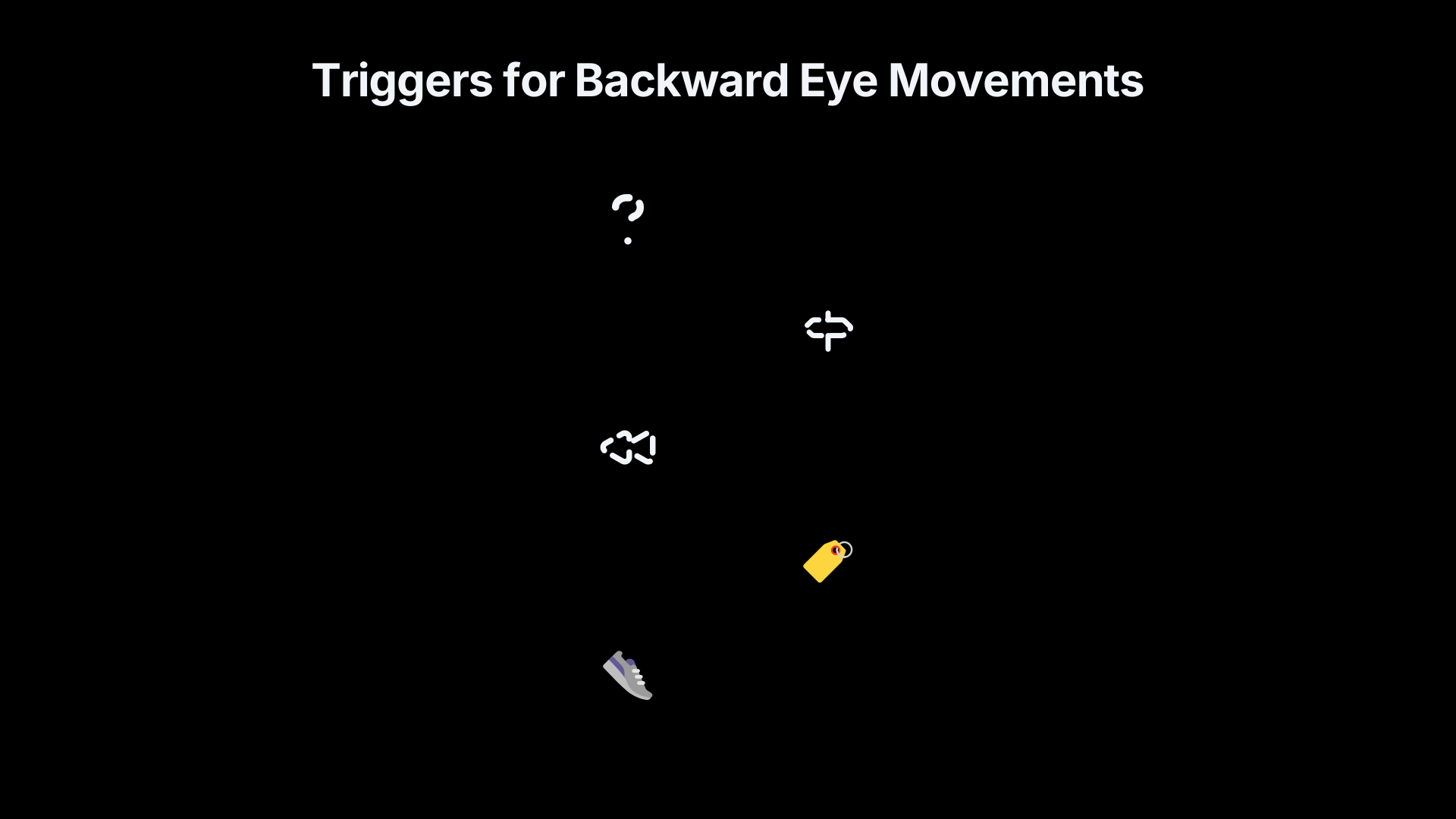
One of the strongest triggers for regressions is ambiguity. Readers often construct an initial interpretation of a sentence before reaching its end. When later words reveal that this interpretation was incomplete or wrong, the eyes frequently move backwards to repair understanding.[PLOS]journals.plos.orgChildren's and Adults' On-Line Processing of Syntactically…by HSSL Joseph · 2013 · Cited by 61 — Frazier L, Rayner K (1982) Making…
Consider a sentence that temporarily suggests one meaning before revealing another. Psycholinguistic research has repeatedly shown that readers slow down and make regressions when they encounter these “garden-path” structures, where the mind initially follows a misleading interpretation. The backward movement helps reconstruct the sentence using the new information.[PLOS]journals.plos.orgChildren's and Adults' On-Line Processing of Syntactically…by HSSL Joseph · 2013 · Cited by 61 — Frazier L, Rayner K (1982) Making…
Contradictions create a similar effect. If a new statement appears inconsistent with something read earlier, readers often return to the earlier passage to verify details and reconcile the conflict. This is not wasted motion. It reflects the effort required to build a coherent mental model of the text. Studies linking eye movements with comprehension suggest that these integration processes are visible in regression behaviour.[Educational Data Mining]educationaldatamining.org2022.EDM long papers.13Educational Data MiningGoing Deep and Far: Gaze-based Models Predict Multiple…by M Caruso · 2022 · Cited by 15 — This shows that eye m…
Even apparently simple tasks such as resolving pronoun references can trigger backward glances. When a sentence contains multiple possible referents, readers may revisit an earlier noun phrase to confirm who or what is being discussed. These checks are a consequence of understanding language, not a sign that reading has broken down.[EyeLogic]eyelogicsolutions.comEye Logic BlogEyeLogicBlog - How Eye Tracking is Transforming Reading Research13 May 2025 — Eye tracking offers a way to observe how readers interpret…
What Skilled Readers Do Differently from Rigid Speed Readers
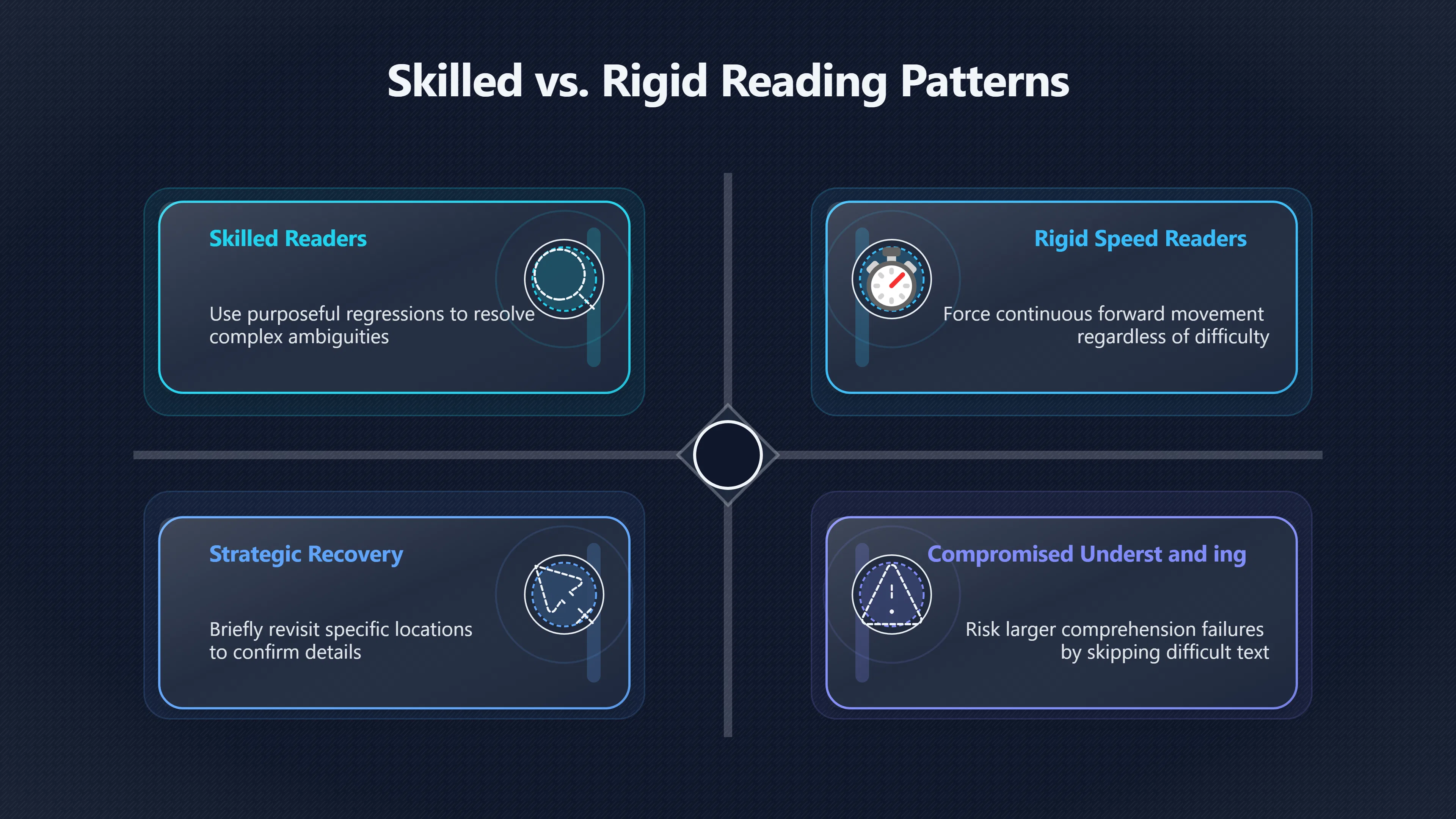
A common misconception is that expert readers suppress regressions entirely. Eye-tracking evidence does not support this view. Skilled readers still look back, but they tend to do so selectively and purposefully.[MDPI]mdpi.comRegressions during Readingby AW Inhoff · 2019 · Cited by 74 — Readers occasionally move their eyes to prior text. We distinguish two…
Several patterns distinguish efficient readers:
- They allow regressions when comprehension genuinely requires them.
- They are more likely to revisit a specific location rather than restart large sections.
- They often recover understanding quickly and continue forward.
- They avoid repeatedly rereading text that is already understood.[MDPI]mdpi.comRegressions during Readingby AW Inhoff · 2019 · Cited by 74 — Readers occasionally move their eyes to prior text. We distinguish two…
By contrast, rigid speed-reading approaches sometimes encourage readers to force continuous forward movement regardless of comprehension difficulty. This can reduce the immediate time spent on a page, but it may also increase misunderstanding when the text contains ambiguity, technical information, or complex reasoning. A reader who never permits a brief regression may end up spending more time later correcting a larger comprehension failure.[PubMed]pubmed.ncbi.nlm.nih.govThe function of these "regressions" is still largely unknownThe function of regressions in reading: backward eye…by RW Booth · 2013 · Cited by 134 — Standard text reading involves frequent…
Research on reading strategies also suggests that eye-movement patterns reflect different approaches to processing information. Some readers adopt a riskier style, moving quickly and relying heavily on prediction, which can lead to more later regressions when predictions fail. Others proceed more cautiously. Neither style eliminates backward movements altogether.[PMC]pmc.ncbi.nlm.nih.govPMCCan We 'Read' the Eye-Movement Patterns of Readersby A Koornneef · 2016 · Cited by 30 — Novel evidence for the general idea that the eye-movement profile of readers reveals valuable in…

What This Means for Faster Reading
For readers seeking greater speed, the practical lesson is not to fight every backward glance. A small number of targeted regressions is part of normal skilled reading, especially when texts become challenging. Attempting to suppress them completely can interfere with comprehension and may create additional work later.[Cambridge Assets]assets.cambridge.orgCambridge AssetsChapter 1 Introduction to Eye-TrackingAbout 10–15 per cent of the time, readers move their eyes back (regress) to previou…
A more productive goal is to reduce unnecessary regressions while accepting necessary ones. When a regression answers a specific question—resolving an ambiguity, checking a reference, or reconciling a contradiction—it is functioning as a comprehension tool. When it occurs repeatedly without adding new understanding, it is more likely to be a habit.
The fastest effective readers are not those who never look back. They are those who know when a brief glance backwards will save far more time than pushing forwards in confusion.[PubMed]pubmed.ncbi.nlm.nih.govThe function of these "regressions" is still largely unknownThe function of regressions in reading: backward eye…by RW Booth · 2013 · Cited by 134 — Standard text reading involves frequent…
Amazon book picks
Further Reading
Books and field guides related to Are Backward Eye Movements Actually Bad?. Use these as the next step if you want deeper reading beyond the article.
How to Read a Book
Rating: 4.0/5 from 41 Google Books ratings
Provides practical guidance on strategic rereading.

eBay marketplace picks
Marketplace Samples
Example marketplace items related to this page. Use the search link to explore similar finds on eBay.




Endnotes
1.
Source: assets.cambridge.org
Link:https://assets.cambridge.org/97811084/15354/excerpt/9781108415354_excerpt.pdf
Source snippet
Cambridge AssetsChapter 1 Introduction to Eye-TrackingAbout 10–15 per cent of the time, readers move their eyes back (regress) to previou...
2.
Source: mdpi.com
Link:https://www.mdpi.com/2411-5150/3/3/35
Source snippet
Regressions during Readingby AW Inhoff · 2019 · Cited by 74 — Readers occasionally move their eyes to prior text. We distinguish two...
3.
Source: pmc.ncbi.nlm.nih.gov
Title: PMCWord difficulty determines the accuracy of regressive
Link:https://pmc.ncbi.nlm.nih.gov/articles/PMC12769648/
Source snippet
by A Friede · 2026 · Cited by 1 — The manipulation of word difficulty leads to distinctive differences in word processing, as demonstr...
4.
Source: journals.plos.org
Link:https://journals.plos.org/plosone/article?id=10.1371%2Fjournal.pone.0054141
Source snippet
Children's and Adults' On-Line Processing of Syntactically...by HSSL Joseph · 2013 · Cited by 61 — Frazier L, Rayner K (1982) Making...
5.
Source: pmc.ncbi.nlm.nih.gov
Title: PMCCan We ‘Read’ the Eye-Movement Patterns of Readers
Link:https://pmc.ncbi.nlm.nih.gov/articles/PMC5290069/
Source snippet
by A Koornneef · 2016 · Cited by 30 — Novel evidence for the general idea that the eye-movement profile of readers reveals valuable in...
6.
Source: pubmed.ncbi.nlm.nih.gov
Title: The function of these “regressions” is still largely unknown
Link:https://pubmed.ncbi.nlm.nih.gov/22886737/
Source snippet
The function of regressions in reading: backward eye...by RW Booth · 2013 · Cited by 134 — Standard text reading involves frequent...
7.
Source: educationaldatamining.org
Title: 2022.EDM long papers.13
Link:https://educationaldatamining.org/edm2022/proceedings/2022.EDM-long-papers.13/
Source snippet
Educational Data MiningGoing Deep and Far: Gaze-based [Models]({{ 'models/' | relative_url }}) Predict Multiple...by M Caruso · 2022 · Cited by 15 — This shows that eye m...
8.
Source: eyelogicsolutions.com
Title: Eye Logic Blog
Link:https://www.eyelogicsolutions.com/blog-how-eye-tracking-is-transforming-reading-research/
Source snippet
EyeLogicBlog - How Eye Tracking is Transforming Reading Research13 May 2025 — Eye tracking offers a way to observe how readers interpret...
Published: May 2025
9.
Source: pmc.ncbi.nlm.nih.gov
Link:https://pmc.ncbi.nlm.nih.gov/articles/PMC12409514/
Source snippet
the rereading effect of digital reading through eye...by Y Xu · 2025 — This study aimed to investigate the differences in eye movement c...
Additional References
10.
Source: readlite.in
Link:https://readlite.in/concepts/regressions-reading
Source snippet
These regressions aren't mistakes — they're essential comprehension repairs that skilled...Read more...
11.
Source: centaur.reading.ac.uk
Title: Cent AURIs children’s reading “good enough”?
Link:https://centaur.reading.ac.uk/43398/3/Preprint_Jan2015.pdf
Source snippet
Links between online...by E Wonnacott · 2016 · Cited by 41 — In this paper we begin to explore this link by recording children's eye mov...
12.
Source: researchgate.net
Title: 334364752 Regressions during Reading
Link:https://www.researchgate.net/publication/334364752_Regressions_during_Reading
Source snippet
(PDF) Regressions during Reading29 Oct 2025 — Readers occasionally move their eyes to prior text. We distinguish two types of these movem...
13.
Source: d-nb.info
Link:https://d-nb.info/1227301006/34
Source snippet
Comprehension demands modulate re-reading, but not first...by AF Weiss · Cited by 58 — Abstract: Several studies have examined effec...
14.
Source: researchgate.net
Link:https://www.researchgate.net/publication/230658181_The_function_of_regressions_in_reading_Backward_eye_movements_allow_rereading
Source snippet
ue their memory for previously read words.Read more...
15.
Source: tandfonline.com
Link:https://www.tandfonline.com/doi/abs/10.1080/02687038.2024.2326407
Source snippet
A preliminary examination of regressive eye movements to...by A Bevelhimer · 2024 · Cited by 1 — Eye-tracking technology provides a mech...
16.
Source: cognitivetrain.com
Link:https://cognitivetrain.com/regression-in-reading/
Source snippet
Regression in Reading: Why Your Eyes Keep Going...Eye-tracking research shows that regressions account for 10-15% of all eye movements d...
17.
Source: youtube.com
Title: What Can Our Eyes Tell Us About Language? Eye Tracking
Link:https://www.youtube.com/watch?v=uXx73W0uyCg
Source snippet
Milliseconds Matter: Understanding How We Read with Eye-Tracking Research...
18.
Source: link.springer.com
Link:https://link.springer.com/article/10.3758/s13423
Source snippet
Regressions during reading: The cost depends on the causeby MA Eskenazi · 2017 · Cited by 31 — The [purpose]({{ 'purpose/' | relative_url }}) of the current study w...
19.
Source: papers.ssrn.com
Link:https://papers.ssrn.com/sol3/papers.cfm?abstract_id=5405257
Source snippet
Eye Movements in Reading Go from Easy to...by AT Lopes Rego — One prevailing hypothesis is that regressions reflect comprehension proces...
Topic Tree