Within Three passes
Does This Document Really Need a Third Pass?
Not every report or article needs deep analysis, and knowing when to stop can save substantial reading time.
On this page
- Signals that a deeper read is justified
- When the first two passes are enough
- Balancing importance against time cost
Page outline Jump by section
Introduction
A third pass is where reading stops being reconnaissance and becomes investigation. In a three-pass approach to nonfiction, the first pass maps the document and the second follows the argument. The third pass is reserved for documents that genuinely matter. The speed advantage comes not from reading every document faster, but from avoiding deep analysis when it is unnecessary.
 Many readers assume that every report, article, white paper, or academic paper deserves close scrutiny. In practice, the opposite is true. The original three-pass method was designed so that readers could decide early whether a text justified deeper effort. After the first and second passes, you should have enough information to judge relevance, credibility, and potential value before investing substantial time in detailed reading.[CCR+2경민수의 블로그]ccr.sigcomm.org2. THE THREE-PASS APPROACH. The key idea is that you should read the…Read more…
Signals That a Deeper Read Is Justified
The strongest reason for a third pass is simple: the document will influence a decision, belief, recommendation, or piece of work.
A third pass is usually warranted when one or more of the following conditions apply:
- The document is directly relevant to an important task. If you are writing a report, making a policy recommendation, planning a project, or preparing for an examination, surface-level understanding may not be sufficient.
- The conclusions affect real decisions. A report that could change spending, strategy, hiring, regulation, or research priorities deserves closer verification.
- The argument appears unusually strong or unusually surprising. Claims that challenge established assumptions should be examined carefully before being accepted.
- The evidence is central rather than incidental. If statistics, methods, sources, or case studies are the reason the document matters, those details require inspection.
- You expect to cite, quote, teach, or defend the material later. Repeating an argument responsibly requires more than understanding its outline.
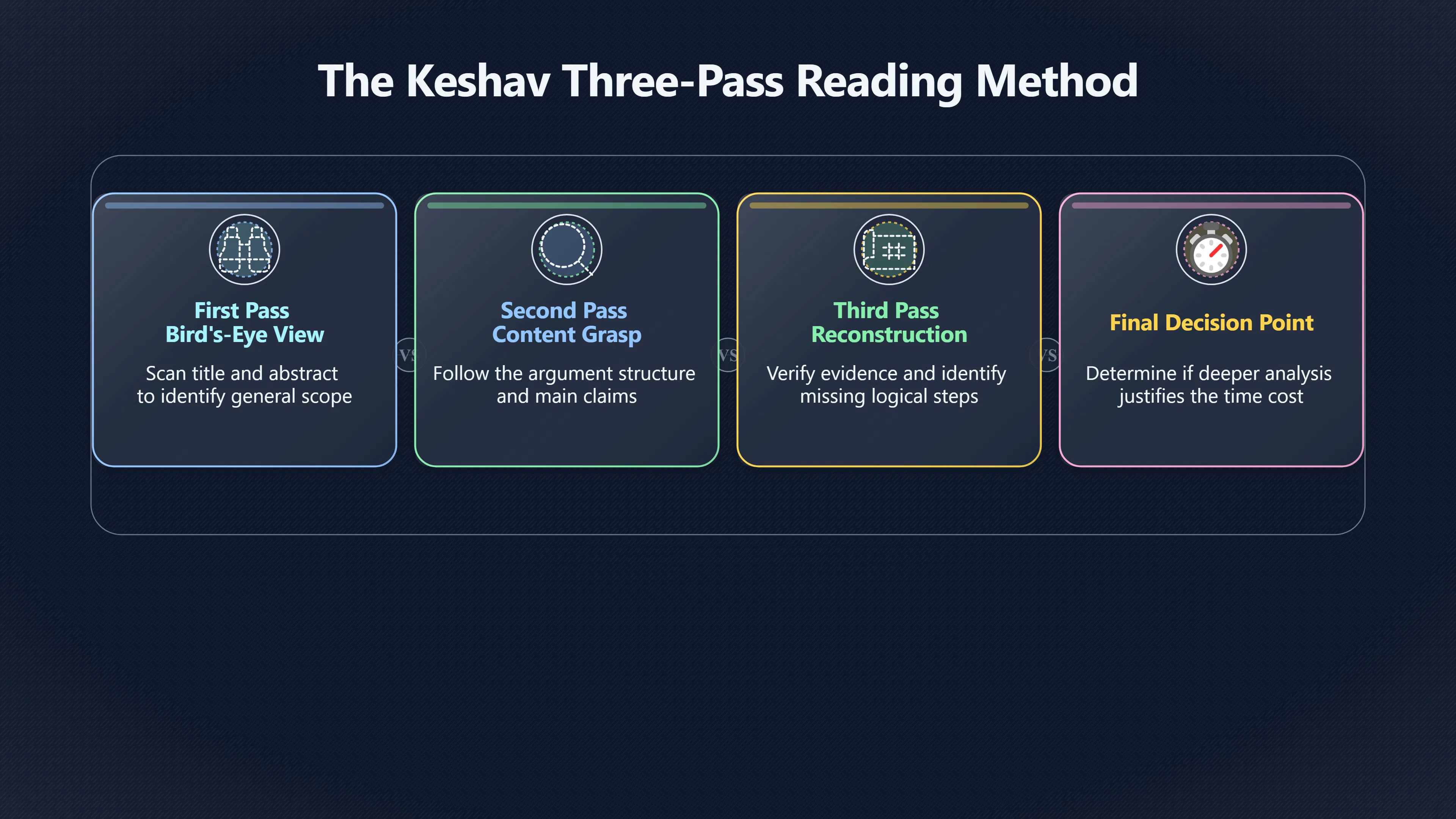
Keshav’s widely cited three-pass framework treats the third pass as a reconstruction exercise: the reader should be able to follow the author’s reasoning in enough detail to identify assumptions, weaknesses, and missing steps. That level of effort is only worthwhile when the document’s importance justifies it.[CCR]ccr.sigcomm.org2. THE THREE-PASS APPROACH. The key idea is that you should read the…Read more…
A Practical Importance Test
Before beginning a third pass, ask three questions:
- Will this document influence a meaningful decision?
- Will I need to rely on its evidence rather than merely know its conclusion?
- Would misunderstanding it have a noticeable cost?
If the answer is “yes” to at least two, a third pass is often justified.
This test works because reading time is limited. The purpose of faster reading is not to maximise pages consumed but to allocate attention where it produces the greatest return.
When the First Two Passes Are Enough
Many documents reveal their value surprisingly early.
After a successful first and second pass, you should usually know:
- What the document is about.
- What claim it makes.
- How the argument is structured.
- Whether it appears relevant to your needs.
If those questions are answered and no major decisions depend on the details, further reading often provides diminishing returns. Several university reading guides describe skimming as a deliberate strategy for identifying which texts deserve concentrated attention and which do not.[Open University Help+2The Learning Center]help.open.ac.ukOpen University HelpUse an efficient approach: Critical reading techniquesScanning and skimming · get an indication of the scope and cont…
Common examples include:
- Industry reports that confirm information you already know.
- News analyses that summarise familiar developments.
- Background articles used only for orientation.
- Academic papers that are adjacent to, but not central to, your project.
- Long reports where only one section is relevant.
In these situations, the second pass may provide all the understanding required. Continuing into a detailed review can create the illusion of productivity while consuming time that could be spent on more valuable material.

Warning Signs That a Third Pass Is Necessary
Sometimes the need for deeper reading becomes apparent because something feels unresolved after the second pass.
Pay attention to these signals:
You cannot explain why the conclusion follows from the evidence.
You understand the claim but not the reasoning that supports it.
Important terms remain unclear.
A conclusion built on undefined concepts is difficult to evaluate accurately.
The document conflicts with other credible sources.
Contradictions often require examination of methods, assumptions, or evidence.
The evidence appears selective.
If examples seem unusually convenient or counterarguments are absent, closer inspection may reveal limitations.
You intend to act on the recommendations.
Implementation decisions require confidence in the underlying analysis, not merely familiarity with the headline findings.
These warning signs indicate that your current understanding may be too shallow for the stakes involved.
Balancing Importance Against Time Cost
The most useful decision rule is not “Is this document interesting?” but “Is this document worth the next hour?”
A simple matrix can help:
ImportanceConsequence of ErrorRecommended ActionLowLowStop after first or second passHighLowSecond pass usually sufficientLowHighVerify key sections selectivelyHighHighComplete a third pass
For example, a 60-page policy report may be highly interesting but have little impact on your current work. In that case, a thorough second pass may be enough. By contrast, a short technical memo that influences a major purchasing or research decision may deserve a full third pass despite its modest length.
Reading experts consistently emphasise that reading strategy should be guided by purpose. Skimming and selective reading are most effective when readers consciously match effort to objectives rather than treating every text the same way.[National Geographic+2Open University Help]nationalgeographic.comreading skimming attentionNational GeographicIs there a 'right' way to read?17 Jan 2025 — According to experts, skimming—where you skip over words and sections to…
A Useful Rule for Faster Readers
One of the most common mistakes in speed-oriented reading is assuming that efficiency means moving through text rapidly. In practice, efficiency often means stopping early.
If a first pass reveals irrelevance, stop. If a second pass provides enough understanding for your purpose, stop. Reserve the third pass for documents whose details matter.
That discipline is what makes the three-pass approach effective. The goal is not to read everything deeply. The goal is to identify the small fraction of documents that truly deserve deep attention and spend your time there.[CCR+2경민수의 블로그]ccr.sigcomm.org2. THE THREE-PASS APPROACH. The key idea is that you should read the…Read more…

Amazon book picks
Further Reading
Books and field guides related to Does This Document Really Need a Third Pass?. Use these as the next step if you want deeper reading beyond the article.
How to Read a Book
Rating: 4.0/5 from 41 Google Books ratings
Directly addresses inspectional versus analytical reading and when deeper reading is justified.
Thinking, Fast and Slow
Encourages slowing down when stakes and evidence warrant deeper scrutiny.

The Art of Statistics
Useful when deciding whether evidence deserves a closer analytical pass.

Critical Thinking
Supports decisions about investing effort in careful reading and analysis.
eBay marketplace picks
Marketplace Samples
Example marketplace items related to this page. Use the search link to explore similar finds on eBay.



Endnotes
1.
Source: ccr.sigcomm.org
Link:https://ccr.sigcomm.org/online/files/p83-keshavA.pdf
Source snippet
2. THE THREE-PASS APPROACH. The key idea is that you should read the...Read more...
2.
Source: help.open.ac.uk
Link:https://help.open.ac.uk/critical-reading-techniques/use-an-efficient-approach
Source snippet
Open University HelpUse an efficient approach: Critical reading techniquesScanning and skimming · get an indication of the scope and cont...
3.
Source: learningcenter.unc.edu
Title: The Learning Center Skimming
Link:https://learningcenter.unc.edu/tips-and-tools/skimming/
Source snippet
The Learning CenterSkimming - The Learning CenterSkimming is a strategic, selective reading method in which you focus on the main ideas o...
4.
Source: nationalgeographic.com
Title: reading skimming attention
Link:https://www.nationalgeographic.com/science/article/reading-skimming-attention
Source snippet
National GeographicIs there a 'right' way to read?17 Jan 2025 — According to experts, skimming—where you skip over words and sections to...
Additional References
5.
Source: medium.com
Link:https://medium.com/data-science/how-to-read-scientific-papers-df3afd454179
Source snippet
How To Read Scientific PapersThe three-pass approach (tl;dr); The first pass: The bird's-eye view; The second pass: Grasp the content; Th...
6.
Source: masterpiecek12.org
Link:https://masterpiecek12.org/stop-skimming-unlock-deeper-lasting-understanding/
7.
Source: teachbritannica.com
Link:https://teachbritannica.com/academic-toolkits/strategies-for-deep-reading/
Source snippet
Strategies for Deep ReadingEngage in active pre-reading by skimming the material and formulating questions before detail-oriented reading...
8.
Source: linkedin.com
Link:https://www.linkedin.com/posts/emmanueltsekleves_phdlife-academictwitter-activity-7422270957064491008-Wb0s
Source snippet
Boost Reading Speed by 70% with the Three-Pass ApproachWrite for Pass 1: • A clear abstract • Informative headings • A strong figure or t...
9.
Source: blog-sc.hku.hk
Title: reading papers efficiently with the three pass approach
Link:https://blog-sc.hku.hk/reading-papers-efficiently-with-the-three-pass-approach/
Source snippet
Keshav noted, the first pass helps readers to get a general idea of a paper. It usually takes five to ten minutes to glance at the title...
10.
Source: utc.edu
Link:https://www.utc.edu/enrollment-management-and-student-affairs/center-for-academic-support-and-advisement/tips-for-academic-success/skimming
Source snippet
University of Tennessee at ChattanoogaSkimming and [Scanning]({{ 'scanning-vs-reading/' | relative_url }}) | University of Tennessee at...With skimming, your overall understanding is...
11.
Source: libguides.exeter.ac.uk
Title: exeter.ac.uk Academic Reading: Reading Strategies
Link:https://libguides.exeter.ac.uk/c.php?g=727783&p=5297946
Source snippet
Reading: Reading Strategies - LibGuides9 Mar 2026 — Without structured approaches such as skimming, scanning, and critical reading, it ca...
12.
Source: dl.acm.org
Link:https://dl.acm.org/doi/10.1145/1273445.1273458
Source snippet
I also describe how to use this method to do a literature survey.Read more...
13.
Source: concordia.ca
Title: reading strategies skimming vs close reading
Link:https://www.concordia.ca/cunews/offices/vprgs/gradproskills/blogs/2022/10/13/reading-strategies-skimming-vs-close-reading.html
Source snippet
Concordia UniversityReading Strategies: Skimming vs Close Reading | News12 Oct 2022 — Contrary to scanning, which requires you to search...
14.
Source: educationendowmentfoundation.org.uk
Link:https://educationendowmentfoundation.org.uk/education-evidence/teaching-learning-toolkit/reading-comprehension-strategies
Source snippet
The strategies focus mainly on language comprehension...Read more...
Topic Tree