Within Self Test
How long should a reading speed test be?
A longer, unfamiliar passage gives a steadier reading-speed result than a one-minute sprint through easy text.
On this page
- Why very short tests can exaggerate speed
- How 800 to 1,500 words improves reliability
- Matching passage difficulty to real reading
Page outline Jump by section
Introduction
If the goal of a reading-speed test is to measure how fast you can read while still understanding the material, the test needs to be long enough to reflect normal reading behaviour. Very short tests often produce inflated words-per-minute (wpm) scores because readers can sustain unusually high concentration for a brief burst, guess unfamiliar words from context, and avoid the mental fatigue that appears during longer reading sessions. A more realistic benchmark comes from using an unfamiliar passage that resembles your everyday reading and is long enough for comprehension demands to emerge naturally.
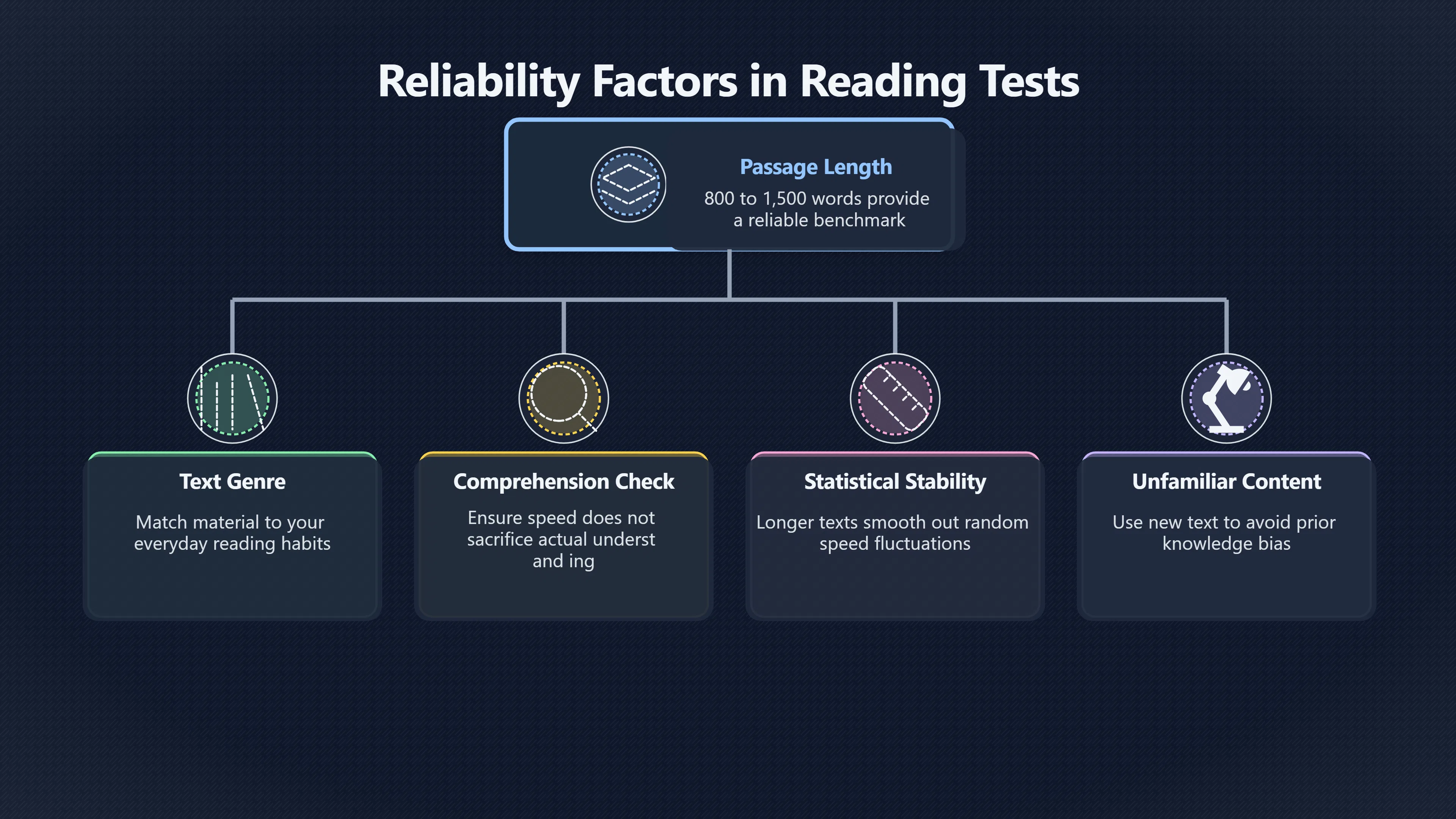
 For most adults, a passage of roughly 800 to 1,500 words provides a practical balance between convenience and reliability. It is long enough to smooth out random fluctuations in speed while remaining short enough to complete in a single sitting with a meaningful comprehension check afterwards. This approach aligns more closely with real-world reading than the one-minute tests commonly found online.[SwiftRead]swiftread.comOpen source on swiftread.com.
Why very short tests can exaggerate speed
A one-minute reading test is easy to administer, which explains its popularity. However, convenience and accuracy are not the same thing.
When a passage is extremely short, the measured speed can be heavily influenced by factors that have little to do with a reader’s typical performance:
- The opening sentences may be unusually easy.
- The reader may maintain a sprint-like level of focus that would not last through a chapter or report.
- There is little opportunity for vocabulary difficulty, complex arguments, or attention drift to affect the result.
- A small timing error can noticeably change the final wpm score.
Short assessments are useful as screening tools, but they provide only a snapshot. Reading researchers have long recognised that test design influences measured comprehension and performance. Different passage formats and lengths can identify different levels of understanding, even when they are intended to assess the same skill.[PMC]pmc.ncbi.nlm.nih.govTest Differences in Diagnosing Reading Comprehension…by JM Keenan · 2012 · Cited by 213 — We examined the implications of test diff…
A practical example illustrates the problem. A reader who races through a 250-word passage at 350 wpm may feel exceptionally fast. Yet the same reader might settle into 240–280 wpm across a 1,200-word article once unfamiliar terminology, denser paragraphs, and natural fluctuations in attention appear. The longer result is usually the more useful benchmark because it reflects sustained reading rather than a brief burst of performance.
How 800 to 1,500 words improves reliability
A realistic reading-speed test should resemble the task you actually care about improving. For most adults, that means reading continuously for several minutes rather than for sixty seconds.
An 800–1,500 word passage typically takes between three and seven minutes for readers in the normal adult range. That duration is long enough for several important effects to appear:
- Initial acceleration settles into a natural pace.
- Difficult sections and easy sections balance each other out.
- Minor distractions have less impact on the overall score.
- Comprehension becomes a meaningful constraint rather than an afterthought.
Research on sustained silent reading has shown the value of longer passages when the objective is to evaluate real reading behaviour rather than isolated decoding speed. Some validated reading assessments use passages containing several thousand words specifically to capture sustained performance over time rather than brief samples.[PMC]pmc.ncbi.nlm.nih.govStandardized 7300 and 7600 word passages were written to evaluate sustained silent reading…
Another advantage is statistical stability. A single difficult sentence can significantly affect a 150-word sample but has little influence on a 1,200-word passage. As passage length increases, the measured wpm becomes less sensitive to chance variation and more representative of everyday reading.
For readers tracking progress over weeks or months, this stability matters. A test that fluctuates wildly from session to session makes it difficult to know whether improvement is genuine or simply measurement noise.

Matching passage difficulty to real reading
Passage length alone does not guarantee a meaningful score. The text must also resemble the material you normally read.
Someone who spends most of the day reading legal contracts, research papers, or technical documentation should not evaluate their reading speed using a simple narrative designed for general audiences. Likewise, a regular fiction reader may obtain misleadingly low results if tested with highly specialised academic prose.
A large meta-analysis covering 190 studies and more than 18,000 participants found that average adult silent reading rates differ by text type. The researchers estimated approximately 238 wpm for non-fiction and 260 wpm for fiction, demonstrating that genre and language characteristics influence reading speed.[Audio-Reader]reader.ku.eduAudio-Reader How many words do we read per minuteAudio-ReaderHow many words do we read per minuteJanuary 8, 2024 — by M Brysbaert · Cited by 879 — Based on the analysis of 190 studies (1…
This difference highlights an important principle: the “correct” reading speed depends on the reading task.
To make a test realistic:
- Use material you have not previously read.
- Match the genre to your normal reading habits.
- Avoid texts that are substantially easier or harder than your everyday material.
- Complete the entire passage in one sitting.
- Measure comprehension afterwards.[swiftread.com]swiftread.comSwiftReadFree Reading Speed Test (1 Minute) + Comprehension…Take a free 1-minute reading speed test to measure words per minute (WPM)…
For example, a university student trying to improve study efficiency should test with textbook chapters, scholarly articles, or analytical essays. A reader focused on leisure reading should use fiction of comparable complexity to the books they normally enjoy.
A practical rule for choosing passage length
For most self-testing situations, the simplest rule is:
- Under 500 words: useful for a quick estimate, but results are often volatile.
- Around 800–1,500 words: usually the best balance of convenience and reliability.
- Several thousand words: useful when evaluating sustained reading performance, though more time-consuming.
The ideal passage is not necessarily the longest available. It is the shortest passage that still behaves like real reading. Once the text is long enough for comprehension, attention, vocabulary difficulty, and natural pacing to influence performance, the resulting wpm score becomes far more meaningful.
When the objective is increasing reading speed, a realistic benchmark is more valuable than an impressive one. A steady score from a suitably long passage provides a trustworthy baseline for measuring future improvement and helps ensure that gains in speed are not coming at the expense of understanding.
Amazon book picks
Further Reading
Books and field guides related to How long should a reading-speed test be?. Use these as the next step if you want deeper reading beyond the article.

10 days to faster reading
Includes testing and benchmarking approaches relevant to reading-speed measurement.
Breakthrough rapid reading
Emphasizes measurable reading-speed gains through practice.

Train your brain for success
Links reading speed with retention and measurable outcomes.
Endnotes
1.
Source: swiftread.com
Link:https://swiftread.com/reading-speed-test
2.
Source: pmc.ncbi.nlm.nih.gov
Link:https://pmc.ncbi.nlm.nih.gov/articles/PMC3559071/
Source snippet
Standardized 7300 and 7600 word passages were written to evaluate sustained silent reading...
3.
Source: pmc.ncbi.nlm.nih.gov
Link:https://pmc.ncbi.nlm.nih.gov/articles/PMC3383937/
Source snippet
Test Differences in Diagnosing Reading Comprehension...by JM Keenan · 2012 · Cited by 213 — We examined the implications of test diff...
4.
Source: reader.ku.edu
Title: Audio-Reader How many words do we read per minute
Link:https://reader.ku.edu/sites/reader/files/2024-01/How%20many%20words%20do%20we%20read%20per%20minute%20%281%29.pdf
Source snippet
Audio-ReaderHow many words do we read per minuteJanuary 8, 2024 — by M Brysbaert · Cited by 879 — Based on the analysis of 190 studies (1...
Published: January 8, 2024
5.
Source: Wikipedia
Link:https://en.wikipedia.org/wiki/Average
Source snippet
AverageIn mathematics, an average of a collection or group is a value that is most central, common, or typical in some sense, and repr...
6.
Source: readingspeedtest.net
Title: Reading Speed Test
Link:https://readingspeedtest.net/
Source snippet
Calculate Your WPM & Improve...The Reading Speed Test is a powerful tool to measure your words-per-minute (WPM) rate and assess your com...
Additional References
7.
Source: fivefromfive.com.au
Link:https://fivefromfive.com.au/fluency/assessing-fluency/
Source snippet
Assessing fluencyORF assessments measure reading rate and accuracy and are expressed in terms of the number of words read correctly per m...
8.
Source: researchgate.net
Link:https://www.researchgate.net/figure/Distribution-of-reading-rates-for-fiction-books_fig4_335174808
Source snippet
Figure 5: Distribution of reading rates for fiction booksWe estimate that the average silent reading rate for adults in English is 238 wo...
9.
Source: informedliteracy.com
Link:https://informedliteracy.com/calculating-fluency-rate/
Source snippet
How to Calculate Fluency RateFormula for fluency rate only: Total # words read _____x (multiply by) 60; ÷ (divide by) # of seconds to rea...
10.
Source: merriam-webster.com
Link:https://www.merriam-webster.com/dictionary/average
Source snippet
AVERAGE Definition & MeaningThe meaning of AVERAGE is a single value (such as a mean, mode, or median) that summarizes or represents the...
11.
Source: revistas-fonseca.com
Link:https://revistas-fonseca.com/index.php/2172-9077/article/download/626/624/1337
12.
Source: sasc.org.uk
Link:https://www.sasc.org.uk/media/4d4lsrfv/assessing-reading-and-writing-speeds-presentation-june-2020.pdf
Source snippet
• average silent reading speed for healthy adults was 238 wpm for non-fiction and 260 for fiction.Read more...
13.
Source: researchgate.net
Title: Research Gate(PDF) How many words do we read per minute?
Link:https://www.researchgate.net/publication/332380784_How_many_words_do_we_read_per_minute_A_review_and_meta-analysis_of_reading_rate
Source snippet
A review...by M Brysbaert · Cited by 806 — We estimate that the average silent reading rate for adults in English is 238 word per minute...
14.
Source: scholarwithin.com
Link:https://scholarwithin.com/average-reading-speed?srsltid=AfmBOooVdF_DYfSb1Y6WSfWBlPIXjiOCX3RbEbeODVoCrNVzGWeTYq0c
Source snippet
When [reading aloud]({{ 'reading-aloud/' | relative_url }}), the average reader can read 183 words per minute (WPM).Read more...
15.
Source: scholarwithin.com
Link:https://scholarwithin.com/average-reading-speed?srsltid=AfmBOortJa0UI_6LFjOZhagQvzyKM6vp0bOAmCSsKSikFH5pOeamNGU_
Source snippet
When reading aloud, the average reader can read 183 words per minute (WPM).Read more...
16.
Source: readingsoft.com
Link:https://readingsoft.com/
Source snippet
60% or 120 efficient words per minute (ewpm) for the average reader...Read more...
Topic Tree