Within Worth It
Why Numbers and Exceptions Deserve a Second Look
Precise figures, dates, rules, and exceptions are often worth verifying because small errors can change the meaning.
On this page
- Why exact details are hard to reconstruct
- When a number changes the whole argument
- How conditions and exceptions guide comprehension
Page outline Jump by section
Introduction
When the goal is increasing reading speed, not every uncertainty deserves a backward glance. One category does: exact details that can change the meaning of everything that follows. Numbers, dates, thresholds, quantities, conditions, exceptions, and rule qualifiers are often difficult to reconstruct accurately from memory. A brief regression to verify them can prevent larger misunderstandings later, making it one of the few forms of rereading that frequently saves time rather than wastes it. Research on eye movements suggests that regressions are often used to repair comprehension and reprocess information when the reader detects a specific problem rather than a vague feeling of uncertainty.[PubMed]pubmed.ncbi.nlm.nih.govThe function of these "regressions" is still largely unknownThe function of regressions in reading: backward eye…by RW Booth · 2013 · Cited by 132 — Standard text reading involves frequent…
Why Exact Details Are Hard to Reconstruct
Reading comprehension relies heavily on meaning extraction. The brain often remembers the gist of a sentence better than its precise wording. That is usually efficient. The problem arises when the exact wording matters.
A reader may correctly remember that a report mentioned a percentage increase, yet forget whether the figure was 5%, 15%, or 50%. The general idea survives, but the factual content changes dramatically. Likewise, a reader may remember that a rule applied under certain circumstances while forgetting the qualifying condition that limited its scope.
Eye-tracking research shows that readers naturally make regressions when incoming information conflicts with their current interpretation or when they need targeted reanalysis of earlier text. These backward eye movements are part of normal comprehension monitoring rather than evidence of poor reading.[Oxford University Research Archive+2PMC]ora.ox.ac.ukford University Research ArchiveComprehension monitoring during reading: an eye-tracking…by AK Hessel · 2020 · Cited by 50 — We chos…
For speed-focused reading, this distinction matters. Looking back because you cannot remember whether a quantity was 1.5 million or 15 million is different from looking back because you feel slightly unsure.
When a Number Changes the Whole Argument
Some numbers are decorative. Others are structural.
A quick regression is often worthwhile when the number affects the interpretation of claims, evidence, or instructions.
Common examples include:
- Quantities and measurements.
- Percentages and rates.
- Dates and timelines.
- Financial figures.
- Scientific results.
- Threshold values.
- Time limits and deadlines.
Consider the difference between:
- “A treatment reduced symptoms by 2%.”
- “A treatment reduced symptoms by 20%.”
The narrative sounds similar, but the practical significance changes completely.
The same principle applies to dates. If a report refers to events occurring before or after a regulatory change, misremembering the year can invert the causal story. In technical and administrative documents, even a single digit can alter the meaning of instructions, compliance requirements, or eligibility criteria. Government testing and examination guidance routinely emphasises exact procedural requirements because small deviations can invalidate a process.[GOV.UK]GOV.UK2026 key stage 2 test administration guidanceMarch 11, 2024 — 30 Apr 2026 — This guidance is for schools administering the 2026 key stage…
A useful question is:
If this number were different, would my understanding change?
If the answer is yes, a brief verification is usually justified.
How Conditions and Exceptions Guide Comprehension
Numbers are not the only details that deserve checking. Conditions often carry even more interpretive weight.
Readers frequently remember the main rule while overlooking the clause that limits it.
Examples include:
- “Only if…”
- “Unless…”
- “Except when…”
- “Provided that…”
- “In cases where…”
- “For participants over age 18…”
- “Applicable only to first-time applicants…”
These phrases determine where a statement applies and where it does not.
A common reading error occurs when the reader retains the rule but loses the exception. For example, a policy may appear universal until a later sentence reveals that it applies only under specific circumstances. If that condition is forgotten, subsequent paragraphs can seem contradictory even when they are internally consistent.
Research on comprehension monitoring shows that readers often revisit earlier text when new information exposes a mismatch between their interpretation and the actual wording. The regression serves as a repair mechanism, helping the reader update the mental model of the text.[Oxford University Research Archive]ora.ox.ac.ukford University Research ArchiveComprehension monitoring during reading: an eye-tracking…by AK Hessel · 2020 · Cited by 50 — We chos…
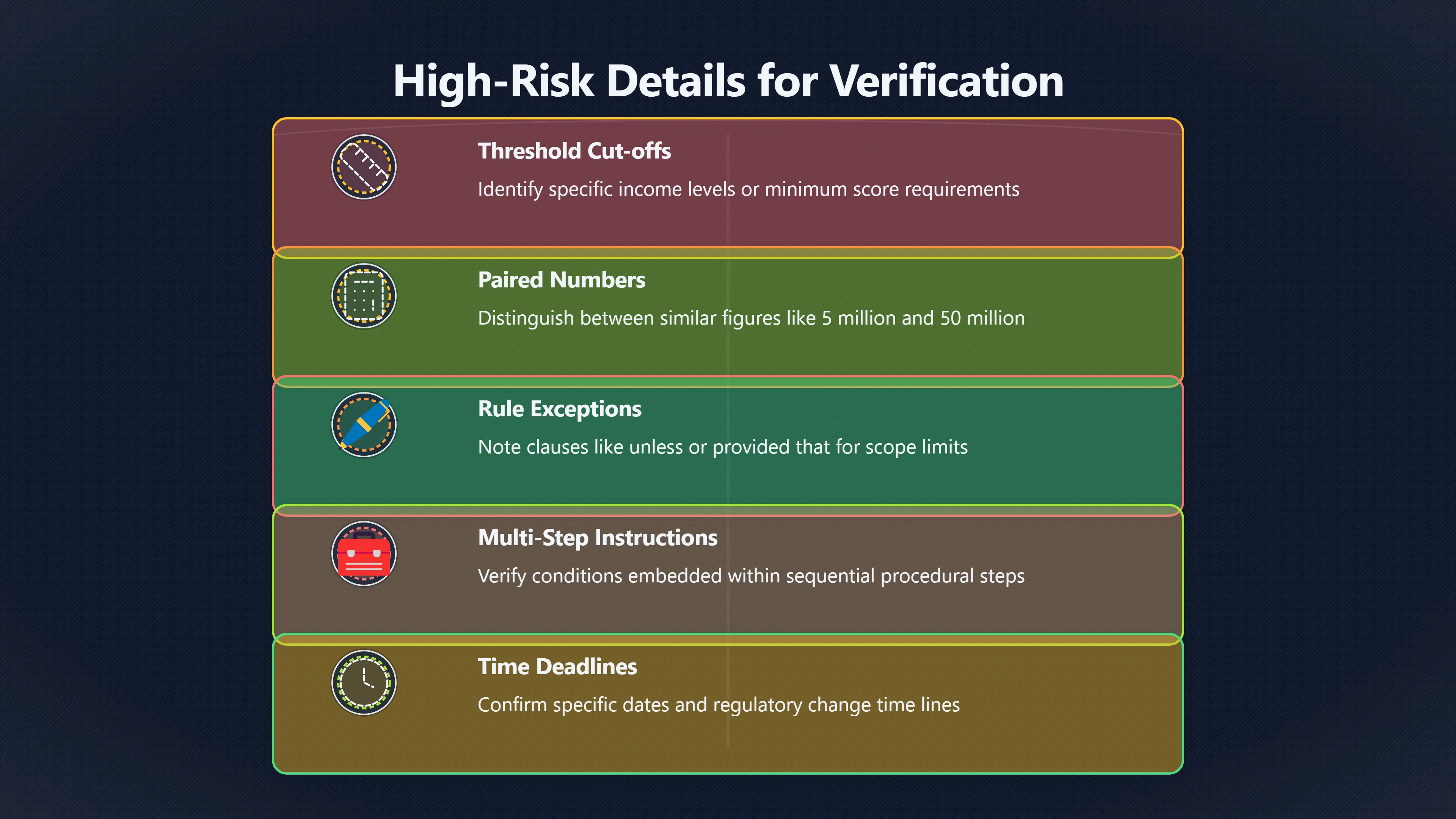
The High-Risk Details Most Worth Verifying
Not all facts deserve equal attention. Readers aiming for speed can prioritise a small set of details that are unusually vulnerable to distortion.
Thresholds and Cut-Off Points
Thresholds create categories.
Examples include:
- Above versus below a certain income level.
- Greater than versus greater than or equal to.
- Minimum score requirements.
- Eligibility criteria.
Crossing a threshold can change the entire outcome. Missing it often produces larger comprehension errors than missing surrounding descriptive information.
Paired Numbers
Pairs are especially easy to confuse.
Examples include:
- 14 days versus 21 days.
- 5 million versus 50 million.
- 0.5% versus 5%.
Data-entry research identifies transcription and transposition errors as common sources of mistakes when handling numerical information, illustrating how easily exact figures can be distorted.[Teach Computer Science]teachcomputerscience.comTeach Computer Science Data Verification | MethodsVerification & ErrorsAugust 13, 2019 — There are a few kinds of standard errors that are often experienced when doing data entry. Click h…
Exceptions to General Rules
When a text spends several paragraphs describing a general principle and then introduces an exception, the exception deserves disproportionate attention.
Readers often remember the repeated rule and forget the single sentence that limits it.

Multi-Step Instructions
Instructions frequently contain conditions embedded within steps.
For example:
- Complete Step A.
- Complete Step B only if Condition X applies.
- Skip Step C if Condition Y is present.
In procedural documents, overlooking these qualifiers can create errors that are more costly than the few seconds required to verify them.[GOV.UK]GOV.UK2026 key stage 2 test administration guidanceMarch 11, 2024 — 30 Apr 2026 — This guidance is for schools administering the 2026 key stage…
A Fast Verification Strategy
The goal is not to reread entire paragraphs. It is to recover one specific detail.
When you feel the urge to look back, ask:
- What exact number, condition, or exception am I trying to recover?
- Will getting it wrong affect my understanding of what follows?
- Can I locate the relevant detail quickly?
If all three answers are yes, a targeted regression is usually efficient.
If you cannot identify the missing detail, the urge is more likely to be reassurance-seeking than comprehension repair.
Eye-movement studies suggest that effective regressions are often targeted and purposeful rather than broad rereading of large text sections. Most regressions are relatively local, returning to nearby words or phrases that are directly relevant to resolving uncertainty.[MDPI]mdpi.comSeveral findings indicate that the…Read more…
The Reading-Speed Trade-Off
Readers sometimes assume that any backward eye movement slows them down. In practice, the cost depends on why the regression occurs.
A two-second glance to verify a critical number can prevent several minutes of confusion, mistaken note-taking, or later rereading. By contrast, repeatedly rereading passages because they feel imperfectly remembered often produces little improvement in understanding.
For increasing reading speed, the key distinction is not between rereading and never rereading. It is between checking information that changes meaning and checking information that merely triggers uncertainty. Numbers, thresholds, conditions, and exceptions belong to the first category. When they are central to the text’s logic, a quick verification is often one of the most efficient regressions a reader can make.
Amazon book picks
Further Reading
Books and field guides related to Why Numbers and Exceptions Deserve a Second Look. Use these as the next step if you want deeper reading beyond the article.
How to Read a Book
Rating: 4.0/5 from 41 Google Books ratings
Emphasises careful attention to key details, qualifications, and argument structure.
Make It Stick
Explains why precise details and retrieval matter for accurate understanding.

The art of thinking clearly
First published 2013. Subjects: nonfiction, psychology, Errors, Développement d'aptitudes, Prise de décision (Relations humaines).

Endnotes
1.
Source: pmc.ncbi.nlm.nih.gov
Link:https://pmc.ncbi.nlm.nih.gov/articles/PMC6235565/
Source snippet
by JR Folk · 2018 · Cited by 9 — The current research provides a method for distinguishing between two different types of regressive e...
2.
Source: mdpi.com
Link:https://www.mdpi.com/2411-5150/3/3/35
Source snippet
Several findings indicate that the...Read more...
3.
Source: GOV.UK
Link:https://www.gov.uk/government/publications/key-stage-2-tests-test-administration-guidance-tag/key-stage-2-test-administration-guidance
Source snippet
2026 key stage 2 test administration guidanceMarch 11, 2024 — 30 Apr 2026 — This guidance is for schools administering the 2026 key stage...
Published: March 11, 2024
4.
Source: pubmed.ncbi.nlm.nih.gov
Title: The function of these “regressions” is still largely unknown
Link:https://pubmed.ncbi.nlm.nih.gov/22886737/
Source snippet
The function of regressions in reading: backward eye...by RW Booth · 2013 · Cited by 132 — Standard text reading involves frequent...
5.
Source: ora.ox.ac.uk
Link:https://ora.ox.ac.uk/objects/uuid%3Aa16f42e2-529d-47ae-ba51-50b75dd43899/files/rkh04dp70d
Source snippet
ford University Research ArchiveComprehension monitoring during reading: an eye-tracking...by AK Hessel · 2020 · Cited by 50 — We chos...
6.
Source: teachcomputerscience.com
Title: Teach Computer Science Data Verification | Methods
Link:https://teachcomputerscience.com/data-verification/
Source snippet
Verification & ErrorsAugust 13, 2019 — There are a few kinds of standard errors that are often experienced when doing data entry. Click h...
Published: August 13, 2019
Additional References
7.
Source: jcq.org.uk
Title: intructions for conducting examinations
Link:https://www.jcq.org.uk/[knowledge
Source snippet
Joint Council for QualificationsInstructions for Conducting Examinations (ICE)Key changes for 2025–26 This document now covers Cambridge...
8.
Source: youtube.com
Title: Professor Denis Drieghe | Inaugural Lecture Series | University of Southampton
Link:https://www.youtube.com/watch?v=QA1_8Ma88XE
Source snippet
The Brain's Challenge: Processing: What Eye Movements During Reading Reveal About Processing Speed...
9.
Source: youtube.com
Title: How do FLUENT readers move their EYES? vs. Struggling/Beginner/Dyslexic Readers
Link:https://www.youtube.com/watch?v=d7jzeZCYMLw
Source snippet
Dr. Keith Rayner - What Eye Movements Tell Us About the Processing Involved In Reading...
10.
Source: youtube.com
Link:https://www.youtube.com/watch?v=zQmf5TkJrJ8
Source snippet
Become a Speed Reader in 10 Minutes...
11.
Source: assets.cambridge.org
Title: Chapter 1
Link:https://assets.cambridge.org/97811084/15354/excerpt/9781108415354_excerpt.pdf
Source snippet
About 10–15 per cent of the time, readers move their eyes back (regress) to previously...Read more...
12.
Source: youtube.com
Title: Become a Speed Reader in 10 Minutes
Link:https://www.youtube.com/watch?v=KUpLxO7wJU4
Topic Tree