Within Reading Clusters
How repeated terms unlock faster reading
Repeated exposure turns unfamiliar terms into quick recognition, reducing the effort needed to follow serious nonfiction.
On this page
- Why unfamiliar vocabulary creates friction
- How repeated encounters build automatic recognition
- When a term is learned well enough to stop slowing you down
Page outline Jump by section
Introduction
Difficult texts become faster to read when their key terminology stops feeling new. In serious nonfiction, much of the apparent difficulty comes not from sentence length or argument complexity but from repeatedly encountering unfamiliar terms that must be decoded, interpreted and connected to prior knowledge. Once those terms become familiar, reading shifts from deliberate interpretation to rapid recognition. The reader no longer pauses to work out what a term means, how it relates to other concepts, or whether it is important. Instead, meaning arrives almost immediately. This is one of the main reasons that reading several texts within the same field often produces a noticeable increase in reading speed after only a few sessions.
Why unfamiliar vocabulary creates friction
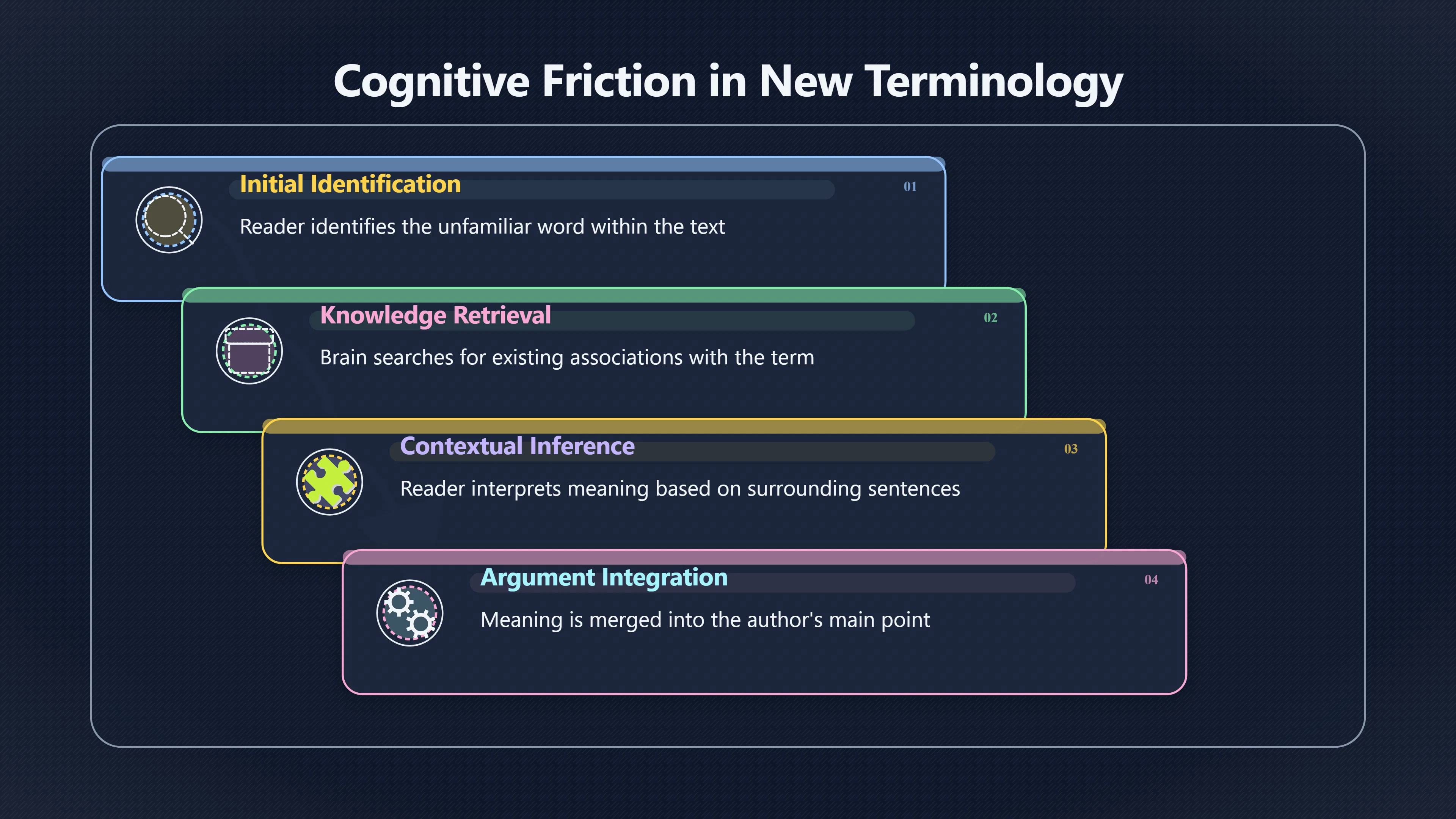
When readers encounter an unfamiliar technical term, they perform several mental operations at once. They must identify the word, retrieve any existing knowledge associated with it, infer meaning from context if necessary, and then integrate that meaning into the surrounding argument.
Each of these steps consumes attention. Research on reading fluency consistently finds that effortful word recognition competes with comprehension for limited cognitive resources. When readers must devote attention to identifying or interpreting terminology, less attention remains available for understanding the author’s argument.[ut.nesinc.com+2Massachusetts DESE]ut.nesinc.comncy, and in turn, often cause problems with comprehension.Read more…
Consider a first encounter with a specialist article on epidemiology. Terms such as “incidence rate”, “prevalence”, “cohort study” and “confounding variable” may appear repeatedly. Even if definitions are available, the reader initially spends time translating these terms into usable meaning. The text feels slow because the vocabulary acts as a series of speed bumps.
Importantly, the friction is cumulative. A page containing ten unfamiliar terms is not merely ten times harder than a page containing one. Each unfamiliar term interrupts the flow of comprehension and increases the likelihood that the reader will reread earlier sentences to rebuild context.
How repeated encounters build automatic recognition
Repeated exposure changes the way terminology is processed. Instead of consciously decoding a term each time it appears, readers gradually build a direct connection between the word form and its meaning.
Reading researchers often describe this transition as a move towards automatic word recognition. Familiar words can be recognised rapidly and with little conscious effort because they have been stored in long-term memory through repeated encounters. Once this happens, readers no longer need to reconstruct meaning from scratch each time they see the term.[ut.nesinc.com+2Joyner Library]ut.nesinc.comAutomatic Word RecognitionBy promoting long-term memory of…Read more…
The process resembles learning faces. The first time you meet someone, recognition requires effort. After repeated encounters, identification becomes immediate. Technical vocabulary develops in much the same way.
Studies of vocabulary acquisition show that repeated encounters with words strengthen learning and improve access to meaning, particularly when those encounters occur in informative contexts. Research examining word exposure frequency has found cumulative benefits from multiple encounters with new vocabulary rather than isolated appearances.[Taylor & Francis Online]tandfonline.comTaylor & Francis OnlineThe effects of context and word exposure frequency on…by F Teng · 2019 · Cited by 115 — With regard to acquisit…
This is why clustered reading is so powerful. If five articles in the same discipline all use the term “opportunity cost”, the reader receives multiple opportunities to reinforce recognition. The term gradually stops being an object of study and becomes part of the background language of the field.
What changes after recognition becomes automatic
The largest gain is not that individual words are processed faster. The larger gain is that attention becomes available for higher-level thinking.
When terminology is unfamiliar, readers constantly switch between decoding vocabulary and understanding arguments. Once terminology becomes familiar, those switching costs largely disappear. Research on automaticity suggests that fluent recognition allows readers to allocate more mental resources to comprehension and interpretation rather than identification.[Ovid+2PMC]ovid.comAutomaticity of Word Recognition Is a Unique…by TC Roembke · 2019 · Cited by 87 — Automaticity, particularly in a task stressing me…
Several practical changes follow:
- Fewer pauses: Readers stop interrupting themselves to recall definitions.
- Reduced rereading: Sentences are understood correctly on the first pass more often.
- Faster integration: New information can be attached to existing concepts immediately.
- Better prediction: Familiar terminology helps readers anticipate where an argument is heading.
The result feels like the text itself has become easier, even when the actual complexity has not changed.
When a term is learned well enough to stop slowing you down
A useful sign is that the term no longer triggers an internal translation step.
Early encounters often follow a pattern:
- See the term.
- Recall or infer its definition.
- Apply the definition to the sentence.
- Continue reading.
After sufficient repetition, the process shortens:
- See the term.
- Understand the meaning instantly.
- Continue reading.
At that point, the term functions much like a common everyday word. Reading researchers describe fluent reading as relying on automatic recognition rather than effortful decoding. Repeated exposure helps move words into this automatic category.[WordFlight+2Milne Publishing]wordflight.comWhat is Automatic Word Recognition?Automatic word recognition is a foundational reading skill that enables students to decode w…
The transition does not require perfect mastery. A reader may still be unable to give a textbook definition of a term while nevertheless recognising it quickly enough that it no longer disrupts comprehension. For reading speed, rapid contextual recognition often matters more than formal memorisation.
Why field-specific terminology produces compounding gains
The effect becomes especially powerful in specialised subjects because the same vocabulary tends to recur across many texts.
Economics repeatedly uses terms such as “inflation expectations”, “marginal utility” and “productivity growth”. Legal writing repeatedly references doctrines, standards and procedural concepts. Biology papers repeatedly use the same terminology for processes, structures and methods.
Every successful recognition makes the next encounter easier. Research on prior knowledge suggests that familiarity with a topic supports faster and more accurate word identification, creating a positive cycle between knowledge and fluency.[PMC]pmc.ncbi.nlm.nih.govby SJ Priebe · 2011 · Cited by 157 — Because we expect that having prior knowledge leads to more automatic word recognition, we will a…
This explains why experts often appear to read difficult material effortlessly. Their advantage is not simply higher intelligence or faster eyes. Much of their speed comes from possessing a large library of instantly recognisable terms and concepts within their field. What looks like rapid reading is often rapid recognition.

The practical implication for faster reading
If the goal is to increase reading speed in demanding nonfiction, repeated exposure to the same terminology is more valuable than constantly seeking new topics. Reading several related texts in succession allows specialised vocabulary to become familiar enough that it stops consuming attention.
As terminology becomes automatic, comprehension requires less effort, rereading declines, and more of the reader’s attention can stay focused on the ideas that matter. The text has not changed, but the amount of work required to understand it has. That reduction in cognitive friction is one of the clearest mechanisms through which reading clusters produce faster reading.
Amazon book picks
Further Reading
Books and field guides related to How repeated terms unlock faster reading. Use these as the next step if you want deeper reading beyond the article.

Word Power Made Easy
Directly addresses repeated exposure and automatic recognition of vocabulary.
The vocabulary builder workbook
Uses repeated encounters and practice to accelerate word recognition.
eBay marketplace picks
Marketplace Samples
Example marketplace items related to this page. Use the search link to explore similar finds on eBay.
Endnotes
1.
Source: ut.nesinc.com
Link:https://www.ut.nesinc.com/TestView.aspx?f=HTML_FRAG%2Fflex%2Fautomaticity-and-fluency.html
Source snippet
ncy, and in turn, often cause problems with comprehension.Read more...
2.
Source: doe.mass.edu
Title: achusetts DESEAutomaticity & Fluency
Link:https://www.doe.mass.edu/massliteracy/reading-difficulties/automaticity-fluency.html
Source snippet
achusetts DESEAutomaticity & Fluency - Evidence Based Early LiteracyNov 20, 2020 — Automaticity and Fluency Can Be an Underlying Caus...
3.
Source: ut.nesinc.com
Title: Automatic Word Recognition
Link:https://www.ut.nesinc.com/TestView.aspx?f=HTML_FRAG%2Fflex%2Fword-recognition.html
Source snippet
By promoting long-term memory of...Read more...
4.
Source: doe.mass.edu
Title: word recognition
Link:https://www.doe.mass.edu/massliteracy/skilled-reading/fluent-word-reading/word-recognition.html
Source snippet
for Early Reading: Automatic Word RecognitionDecember 18, 2020 — All fluent readers can instantly and automatically recognize a large num...
Published: December 18, 2020
5.
Source: ovid.com
Link:https://www.ovid.com/journals/jedup/fulltext/10.1037/edu0000279~automaticity-of-word-recognition-is-a-unique-predictor-of
Source snippet
Automaticity of Word Recognition Is a Unique...by TC Roembke · 2019 · Cited by 87 — Automaticity, particularly in a task stressing me...
6.
Source: pmc.ncbi.nlm.nih.gov
Link:https://pmc.ncbi.nlm.nih.gov/articles/PMC8559868/
Source snippet
as an Independent Trait in Predicting Reading...by TC Roembke · 2021 · Cited by 27 — Automaticity should be considered an individually r...
7.
Source: wordflight.com
Link:https://www.wordflight.com/what-is-automatic-word-recognition/
Source snippet
What is Automatic Word Recognition?Automatic word recognition is a foundational reading skill that enables students to decode w...
8.
Source: pmc.ncbi.nlm.nih.gov
Link:https://pmc.ncbi.nlm.nih.gov/articles/PMC3142886/
Source snippet
by SJ Priebe · 2011 · Cited by 157 — Because we expect that having prior knowledge leads to more automatic word recognition, we will a...
9.
Source: heinemann.com
Link:https://www.heinemann.com/blog/bridging-processes-of-word-recognition-and-language-comprehension-in-the-active-view-of-reading
10.
Source: westportps.org
Link:https://www.westportps.org/departments/teaching-learning/literacy/our-approach-to-literacy/literacy-word-recognition
Source snippet
Literacy: Word Recognition - Westport Public SchoolsSight word recognition, according to Scarborough's Reading Rope, refers to a child's...
11.
Source: library.ecu.edu
Link:https://library.ecu.edu/networkingsummit/wp-content/pv-uploads/sites/257/2019/07/ehri.pdf
Source snippet
Joyner LibraryOrthographic Mapping in the Acquisition of Sight Word...by LC Ehri · 2014 · Cited by 1437 — With repeated readings that ac...
12.
Source: tandfonline.com
Link:https://www.tandfonline.com/doi/abs/10.1080/09571736.2016.1244217
Source snippet
Taylor & Francis OnlineThe effects of context and word exposure frequency on...by F Teng · 2019 · Cited by 115 — With regard to acquisit...
13.
Source: milnepublishing.geneseo.edu
Link:https://milnepublishing.geneseo.edu/steps-to-success/chapter/3-word-recognition-skills-one-of-two-essential-components-of-reading-comprehension/
Source snippet
Milne Publishing3. Word Recognition Skills: One of Two Essential...by MS Murray · 2016 · Cited by 31 — This chapter focuses on word reco...
14.
Source: pmc.ncbi.nlm.nih.gov
Link:https://pmc.ncbi.nlm.nih.gov/articles/PMC8894658/
Source snippet
by H Soleimani · 2022 · Cited by 42 — The [purpose]({{ 'purpose/' | relative_url }}) of the current study was to investigate the effect of two types of repeated reading...
15.
Source: pmc.ncbi.nlm.nih.gov
Link:https://pmc.ncbi.nlm.nih.gov/articles/PMC9874682/
Source snippet
Eye-movement studies have also revealed that phonemic awareness, a known predictor for early word recognition and decoding, contribute...
16.
Source: tandfonline.com
Link:https://www.tandfonline.com/doi/full/10.1111/ajpy.12095
Source snippet
Full article: Beyond word recognition, fluency, and vocabularyby I Ribeiro · 2016 · Cited by 84 — The aim of this study was to investigat...
Additional References
17.
Source: researchgate.net
Link:https://www.researchgate.net/publication/274264677_Incidental_Vocabulary_Learning_in_Second_Language_Acquisition_A_Literature_Review
Source snippet
(PDF) Incidental Vocabulary Learning in Second...Mar 23, 2026 — The findings show that L2 learners develop much of their vocabulary by i...
18.
Source: researchgate.net
Link:https://www.researchgate.net/publication/397452445_The_Impact_Of_Extensive_Reading_On_Vocabulary_Development_And_Reading_Fluency_Among_Graduate_Students_At_Onaizah_College_Saudi_Arabia
Source snippet
(PDF) The Impact Of Extensive Reading On Vocabulary...Aug 20, 2025 — This research analyzed the relationship between extensive reading h...
19.
Source: readingrockets.org
Link:https://www.readingrockets.org/reading-101/reading-101-learning-modules/course-modules/fluency/depth
Source snippet
Fluency: In DepthAutomaticity refers only to accurate, speedy word recognition, not to reading passages or connected text with ease and g...
20.
Source: researchgate.net
Link:https://www.researchgate.net/publication/23416074_Fluency_A_Key_Link_Between_Word_Identification_and_Comprehension
Source snippet
(PDF) Fluency: A Key Link Between Word Identification and...Conceptually, reading fluency involves both fast decoding of words in text a...
21.
Source: allohio.org
Link:https://allohio.org/wp-content/uploads/2025/03/PL10-Module-Resource-Guide.pdf
Source snippet
teaching for reading fluencyWhen students are fluent readers, they can recognize words automatically and read for meaning. Fluency is som...
22.
Source: leadinliteracy.com
Link:https://leadinliteracy.com/the-benefits-of-repeated-reading/
23.
Source: facebook.com
Link:https://www.facebook.com/groups/scienceofreading/posts/2027536811028104/
Source snippet
My daughter tells me that she used to do timed [oral reading]({{ 'reading-aloud/' | relative_url }}) and be...January 1, 2025 — How Does Reading Speed Fit into the Fluency Equat...
Published: January 1, 2025
24.
Source: hmhco.com
Link:https://www.hmhco.com/blog/what-is-orthographic-mapping-in-reading?srsltid=AfmBOoqAYCz3mOLdf29HWjaYGnh0LlSPFdMd_1m6x0GQ79KEnTW5HazW
Source snippet
se to store and retrieve words by connecting their pronunciation, spelling, and meaning automatically...Read more...
25.
Source: instagram.com
Title: Because that is where automaticity is built. Decodable books give students
Link:https://www.instagram.com/reel/DXRlSIxjYI4/
Source snippet
Orthographic Mapping: Part 2 The fastest path to fluency is...The fastest path to fluency is repeated reading in connected text...
26.
Source: medium.com
Title: How to Read Faster in a Second Language (Without Losing Meaning)
Link:https://medium.com/language-lab/how-to-read-faster-in-a-second-language-without-losing-meaning-7022bcbbc74d
Source snippet
February 26, 2026 — Your reading speed may range between 100 and 200 words per minute on familiar or graded material, depending on text d...
Published: February 26, 2026
Topic Tree