Within Text Profiles
Is familiarity flattering your reading speed?
Subject familiarity can make a reading-speed test look better than your real progress, especially when later texts are harder or less familiar.
On this page
- Why familiar material feels faster
- How to mark topic familiarity in each record
- Comparing progress without fooling yourself
Page outline Jump by section
Introduction
A rising words-per-minute (WPM) score does not always mean your reading ability has improved. One of the most common distortions in reading-speed tracking is familiarity bias: you read faster because you already know the topic, vocabulary, examples, or argumentative structure. Familiarity reduces the mental effort needed to interpret a text, allowing you to move through it more quickly while maintaining comprehension. Research on background knowledge and topic familiarity consistently shows that readers understand and process familiar material more efficiently than unfamiliar material.[ResearchGate+2Taylor & Francis Online]researchgate.netResearchGate(PDF) The Effects of Content Familiarity and Language…Jun 14, 2022 — This study investigates the effects of content famili…
 This becomes a problem when reading-speed records are compared across different subjects. A reader may appear to have gained 40 WPM over several weeks, when in reality the later tests happened to cover topics they already knew well. If the next test uses an unfamiliar subject, the apparent progress can disappear overnight.
Why familiar material feels faster
The effect begins long before you consciously notice it. Reading is not simply decoding words; it is the process of connecting new information to existing knowledge. When a topic is familiar, much of that work has already been done.
Studies examining background knowledge repeatedly find that prior knowledge improves comprehension and reduces the effort required to make sense of a text. Readers can use existing mental frameworks to predict ideas, interpret terminology, and fill in gaps more efficiently.[Taylor & Francis Online+2ResearchGate]tandfonline.comA critical review was conducted to determine the influence background knowledge has on the reading comprehension of primary school-aged c…
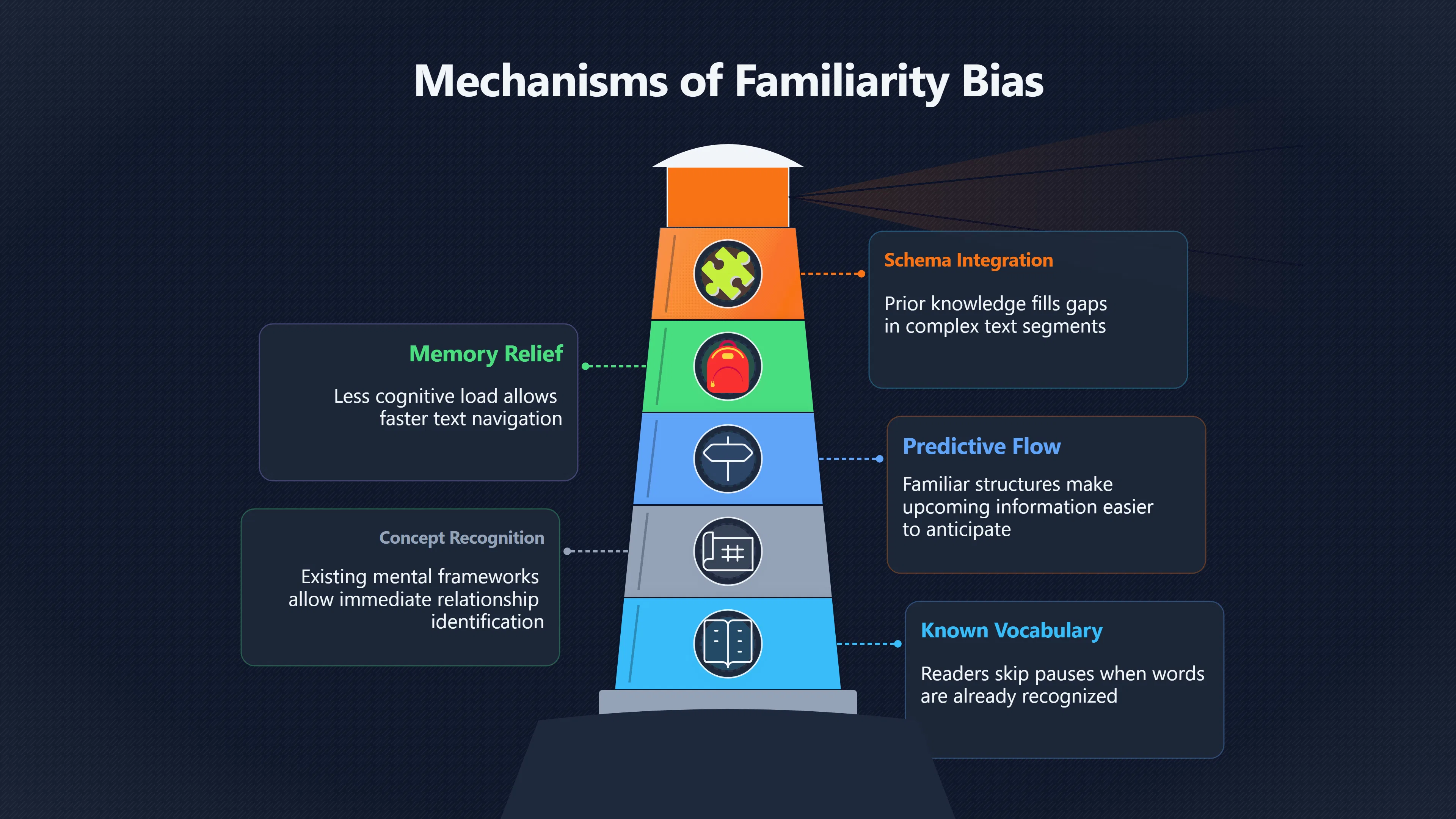
Several mechanisms contribute to faster reading:
- Vocabulary is already known. Fewer pauses are needed to infer meanings.
- Concepts require less explanation. The reader recognises relationships immediately.
- Predictions become easier. Familiar structures make upcoming information more predictable.
- Working memory is less burdened. More attention can be devoted to moving through the text rather than constructing understanding from scratch.
Research on reading times shows that predictable words and anticipated information are processed more quickly than unexpected content. Familiar subjects create exactly these conditions.[arXiv]arxiv.orgarXiv On the Effect of Anticipation on Reading TimesOn the Effect of Anticipation on Reading TimesNovember 25, 2022…
A practical example illustrates the effect. An experienced software engineer may read an article about programming at 320 WPM while maintaining excellent comprehension. The same reader might slow to 220 WPM when reading a detailed article on medieval history. The difference does not necessarily reflect reading skill. It reflects the amount of existing knowledge available to support comprehension.
The hidden danger in WPM records
Familiarity bias becomes especially misleading when readers use reading-speed tests to judge improvement.
Suppose someone records:
DateTopicWPMWeek 1Unfamiliar economics article230Week 4Familiar technology article285Week 8Unfamiliar philosophy chapter225
Looking only at Week 1 and Week 4 suggests dramatic progress. Looking across all three records suggests something different: reading speed may be stable, while topic familiarity is changing.
Research has found that familiar content can increase both reading speed and comprehension simultaneously. In one study examining topic familiarity, readers moved through familiar material faster and understood it better than unfamiliar material.[Taylor & Francis Online]tandfonline.comThe results supported schema-based comprehension theory.Read moreTaylor & Francis OnlineThe Effects of Interesting Examples and Topic Familiarity…by TA Shimoda · 1993 · Cited by 58 — Familiar topics…
This is why a single personal WPM record often becomes unreliable. The score is influenced not only by reading skill but also by what the reader already knows.
A second trap appears when readers repeatedly consume material within one speciality. Someone who spends months reading about investing, medicine, law, football, or software development gradually acquires domain knowledge that makes future texts in that area easier to process. Their increasing WPM may reflect genuine learning of the subject as much as improvement in reading efficiency.

How to mark topic familiarity in each record
The simplest defence against familiarity bias is to record familiarity alongside WPM.
Instead of logging only speed and comprehension, add a familiarity rating such as:
Familiarity levelMeaning1Completely unfamiliar subject2Some awareness but little knowledge3General familiarity4Strong familiarity5Professional or expert-level familiarity
This takes only a few seconds but adds crucial context.
For example:
TextWPMComprehensionFamiliarityClimate science article24085%2Software engineering article31090%5Political history chapter23582%2
The pattern immediately becomes more informative. Rather than concluding that reading speed ranges wildly, you can see that familiarity is explaining much of the variation.
Another useful note is whether the text contains:
- Familiar terminology
- Previously studied concepts
- Repeated themes
- Material from your professional field
- Topics you regularly read for leisure
These factors often matter more than the publication type itself.
Comparing progress without fooling yourself
The goal is not to eliminate familiarity from reading. Familiarity is a legitimate advantage that skilled readers naturally build over time. The goal is to prevent it from disguising what is happening.
A better comparison method is to evaluate progress within similar familiarity levels.
For example:
- Compare unfamiliar science articles against other unfamiliar science articles.
- Compare familiar business texts against other familiar business texts.
- Compare beginner-level exposure to a topic with later readings of equally unfamiliar topics.
This approach reveals whether your reading process has become more efficient independent of subject knowledge.
One useful benchmark is the “cold read” test: measure WPM using a text on a topic you know little about and have never read before. Because prior knowledge contributes less, cold-read scores often provide a cleaner estimate of underlying reading performance. They are not perfect, but they reduce the inflation caused by expertise and familiarity.[Cognitive Train]cognitivetrain.comCognitive Train What Is a Good Reading Speed?WPM Ranges ExplainedWhen you take a reading speed test, the comprehension score matters as much as the WPM figure. Text difficulty shifts…
Another option is to maintain separate records for familiar and unfamiliar material within each text category. A reader might discover:
- Technical texts, familiar subject: 300 WPM
- Technical texts, unfamiliar subject: 210 WPM
- General articles, familiar subject: 340 WPM
- General articles, unfamiliar subject: 280 WPM
Those numbers tell a much richer story than a single average score.
When faster reading really is progress
Familiarity bias does not mean every increase in WPM is an illusion. Genuine improvement can still occur.
The key question is whether speed rises across a range of unfamiliar materials while comprehension remains stable. If a reader consistently performs better on new topics than they did months earlier, that is stronger evidence of actual reading development.
At the same time, increasing familiarity with a field has practical value. A doctor reading medical journals faster than a non-specialist is not cheating the measurement; specialised knowledge genuinely reduces processing demands. The mistake is treating that gain as evidence that reading speed has increased equally across all subjects.
For tracking reading improvement, the safest interpretation is simple: a higher WPM on familiar material may indicate growing expertise, growing reading skill, or both. Unless familiarity is recorded, there is no reliable way to separate them.
Amazon book picks
Further Reading
Books and field guides related to Is familiarity flattering your reading speed?. Use these as the next step if you want deeper reading beyond the article.
How to Read a Book
Rating: 4.0/5 from 41 Google Books ratings
Encourages adapting reading strategy to subject matter and prior knowledge.

Breakthrough rapid reading
Useful when comparing reading speeds across familiar and unfamiliar topics.
eBay marketplace picks
Marketplace Samples
Example marketplace items related to this page. Use the search link to explore similar finds on eBay.
Endnotes
1.
Source: researchgate.net
Link:https://www.researchgate.net/publication/255600761_The_Effects_of_Content_Familiarity_and_Language_Ability_on_Reading_Comprehension_Performance_of_Low_and_High-ability_Saudi_Tertiary_Students_Studying_English_as_a_Foreign_Language
Source snippet
ResearchGate(PDF) The Effects of Content Familiarity and Language...Jun 14, 2022 — This study investigates the effects of content famili...
2.
Source: researchgate.net
Link:https://www.researchgate.net/publication/41763128_A_state-of-the-art_review_of_background_knowledge_as_one_of_the_major_factors_that_influence_reading_comprehension_performance
Source snippet
A state-of-the-art review of background knowledge as one...The aim of this paper is to review the research carried out to date on the us...
3.
Source: arxiv.org
Title: arXiv On the Effect of Anticipation on Reading Times
Link:https://arxiv.org/abs/2211.14301
Source snippet
On the Effect of Anticipation on Reading TimesNovember 25, 2022...
Published: November 25, 2022
4.
Source: researchgate.net
Link:https://www.researchgate.net/publication/375035149_Reading_Skill_Correlation_Between_Reading_Speed_and_Reading_Comprehension
Source snippet
Reading Skill: Correlation Between Reading Speed and...Jan 9, 2026 — This article aims to discover whether there is a relationship betw...
5.
Source: tandfonline.com
Link:https://www.tandfonline.com/doi/full/10.1080/02702711.2021.1888348
Source snippet
A critical review was conducted to determine the influence background knowledge has on the reading comprehension of primary school-aged c...
6.
Source: tandfonline.com
Title: The results supported schema-based comprehension theory.Read more
Link:https://www.tandfonline.com/doi/abs/10.1080/00220973.1993.9943854
Source snippet
Taylor & Francis OnlineThe Effects of Interesting Examples and Topic Familiarity...by TA Shimoda · 1993 · Cited by 58 — Familiar topics...
7.
Source: cognitivetrain.com
Title: Cognitive Train What Is a Good Reading Speed?
Link:https://cognitivetrain.com/what-is-a-good-reading-speed/
Source snippet
[WPM Ranges]({{ 'wpm-ranges/' | relative_url }}) ExplainedWhen you take a reading speed test, the comprehension score matters as much as the WPM figure. Text difficulty shifts...
8.
Source: tandfonline.com
Link:https://www.tandfonline.com/doi/full/10.1080/02702711.2024.2351485
Source snippet
Full article: Reading Comprehension Skills and Prior Topic...by C Kiili · 2024 · Cited by 26 — Word recognition and reading comprehensio...
9.
Source: fivefromfive.com.au
Title: Background knowledge
Link:https://fivefromfive.com.au/comprehension/background-knowledge/
Source snippet
prehensionBackground knowledge (or prior knowledge) is an important factor in reading comprehension above and beyond the reader's unde...
10.
Source: support.gl-education.com
Link:https://support.gl-education.com/knowledge-base/assessments/exact-support/frequently-asked-questions/reading
Source snippet
GL EducationThe Exact reading comprehension speed is one of a very few tests which assess the time it takes a learner to read a...
Additional References
11.
Source: readingrockets.org
Link:https://www.readingrockets.org/topics/background-knowledge/articles/building-background-knowledge
Source snippet
Building Background KnowledgeThis article offers practical classroom strategies to build background knowledge such as using contrasts and...
12.
Source: shanahanonliteracy.com
Link:https://www.shanahanonliteracy.com/blog/everything-you-wanted-to-know-about-repeated-reading
Source snippet
Everything You Wanted to Know about Repeated ReadingRepeated reading usually leads to better [oral reading]({{ 'reading-aloud/' | relative_url }}) performance and reading compreh...
13.
Source: theamericanscholar.org
Link:https://theamericanscholar.org/reading-fast-and-slow/
Source snippet
Reading Fast and SlowA few empirical studies do suggest that reading speeds far beyond 500 words a minute can be attained, though these s...
14.
Source: pmc.ncbi.nlm.nih.gov
Link:https://pmc.ncbi.nlm.nih.gov/articles/PMC3142886/
Source snippet
by SJ Priebe · 2011 · Cited by 156 — While prior knowledge of a passage topic is known to facilitate comprehension, little is known ab...
15.
Source: greatminds.org
Title: the science of reading what is prior knowledge and why is it important
Link:https://greatminds.org/english/blog/witwisdom/the-science-of-reading-what-is-prior-knowledge-and-why-is-it-important
Source snippet
The Science of Reading: What is prior knowledge and why...Feb 24, 2022 — Numerous studies show that background knowledge affects student...
16.
Source: education.qld.gov.au
Link:https://education.qld.gov.au/curriculums/Documents/literature-review.pdf
Source snippet
An overview of the literature effective teaching of readingAs students read, they build a mental representation of the situation being de...
17.
Source: opal.latrobe.edu.au
Title: latrobe.edu.au The Role of Background Knowledge in Reading
Link:https://opal.latrobe.edu.au/articles/journal_contribution/The_Role_of_Background_Knowledge_in_Reading_Comprehension_A_Critical_Review/15022110/files/28892316.pdf
Source snippet
La Trobeby R Smith · 2021 · Cited by 787 — A critical review was conducted to determine the influence background knowledge has on the rea...
18.
Source: studyfast.uk
Title: what is a good reading speed wpm [benchmarks]({{ ‘benchmarks/’ | relative_url }}) explained
Link:https://studyfast.uk/blog/what-is-a-good-reading-speed-wpm-benchmarks-explained
Source snippet
What Is a Good Reading Speed? WPM Benchmarks...18 Apr 2026 — As a rough working guide: reading in the 200 to 300 WPM range with solid co...
19.
Source: nasbe.org
Link:https://www.nasbe.org/how-background-knowledge-builds-good-readers-and-why-knowledge-building-ela-curricula-are-vital/
Source snippet
store of content knowledge in history, geography, social studies...Read more...
20.
Source: scholarwithin.com
Link:https://scholarwithin.com/average-reading-speed?srsltid=AfmBOoo2jxZigrLJq6j_z0iA_oKmwrqTApkcniB77Zd_ytHF3YIdKa7t
Source snippet
When reading aloud, the average reader can read 183 words per minute (WPM)...
Topic Tree