Within Practice
How hard should a rereading passage be?
The right repeated-reading passage is short, readable, and challenging enough to make each reread smoother without causing guessing.
On this page
- The 50 to 200 word sweet spot
- Readable challenge versus overload
- Text features that reward rereading
Page outline Jump by section
Introduction
The best passage for repeated reading is not the most difficult text a reader can tolerate. It is a short passage that is already mostly readable, yet still contains enough challenge for each rereading to feel smoother than the last. When the fit is right, readers gain speed because fewer words require conscious effort. When the fit is wrong, repeated reading turns into repeated struggling, and improvements in fluency slow dramatically. Research and instructional guidance consistently recommend using short passages that can be read with high accuracy rather than texts that trigger frequent guessing, stopping, or frustration.[Reading Rockets+2Reading Rockets]readingrockets.orgReading RocketsFluency: In DepthIndependent Level: Relatively easy for the student to read (at least 95% word accuracy). Instructional Le…
 Within repeated reading programmes aimed at increasing reading speed, passage selection is therefore not a minor detail. It is one of the main factors determining whether practice builds automaticity and confidence or simply rehearses errors.[PMC]pmc.ncbi.nlm.nih.govby EA Stevens · 2016 · Cited by 376 — Guided oral repeated reading (RR) with teacher or peer feedback was identified as an effective m…
How hard should a rereading passage be?
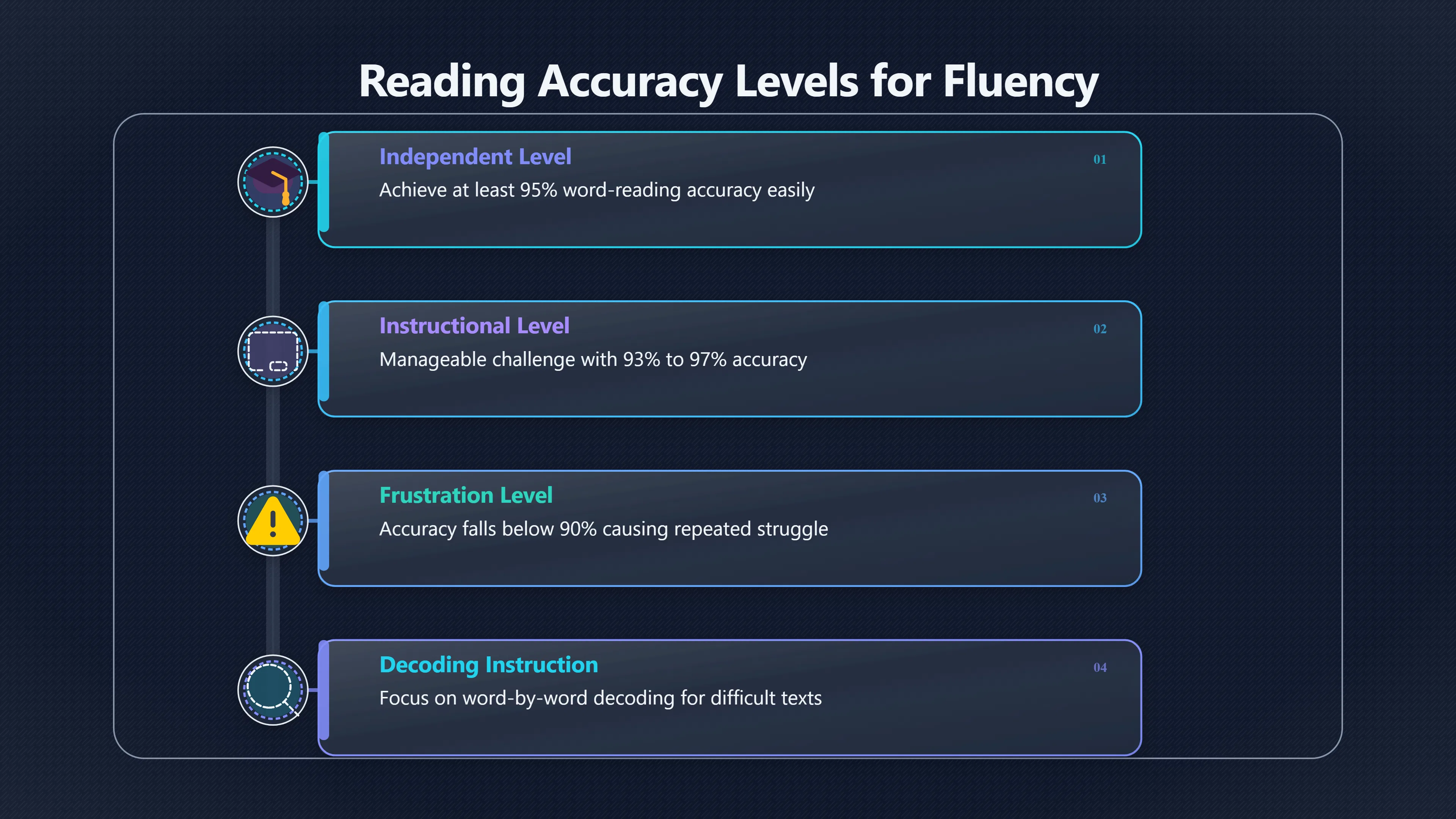
A useful rule is that a reader should be able to read most of the words correctly on the first attempt. Fluency practice is designed to make reading smoother, not to serve as primary decoding instruction. If a passage contains too many unfamiliar words, attention is consumed by figuring out individual words rather than developing rhythm, phrasing, and efficient word recognition.[Reading Rockets]readingrockets.orgReading RocketsFluency: In DepthIndependent Level: Relatively easy for the student to read (at least 95% word accuracy). Instructional Le…
Many fluency frameworks describe three broad text levels:
- Independent level: typically around 95% or higher word-reading accuracy.[readingrockets.org]readingrockets.orgReading RocketsFluency: In DepthIndependent Level: Relatively easy for the student to read (at least 95% word accuracy). Instructional Le… * Instructional level: challenging but manageable with support.[readingrockets.org]readingrockets.orgReading RocketsFluency: In DepthIndependent Level: Relatively easy for the student to read (at least 95% word accuracy). Instructional Le…
- Frustration level: accuracy falls below roughly 90%, indicating that the text is too difficult for fluency practice.[Reading Rockets+2Reading Rockets]readingrockets.orgReading RocketsFluency: In DepthIndependent Level: Relatively easy for the student to read (at least 95% word accuracy). Instructional Le…
The exact percentages vary across researchers, but the pattern is remarkably consistent: readers benefit most when passages are challenging enough to require attention yet easy enough to read accurately. Some analyses place the optimal instructional range around 93–97% accuracy, while other guidance recommends at least 95% accuracy for fluency work.[ResearchGate+2Shanahan on Literacy]researchgate.netA Meta-Analysis of the Effects on ReadingThe specific criterion of 93%-97% correctly read words has been consistently validat…
A simple practical test is whether the reader can finish the first reading while maintaining meaning. If the passage requires constant correction or repeated word-by-word decoding, it is probably better suited to decoding instruction than repeated reading.
The 50-to-200-word sweet spot
Repeated reading traditionally uses brief passages rather than full chapters or lengthy articles. The most commonly cited range is approximately 50 to 200 words. This length is long enough to establish rhythm and sentence flow, yet short enough for multiple rereadings within a single practice session. Institute of Education Sciences+2Institute of Education Sciences[ies.ed.gov]ies.ed.govInstitute of Education SciencesWWC | Repeated ReadingTypically, the teacher selects a passage of about 50 to 200 words in length. If the…
Short passages offer several advantages:
- Progress becomes visible quickly.
- Readers can remember the overall meaning of the text.
- Improvements in speed and expression are easier to notice.
- Fatigue is reduced.
- Several rereadings can occur before attention declines.[Five from Five+2Shanahan on Literacy]fivefromfive.com.aurepeated readingFive from FiveRepeated Reading6 Oct 2025 — Choose a passage that students can read with very few errors. · The passage should be readable…
A passage that can be completed in roughly one to two minutes is often ideal. By the second, third, or fourth reading, the reader should begin noticing fewer hesitations and smoother phrasing. That immediate sense of improvement is part of what makes repeated reading motivating.[Five from Five]fivefromfive.com.aurepeated readingFive from FiveRepeated Reading6 Oct 2025 — Choose a passage that students can read with very few errors. · The passage should be readable…
Readable challenge versus overload
The distinction between productive challenge and overload is easier to see in concrete examples.
A productive passage might contain:
- A few unfamiliar words.
- Some longer sentences.
- Punctuation that requires attention to phrasing.
- Vocabulary that stretches the reader slightly.
An overloaded passage might contain:
- Frequent unknown words.
- Dense technical terminology.
- Complex sentence structures throughout.
- Concepts the reader cannot easily understand from context.
In the first case, rereading removes friction. In the second, rereading mainly repeats confusion. The reader may become faster at recognising a handful of memorised words, but broader fluency gains are limited because too much effort remains tied up in decoding and problem-solving. Reading Rockets+2National Center on Improving Literacy[readingrockets.org]readingrockets.orgReading RocketsFluency: In DepthIndependent Level: Relatively easy for the student to read (at least 95% word accuracy). Instructional Le…
One common mistake is assuming that harder passages automatically create larger gains. In practice, passages that are excessively difficult often produce more errors, more frustration, and weaker engagement. Studies examining instructional-level reading repeatedly find advantages over texts that are either too easy or too difficult.[ResearchGate]researchgate.netA Meta-Analysis of the Effects on ReadingThe specific criterion of 93%-97% correctly read words has been consistently validat…
Text features that reward rereading
Not every readable passage makes an equally good fluency passage. The strongest choices contain features that become more efficient with practice.
Repeated vocabulary patterns
Texts that revisit key words and phrases allow recognition to become increasingly automatic. As familiar words recur, attention shifts from identifying words to understanding sentences and ideas. This supports the development of reading rate without sacrificing accuracy.[CentralReach]centralreach.com2006 Therrien and KubinaPrevious research has shown that…
Natural sentence rhythm
Dialogue, narrative passages, and well-structured informational texts often reward rereading because punctuation and phrasing become clearer each time. Readers begin to group words into meaningful units instead of processing one word at a time. Fluency researchers describe this expressive, phrase-based reading as an important component of skilled reading.[National Center on Improving Literacy]improvingliteracy.orgNational Center on Improving LiteracyHow to Build Fluency with Text in Your Classroom - NCILFluency in oral reading includes: accuracy, w…
Clear meaning
A passage should make sense. If readers understand the topic and can follow the ideas, each rereading strengthens both fluency and comprehension. When meaning remains opaque, improvements in speed are less meaningful because cognitive effort is still devoted to figuring out what the text is about.[National Center on Improving Literacy]improvingliteracy.orgNational Center on Improving LiteracyHow to Build Fluency with Text in Your Classroom - NCILFluency in oral reading includes: accuracy, w…
Limited novelty
A good fluency passage is not packed with entirely new concepts. Readers should spend most of their effort becoming more fluent with the language of the passage rather than learning an unfamiliar subject from scratch.
Signs that a passage is a poor fit
Even a passage that looks appropriate on paper may prove unsuitable during practice. Warning signs include:
- Frequent guessing at words.
- Long pauses before common words.
- Visible frustration or avoidance.
- Little improvement after several rereadings.
- Loss of comprehension despite repeated exposure.
When these signs appear, changing the passage is often more effective than increasing the number of repetitions. Repeated reading is intended to build successful reading experiences, not endurance through difficulty.[Reading Rockets+2ERIC]readingrockets.orgReading RocketsFluency: In DepthIndependent Level: Relatively easy for the student to read (at least 95% word accuracy). Instructional Le…
By contrast, a well-matched passage usually produces a predictable pattern: the first reading is careful, the second is smoother, and later readings become increasingly accurate, expressive, and efficient. That progression is a strong indication that the text is operating at the right level of challenge.[Reading Rockets+2PMC]readingrockets.orgReading RocketsTimed Repeated ReadingsRepeated readings, under timed conditions, of familiar instructional level text can increase studen…
Matching passage choice to the goal of increasing reading speed
For readers using repeated reading to increase reading speed, passage selection should prioritise fluency growth rather than maximum difficulty. The goal is to create conditions where word recognition becomes more automatic and attention can shift towards phrasing and meaning. Research-based fluency programmes consistently centre on short passages, generally 50–200 words long, read with high levels of accuracy and repeated until performance becomes smoother. Institute of Education Sciences+2Institute of Education Sciences[ies.ed.gov]ies.ed.govInstitute of Education SciencesWWC | Repeated ReadingTypically, the teacher selects a passage of about 50 to 200 words in length. If the…
The most effective passage is therefore neither easy enough to be effortless nor difficult enough to trigger constant errors. It sits in the middle: short, understandable, slightly demanding, and capable of sounding noticeably better with each rereading. That balance is what allows repeated reading to build fluency without frustration.[Reading Rockets+2Five from Five]readingrockets.orgReading RocketsFluency: In DepthIndependent Level: Relatively easy for the student to read (at least 95% word accuracy). Instructional Le…
Amazon book picks
Further Reading
Books and field guides related to How hard should a rereading passage be?. Use these as the next step if you want deeper reading beyond the article.
The fluent reader
Explains selecting appropriately challenging texts for fluency practice.

The Megabook of Fluency
Includes passages and activities suited to varied reading levels.
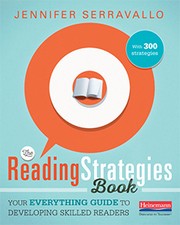
The Reading Strategies Book
Helps educators match texts and strategies to reader needs.
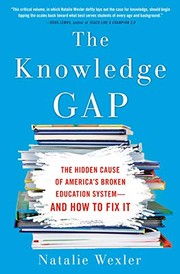
The Knowledge GAP
Discusses reading comprehension and text accessibility in instruction.
eBay marketplace picks
Marketplace Samples
Example marketplace items related to this page. Use the search link to explore similar finds on eBay.


Endnotes
1.
Source: files.eric.ed.gov
Title: ERICAssessing Reading Fluency
Link:https://files.eric.ed.gov/fulltext/ED483166.pdf
Source snippet
Reading Fluency - ERIC - Department of Educationby TV Rasinski · 2004 · Cited by 660 — Those readers who score below 90% in word accuracy...
2.
Source: pmc.ncbi.nlm.nih.gov
Link:https://pmc.ncbi.nlm.nih.gov/articles/PMC5097019/
Source snippet
by EA Stevens · 2016 · Cited by 376 — Guided oral repeated reading (RR) with teacher or peer feedback was identified as an effective m...
3.
Source: researchgate.net
Link:https://www.researchgate.net/publication/379939617_Assessing_an_Instructional_Level_During_Reading_Fluency_Interventions_A_Meta-Analysis_of_the_Effects_on_Reading
Source snippet
A Meta-Analysis of the Effects on ReadingThe specific criterion of 93%-97% correctly read words has been consistently validat...
4.
Source: centralreach.com
Title: 2006 Therrien and Kubina
Link:https://centralreach.com/wp-content/uploads/2019/04/2006-Therrien-and-Kubina.pdf
Source snippet
Previous research has shown that...
5.
Source: researchgate.net
Link:https://www.researchgate.net/publication/399581970_The_Effects_of_Repeated_Reading_Interventions_on_the_Oral_Reading_Fluency_of_Middle_School_Students_With_Reading_Difficulties_and_Disabilities
Source snippet
However, this review indicated that repeated reading...
6.
Source: researchgate.net
Link:https://www.researchgate.net/publication/371706464_Effects_of_a_Repeated_Reading_Intervention_Delivered_Online_to_Upper_Elementary_Students
Source snippet
However, little research has examined...
7.
Source: readingrockets.org
Link:https://www.readingrockets.org/reading-101/reading-101-learning-modules/course-modules/fluency/depth
Source snippet
Reading RocketsFluency: In DepthIndependent Level: Relatively easy for the student to read (at least 95% word accuracy). Instructional Le...
8.
Source: readingrockets.org
Link:https://www.readingrockets.org/topics/fluency/articles/fluency-introduction
Source snippet
Reading RocketsFluency: An IntroductionRelatively easy for the student to read (95% word accuracyThe ability to read words correctly.)...
9.
Source: readingrockets.org
Link:https://www.readingrockets.org/classroom/classroom-strategies/timed-repeated-readings
Source snippet
Reading RocketsTimed Repeated ReadingsRepeated readings, under timed conditions, of familiar instructional level text can increase studen...
10.
Source: improvingliteracy.org
Link:https://improvingliteracy.org/resource/how-to-build-fluency-with-text-in-your-classroom/
Source snippet
National Center on Improving LiteracyHow to Build Fluency with Text in Your Classroom - NCILFluency in [oral reading]({{ 'reading-aloud/' | relative_url }}) includes: accuracy, w...
11.
Source: shanahanonliteracy.com
Title: the instructional level concept revisited teaching with complex text
Link:https://www.shanahanonliteracy.com/blog/the-instructional-level-concept-revisited-teaching-with-complex-text
Source snippet
The Instructional Level Concept RevisitedFeb 7, 2017 — He claimed that the study showed that if you matched kids to text using the criter...
12.
Source: ies.ed.gov
Link:https://ies.ed.gov/ncee/wwc/Intervention/759
Source snippet
Institute of Education SciencesWWC | Repeated ReadingTypically, the teacher selects a passage of about 50 to 200 words in length. If the...
13.
Source: ies.ed.gov
Title: Institute of Education Sciences WWC | Repeated Reading
Link:https://ies.ed.gov/ncee/wwc/EvidenceSnapshot/576
Source snippet
Typically, the teacher selects a passage of about 50 to 200 words in...
14.
Source: fivefromfive.com.au
Title: repeated reading
Link:https://fivefromfive.com.au/fluency/evidence-based-fluency-instruction/repeated-reading/
Source snippet
Five from FiveRepeated Reading6 Oct 2025 — Choose a passage that students can read with very few errors. · The passage should be readable...
15.
Source: shanahanonliteracy.com
Link:https://www.shanahanonliteracy.com/blog/everything-you-wanted-to-know-about-repeated-reading
Source snippet
Everything You Wanted to Know about Repeated ReadingIn this approach, students are asked to read aloud short text passages (50-200 words)...
16.
Source: shanahanonliteracy.com
Link:https://www.shanahanonliteracy.com/blog/the-instructional-level-concept-revisited-teaching-with-complex-text-1
Source snippet
The Instructional Level Concept Revisited: Teaching with...Mar 23, 2024 — One of Linnea Ehri's studies found that the kids who did best...
17.
Source: shanahanonliteracy.com
Title: teaching fluency faqs
Link:https://www.shanahanonliteracy.com/blog/teaching-fluency-faqs
Source snippet
27 July 2024 — Find comprehensive answers to Teaching Fluency FAQs at Shanahan on Literacy. Elevate your teaching methods with expert gui...
Published: July 2024
18.
Source: usefluency.com
Link:https://usefluency.com/
Source snippet
From processes, handoffs, and bottlenecks to patterns and [exceptions]({{ 'exceptions/' | relative_url }}). Read more...
19.
Source: pmc.ncbi.nlm.nih.gov
Link:https://pmc.ncbi.nlm.nih.gov/articles/PMC8500173/
Source snippet
Interventions for Struggling Readers in Grades 6 to 12by PK Steinle · 2021 · Cited by 46 — Most studies examined repeated reading (RR) in...
20.
Source: pmc.ncbi.nlm.nih.gov
Link:https://pmc.ncbi.nlm.nih.gov/articles/PMC3071517/
Source snippet
in the Relationship of Oral Reading Fluency and...by J Wanzek · 2010 · Cited by 67 — The current study examined the predictive validity...
21.
Source: pmc.ncbi.nlm.nih.gov
Link:https://pmc.ncbi.nlm.nih.gov/articles/PMC3320221/
Source snippet
synthesis of fluency interventions for secondary struggling...by J Wexler · 2008 · Cited by 241 — In this study, the authors used a comp...
22.
Source: readingrockets.org
Link:https://www.readingrockets.org/topics/curriculum-and-instruction/articles/what-guided-oral-reading
Source snippet
including fluency.Read more...
23.
Source: fivefromfive.com.au
Link:https://fivefromfive.com.au/fluency/components-of-fluency/
Source snippet
ponents of fluencyText or passage reading fluency is generally defined as having three components: accuracy, rate, and prosody (or exp...
24.
Source: fivefromfive.com.au
Link:https://fivefromfive.com.au/fluency/assessing-fluency/
Additional References
25.
Source: mdpi-res.com
Link:https://mdpi-res.com/bookfiles/book/3337/Reading_Fluency.pdf?v=1778634232
Source snippet
Reading FluencyThis is a reprint of articles from the Special Issue published online in the open access journal. Education Sciences (ISSN...
26.
Source: nifdi.org
Link:https://www.nifdi.org/programs/reading/88-news/kerry-hempenstall/398-fluency-its-significance-and-promotion.html
Source snippet
Reading fluency: Its significance and promotionResults indicate that a word recognition accuracy range of 98-100% and an automaticity ran...
27.
Source: readnaturally.com
Link:https://www.readnaturally.com/research
Source snippet
Research-Based Reading InterventionsRead Naturally interventions work because they provide evidence-based instruction that accelerates re...
28.
Source: allohio.org
Link:https://allohio.org/wp-content/uploads/2025/03/PL10-Module-Resource-Guide.pdf
Source snippet
teaching for reading fluencyThe reading fluency “sweet spot” is a rate (words per minute) between the 50th and 75th percentile on timed o...
29.
Source: literacyworldwide.org
Link:https://www.literacyworldwide.org/docs/default-source/where-we-stand/ila-reading-fluently-does-not-mean-reading-fast.pdf
Source snippet
Reading Fluently Does Not Mean Reading FastResearch suggests that for younger emerging readers, acceptable levels for accuracy should be...
30.
Source: education.ohio.gov
Title: 15. How-to Step 1: Provide a [purpose]({{ ‘purpose/’ | relative_url }}) for each repeated
Link:https://education.ohio.gov/getattachment/Topics/Learning-in-Ohio/Literacy/Literacy-Academy/2023-Literacy-Academy/Providing-Reading-Interventions-for-Students-Gd-4-9-OH-Literacy-Academy-1.pdf.aspx?lang=en-US
Source snippet
Works Clearinghouse Practice Guide on Providing...Recommendation 2: Provide purposeful fluency-building activities to help students read...
31.
Source: nysrti.org
Link:https://nysrti.org/intervention-tools/reading-tools/tool%3Arepeated-reading/
Source snippet
If the student misreads a word or hesitates for longer than 5 seconds, the teacher...Read more...
32.
Source: council-for-learning-disabilities.org
Title: what is oral reading fluency verbal reading proficiency
Link:https://council-for-learning-disabilities.org/what-is-oral-reading-fluency-verbal-reading-proficiency/
Source snippet
Oral Reading Fluency28 Jan 2014 — Repeated Reading: students are asked to read short and meaningful passages until the desired level of f...
33.
Source: ila.onlinelibrary.wiley.com
Title: If students are scoring below 90% accuracy after
Link:https://ila.onlinelibrary.wiley.com/doi/10.1002/trtr.1686
Source snippet
Reading Accuracy: Findings and Implications From...29 Jan 2018 — The goal is that they are scoring in the 95% and higher accuracy band a...
34.
Source: 95percentgroup.com
Title: fluency strategies for lifelong learners
Link:https://www.95percentgroup.com/insights/fluency-strategies-for-lifelong-learners/?srsltid=AfmBOorhkU9epVonnDQsoUdaApZWtsUvYkFjyrFiKnw2DnO4QKppe8zY
Source snippet
Nov 4, 2024 — We'll go over the importance of fluency and examine nine science-backed reading fluency strategies designed to help in the...
Topic Tree