Within One Sentence
Did your summary catch the real point?
A good speed-check summary explains the passage's central message, not just its topic or a memorable detail.
On this page
- What counts as the main idea
- Topic, detail, and gist mistakes
- Examples of accurate and weak summaries
Page outline Jump by section
Introduction
When you use a one-sentence summary as a speed-reading check, the key question is not whether the sentence mentions the topic. The question is whether it captures what the passage was actually trying to say. A reader can finish quickly, remember several facts, and still miss the central message. Research on summarising consistently shows that effective summaries require readers to identify essential ideas, separate them from supporting details, and express the text’s core meaning in their own words.[Reading Rockets]readingrockets.orgReading RocketsSummarizingSummarizing teaches students how to identify the most important ideas in a text, how to ignore irrelevant infor…
 A good summary therefore acts as a comprehension test. If the sentence reflects the passage’s main claim, explanation, argument, or outcome, reading speed probably did not come at the expense of understanding. If it focuses on a memorable detail, a striking example, or only the general subject, comprehension may have been lost along the way.
Did your summary catch the real point?
The fastest way to judge a summary is to ask:
Could someone who never read the passage understand its central message from this sentence alone?
If the answer is yes, the summary probably captures the main idea. If the answer is no, the summary is likely describing the topic, repeating a detail, or giving only a fragment of the meaning.
Reading researchers generally describe summarising as identifying the most important ideas, discarding less important information, and integrating the central points into a concise statement. The ability to distinguish main ideas from details is a core part of the process.[ERIC+2Reading Rockets]files.eric.ed.govERICA Review of Summarizing and Main Idea InterventionsERICby EA Stevens · 2019 · Cited by 162 — Due to the importance of summarization and main idea instruction for reading comprehension, thi…
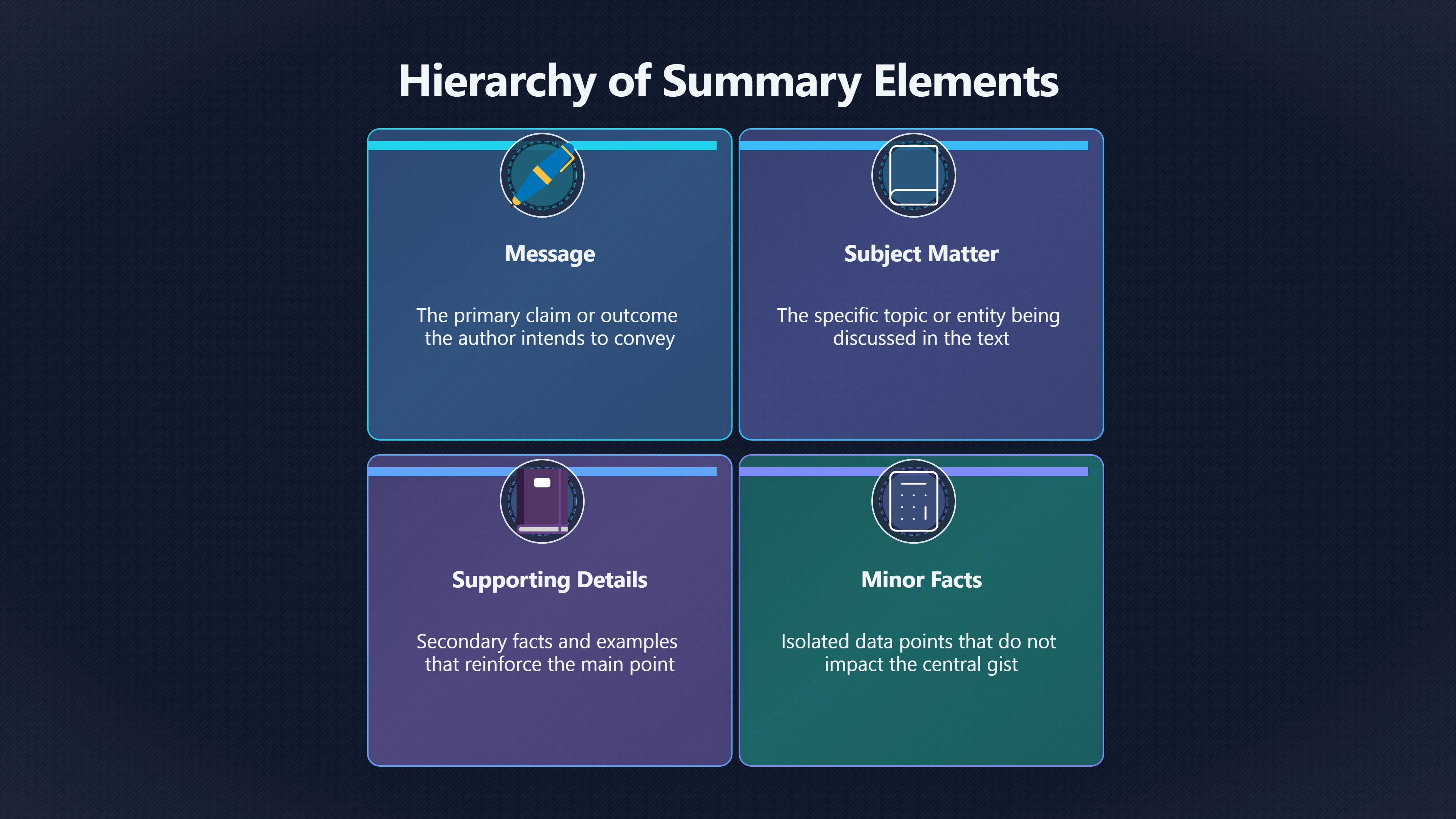
For speed-reading practice, a useful one-sentence summary usually contains three elements:
- What the passage is about (the subject).
- What the passage says about that subject (the main message).
- Why that message matters (the result, implication, or outcome).
Missing any of these pieces often signals incomplete understanding.
What counts as the main idea?
The main idea is not simply the most frequently mentioned fact. It is the organising thought that gives the passage its purpose and structure.
Consider a passage that explains how sleep improves learning by strengthening memory formation.
A strong summary would be:
Sleep helps people learn more effectively because it strengthens the brain’s ability to store memories.
This sentence captures the subject (sleep), the main claim (it improves learning), and the mechanism (memory strengthening).
A weaker version might be:
The passage talks about sleep.
That identifies the topic but not the message.
Another weak version might be:
Memory is important.
That extracts one idea but loses the passage’s central point.
Studies of main-idea instruction emphasise that readers must identify the most important idea in a section or text and distinguish it from supporting information. Simply recognising the topic is not enough.[ERIC]files.eric.ed.govERICA Review of Summarizing and Main Idea InterventionsERICby EA Stevens · 2019 · Cited by 162 — Due to the importance of summarization and main idea instruction for reading comprehension, thi…
Topic, detail, and gist mistakes
Most weak summaries fall into one of three patterns.
Mistaking the topic for the message
This is the most common error during fast reading.
Imagine a passage arguing that remote work increases employee satisfaction but can reduce informal collaboration.
A topic-only summary would be:
The article is about remote work.
The reader has identified the subject but not the author’s point.
A better summary would be:
Remote work often improves employee satisfaction while creating challenges for spontaneous collaboration.
The second version captures the actual message.
Choosing a memorable detail
Interesting facts can distract readers from the broader meaning. Literacy researchers have noted that striking or unusual details can pull attention away from the main idea and weaken understanding of the text as a whole.[Reading Rockets]readingrockets.orghow do i teach main ideaReading RocketsHow Do I Teach Main Idea?Nov 26, 2018 — To teach main idea successfully one is going to have to provide lots of practice w…
Suppose a passage explains that urban tree planting reduces heat in cities.
A weak summary might be:
Trees provide shade.
The detail is true, but it does not communicate the passage’s main purpose.
A stronger summary would be:
Increasing urban tree cover can lower city temperatures by reducing heat build-up.

Listing facts instead of expressing a gist
Some readers compress information without actually summarising it.
For example:
The article discussed pollution, rivers, fish populations, and water quality.
This is a list.
A summary should reveal the relationship between those ideas:
The article argues that river pollution damages ecosystems by reducing water quality and harming fish populations.
The second sentence communicates meaning, not merely content.
A practical test for speed readers
When reviewing a one-sentence summary, ask four quick questions:
- Does it state what the text was mainly trying to communicate?
- Would removing a favourite detail leave the summary unchanged?
- Does it explain a relationship, claim, or outcome rather than naming a subject?
- Could a reader understand the passage’s purpose from this sentence alone?
If the answer to all four is yes, the summary is probably capturing the main idea.[youtube.com]youtube.comFinding the Main Idea | English Reading Skills | 2025…
This method aligns with research-based views of summarisation as a comprehension-monitoring strategy. Strong readers actively check whether they understand the meaning of a text rather than merely recognising words or recalling isolated facts.[Reading Rockets+2Reading Rockets]readingrockets.orgOpen source on readingrockets.org.
Examples of accurate and weak summaries
Example 1: Informational text
Passage idea: Regular exercise reduces the risk of heart disease by improving cardiovascular health.
Accurate summary
Regular exercise lowers heart-disease risk by strengthening cardiovascular health.
Weak summary
The passage discusses exercise.
The weak version identifies the topic but misses the claim.

Example 2: Cause-and-effect passage
Passage idea: Excessive screen use before bed can disrupt sleep because blue light affects the body’s sleep signals.
Accurate summary
Screen use before bedtime can reduce sleep quality because blue light interferes with the body’s sleep regulation.
Weak summary
Blue light comes from screens.
The detail is present, but the central message is missing.
Example 3: Argumentative text
Passage idea: Public transport investment reduces traffic congestion more effectively than expanding road capacity alone.
Accurate summary
Investing in public transport can ease congestion more effectively than relying solely on new roads.
Weak summary
The article compares roads and public transport.
The weak version identifies the subject matter but not the conclusion.
Why this matters for increasing reading speed
A one-sentence summary is valuable because it exposes a specific failure mode of fast reading: the illusion of comprehension. Readers often feel they understood a passage because they recognise its subject or remember several details. Yet genuine comprehension depends on constructing a coherent understanding of the author’s main message.[Reading Rockets]readingrockets.orgwhy main idea not main idea or how best teach reading comprehensionReading RocketsWhy Main Idea Is Not the Main Idea — or, How Best to…Dec 4, 2023 — Focus on summarizing, text structure analysis, and p…
When your summary consistently captures the central point rather than the topic or a memorable fact, you have stronger evidence that increased reading speed is preserving meaning. In that sense, the quality of the summary matters more than the speed at which it was written. A short sentence that accurately expresses the gist of a passage is one of the quickest indicators that faster reading is still producing real understanding.
Amazon book picks
Further Reading
Books and field guides related to Did your summary catch the real point?. Use these as the next step if you want deeper reading beyond the article.
How to Read a Book
Rating: 4.0/5 from 41 Google Books ratings
Teaches identifying arguments, themes, and central ideas.

10 days to faster reading
Useful when checking whether faster reading preserves the main point.
Summarizing, paraphrasing, and retelling
Directly addresses summary quality and main-idea extraction.
Understanding and Teaching Reading Comprehension
First published 2014. Subjects: Reading comprehension.
eBay marketplace picks
Marketplace Samples
Example marketplace items related to this page. Use the search link to explore similar finds on eBay.
Endnotes
1.
Source: readingrockets.org
Link:https://www.readingrockets.org/classroom/classroom-strategies/summarizing
Source snippet
Reading RocketsSummarizingSummarizing teaches students how to identify the most important ideas in a text, how to ignore irrelevant infor...
2.
Source: files.eric.ed.gov
Title: ERICA Review of Summarizing and Main Idea Interventions
Link:https://files.eric.ed.gov/fulltext/EJ1214953.pdf
Source snippet
ERICby EA Stevens · 2019 · Cited by 162 — Due to the importance of summarization and main idea instruction for reading comprehension, thi...
3.
Source: readingrockets.org
Link:https://www.readingrockets.org/sites/default/files/migrated/get_the_gist_comprehension_strategy.pdf
Source snippet
Get The GistSummarising requires students to focus on the main ideas of a text and to decide what is important without omitting key ideas...
4.
Source: files.eric.ed.gov
Link:https://files.eric.ed.gov/fulltext/EJ1285304.pdf
Source snippet
Main Idea Identification and Text Summarization in...by A Shelton · 2021 · Cited by 36 — This article provides guidance for supporting t...
5.
Source: readingrockets.org
Title: how do i teach main idea
Link:https://www.readingrockets.org/blogs/shanahan-on-literacy/how-do-i-teach-main-idea
Source snippet
Reading RocketsHow Do I Teach Main Idea?Nov 26, 2018 — To teach main idea successfully one is going to have to provide lots of practice w...
6.
Source: readingrockets.org
Link:https://www.readingrockets.org/topics/comprehension/articles/seven-strategies-teach-students-text-comprehension
7.
Source: readingrockets.org
Link:https://www.readingrockets.org/classroom/classroom-strategies/reciprocal-teaching
Source snippet
Reciprocal TeachingSummarizing: Students summarize the main ideas of the text in their own words. This helps reinforce understanding and...
8.
Source: readingrockets.org
Link:https://www.readingrockets.org/topics/[background
Source snippet
Strategies that Promote ComprehensionDetermine and summarize important ideas and supportive details. · Make connections between and among...
9.
Source: readingrockets.org
Title: why main idea not main idea or how best teach reading comprehension
Link:https://www.readingrockets.org/blogs/shanahan-on-literacy/why-main-idea-not-main-idea-or-how-best-teach-reading-comprehension
Source snippet
Reading RocketsWhy Main Idea Is Not the Main Idea — or, How Best to...Dec 4, 2023 — Focus on summarizing, text structure analysis, and p...
10.
Source: readingrockets.org
Link:https://www.readingrockets.org/topics/comprehension/articles/key-comprehension-strategies-teach
Source snippet
Key Comprehension Strategies to TeachSummarizing is an important strategy because it can enable readers to recall text quickly. It also c...
11.
Source: readingrockets.org
Link:https://www.readingrockets.org/topics/comprehension/articles/comprehension-instruction-what-works
Source snippet
Comprehension Instruction: What WorksThis article offers research-based strategies for building on these and other skills to increase stu...
12.
Source: readingrockets.org
Title: how teach summarizing part i
Link:https://www.readingrockets.org/blogs/shanahan-on-literacy/how-teach-summarizing-part-i
Source snippet
How to Teach Summarizing (Part I)Jul 15, 2019 — Summarizing is the ability to retell the most important information from a text in a shor...
13.
Source: readingrockets.org
Link:https://www.readingrockets.org/sites/default/files/2023-08/summarizing_Strategies.pdf
Source snippet
Quick Summarizing Strategies to Use in the ClassroomAsk them to choose a key concept from their reading/learning and represent that visua...
14.
Source: readingstrategiesmsu.weebly.com
Link:https://readingstrategiesmsu.weebly.com/summarizing.html
Source snippet
purpose of this strategy is to pull out the main ideas out of the passage and focus on the key details. An example of where this strategy...
15.
Source: youtube.com
Title: How to Summarise a Text in English
Link:https://www.youtube.com/watch?v=Z2OGUQ5A44Q
Source snippet
Main Idea | Summarising | Reading Strategies...
Additional References
16.
Source: researchgate.net
Link:https://www.researchgate.net/publication/233178322_Comprehension_Strategy_Instruction_for_Two_Students_With_Attention-Related_Disabilities
Source snippet
(PDF) Comprehension Strategy Instruction for Two...TWA consists of 9 strategies: State Author's Purpose, What I Know, What I Want to Lea...
17.
Source: keystoliteracy.com
Link:https://keystoliteracy.com/blog/in-support-of-main-idea-and-comprehension-strategy-instruction/
Source snippet
truction of comprehension strategies, including teaching students to identify and state main ideas.Read more...
18.
Source: slpnow.com
Link:https://slpnow.com/blog/summarizing-and-main-idea-intervention/
Source snippet
idea identification, which were provided to struggling readers from elementary school to high...Read more...
19.
Source: lexialearning.com
Title: summarizing strategies for student reading comprehension
Link:https://www.lexialearning.com/blog/summarizing-strategies-for-student-reading-comprehension
Source snippet
31 Mar 2026 — An excellent tool for summarizing all content types, including nonfiction, the Gist method imposes a time or word limit, en...
20.
Source: newsela.com
Link:https://newsela.com/blog/read/summarizing-in-reading
Source snippet
Summarizing in Reading: Help Students Get To The PointSummarizing is about identifying the main idea or the “gist” of a text and restatin...
21.
Source: shanahanonliteracy.com
Title: how to teach summarizing part i
Link:https://www.shanahanonliteracy.com/blog/how-to-teach-summarizing-part-i
Source snippet
How to Teach Summarizing, Part IJul 13, 2019 — The teacher will guide kids to try to identify the main idea, to summarize lists and seque...
22.
Source: keystoliteracy.com
Title: scaffolds support summarizing
Link:https://keystoliteracy.com/blog/scaffolds-support-summarizing/
Source snippet
Scaffolds to Support SummarizingMar 29, 2016 — In order to summarize, students must be able to understand what they are reading, separate...
23.
Source: youtube.com
Link:https://www.youtube.com/watch?v=Ag9LrucETVs
Source snippet
Finding the Main Idea | English Reading Skills | 2025...
24.
Source: coursehero.com
Link:https://www.coursehero.com/file/238737474/Tutoring-Scenario-Joey-Reading/
Source snippet
Enhancing Reading Comprehension: Finding Main IdeasAug 18, 2024 — The document outlines a reading lesson focused on comprehension, specif...
25.
Source: emerald.com
Link:https://www.emerald.com/books/edited-volume/13566/chapter/84247153/Teaching-students-with-LD-to-use-reading
Source snippet
Teaching students with LD to use reading comprehension...While the teacher explained what makes up a main idea, she failed to communicat...
Topic Tree