Within Purpose
The leaflet sections you should not skim
Medicine leaflets can be skimmed for layout, but dosage, interactions, urgent side effects, and do-not-take warnings deserve close reading.
On this page
- Headings that locate the safety critical parts
- Dosage, timing, missed doses, and interactions
- Warnings that change what you should do next
Page outline Jump by section
Introduction
When the goal is increasing reading speed, medicine leaflets are one of the clearest examples of when not to read everything at the same pace. A patient information leaflet can often be skimmed for familiar background details, but sections covering dosage, timing, interactions, contraindications, and serious side effects deserve deliberate, careful reading. These leaflets exist because medicines can cause harm when taken incorrectly, combined with the wrong substances, or used by people with particular medical conditions. UK regulators require medicines to include patient information leaflets so patients can use medicines safely and effectively.[GOV.UK+2GOV.UK]GOV.UKmedicines packaging labelling and patient information leafletspackaging, labelling and patient information leaflets18 Dec 2014 — The MHRA approves all packaging and labelling information for medicine…
 The fastest effective approach is selective reading: scan the leaflet structure first, then slow down dramatically when you reach instructions that affect what you take, when you take it, what you should avoid, and when you should seek medical help.
The leaflet sections you should not skim
Most medicine leaflets follow a similar structure. Once you recognise the layout, you can move quickly to the sections that carry the greatest safety value.
The sections that usually deserve close reading are:
- Do not take this medicine if…
- Warnings and precautions
- Other medicines and interactions[GOV.UK]GOV.UKcommunications concerning medicines, medical…25 Mar 2025 — The MHRA continually monitors the safety of products, balancing their benef…
- How to take the medicine
- What to do if you miss a dose
- Possible side effects requiring urgent action
- Pregnancy, breastfeeding, driving, or alcohol warnings
These sections are specifically designed to prevent avoidable harm and medication errors. Regulatory guidance emphasises that patient information should help people make informed decisions about the safe and effective use of medicines.[GOV.UK]GOV.UKbest practice guidance on patient information leaflets29 Dec 2014 — This guidance sets out the legal framework for patient information leaflets as described in EU and national legislation and…
By contrast, if you have already used the medicine before, sections explaining the general purpose of the drug or administrative information about the manufacturer can often be reviewed more quickly.
Dosage, timing, missed doses, and interactions
Read dosage instructions word by word
Dosage instructions are not merely suggestions. Small details can change effectiveness or safety.
Pay particular attention to:
- How much to take
- How often to take it
- Whether it should be taken with food
- Whether tablets can be split, crushed, or chewed
- Maximum daily amounts
- Instructions for children, older adults, or people with kidney or liver problems
Many medicines also contain special dosing modifications when they are taken alongside other medicines or certain foods. Regulatory guidance specifically highlights dosage adjustments for drug interactions as safety-critical information.[U.S. Food and Drug Administration]fda.govFood and Drug AdministrationDosage and Administration Section of Labeling for Human…January 12, 2023 — 17 Oct 2022 — FDA recommends in…
Do not assume all missed-dose advice is the same
Many people skim past the missed-dose section because they think the answer is obvious. In reality, instructions vary considerably between medicines.
A common pattern is:
- Take the missed dose when remembered.[understoodcare.com]understoodcare.comTiming and DosageGeneral advice for many medicines is to take a missed dose when you remember unless it is close to the next planned time…
- Skip it if the next dose is due soon.
- Never double the next dose.
However, this is not universal. Some medicines require different action because timing affects safety or effectiveness. Research has found that missed-dose instructions are often insufficiently understood and can vary substantially between products. U.S. Food and Drug Administration+2PMC[fda.gov]fda.govFood and Drug AdministrationUseful Written Consumer Medication Information (CMI)August 18, 2014 — If it is almost time for your next dose…
For speed-reading purposes, the missed-dose section should always be read carefully the first time you receive a medicine.
Interaction warnings deserve slow reading
Drug interactions are among the easiest details to overlook and among the most important.
Interactions may involve:
- Prescription medicines
- Over-the-counter medicines
- Herbal remedies
- Supplements
- Alcohol
- Specific foods or drinks
The US Food and Drug Administration notes that interactions can reduce effectiveness, increase side effects, or create harmful reactions.[U.S. Food and Drug Administration]fda.govdrug interactions what you should knowFood and Drug AdministrationDrug Interactions: What You Should Know25 Sept 2013 — Drug interactions may make your drug less effective, ca…
When scanning a leaflet, interaction sections should trigger an automatic slowdown because they often contain information that cannot be inferred from the medicine’s name or purpose.
Warnings that change what you should do next
“Do not take” statements are decision points
The most important warning section is often the list of situations in which the medicine should not be used at all.
These warnings may involve:
- Allergies to ingredients
- Existing medical conditions
- Previous reactions to similar medicines
- Pregnancy or breastfeeding
- Age restrictions
Unlike general precautions, these statements can indicate that a medicine is unsuitable for a particular person. Missing one sentence in this section can have far greater consequences than missing several paragraphs elsewhere.

Learn to spot urgent side-effect warnings
Many side effects listed in leaflets are minor and temporary. Others require immediate action.
Rather than reading every side effect with equal attention, focus on identifying:
- Symptoms that require urgent medical help
- Signs of allergic reactions
- Breathing difficulties
- Severe skin reactions
- Serious bleeding
- Neurological symptoms such as seizures or loss of consciousness
Leaflets commonly separate these from less serious effects, often using phrases such as “stop taking the medicine and seek medical help immediately”. Those phrases should never be skimmed.[U.S. Food and Drug Administration]fda.govFood and Drug AdministrationUseful Written Consumer Medication Information (CMI)August 18, 2014 — If it is almost time for your next dose…
Watch for newly updated safety information
Medicine safety information changes as new evidence emerges. Regulators regularly update warnings, precautions, and patient information when risks become better understood.[MHRA Products+2GOV.UK]products.mhra.gov.ukMHRA Products Patient Information LeafletThis may mean that there are differences between the information in the…Read more…
This means that a leaflet received today may not be identical to one included with the same medicine several years ago. Readers who are continuing a long-term medicine should not assume that previously read instructions remain unchanged.
A fast but safe reading method
For medicine leaflets, effective speed comes from prioritisation rather than acceleration.
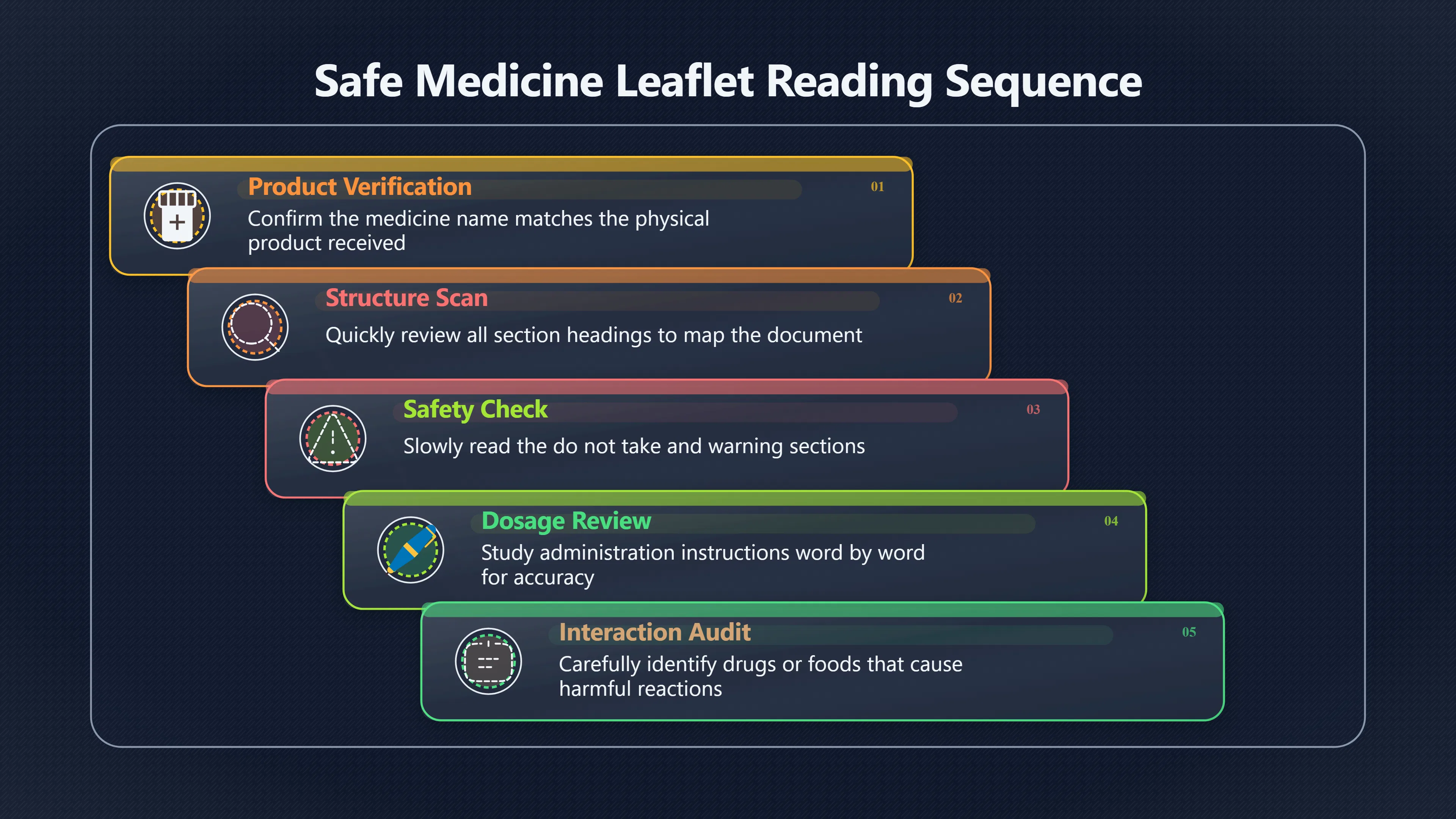
A practical sequence is:
- Read the medicine name and confirm it matches the product received.
- Scan the contents and section headings.
- Read “Do not take” and warning sections carefully.
- Read dosage and administration instructions slowly.
- Read interaction warnings carefully.
- Read missed-dose and overdose instructions.
- Identify side effects that require urgent action.
- Skim the remaining reference information as needed.
This approach preserves speed while protecting against the most costly reading error: overlooking information that changes how the medicine should be taken.
Why slowing down here actually saves time
People often think reading more slowly is inefficient. With medicine leaflets, the opposite is usually true.
A few extra minutes spent checking dosage, interactions, and warning sections can prevent medication errors, unnecessary side effects, treatment failure, or urgent medical consultations. European regulatory guidance identifies medication errors as a significant public-health problem and emphasises the importance of measures that reduce them.[European Medicines Agency (EMA)]ema.europa.euNovember 23, 2015 — 18 Nov 2015 — Medication errors present a major public health burden and there is a need to optimise risk minimisa…
For most documents, faster reading is a productivity choice. For medicine leaflets, selective slowing is a safety skill. The reader who skims the overview but carefully studies dosage, interactions, and warning sections is usually reading at the most efficient speed for the task.
Amazon book picks
Further Reading
Books and field guides related to The leaflet sections you should not skim. Use these as the next step if you want deeper reading beyond the article.
Mayo Clinic family health book
Provides context for treatment decisions and medication guidance.
How to Read a Book
Rating: 4.0/5 from 41 Google Books ratings
With half a million copies in print, How to Read a Book is the best and most successful guide to reading comprehension for the general re...

Thanks for the Feedback
First published 2014. Subjects: BUSINESS & ECONOMICS / Skills, Interpersonal communication, BUSINESS & ECONOMICS / Decision-Making & Prob...
eBay marketplace picks
Marketplace Samples
Example marketplace items related to this page. Use the search link to explore similar finds on eBay.

Endnotes
1.
Source: GOV.UK
Title: medicines packaging labelling and patient information leaflets
Link:https://www.gov.uk/guidance/medicines-packaging-labelling-and-patient-information-leaflets
Source snippet
packaging, labelling and patient information leaflets18 Dec 2014 — The MHRA approves all packaging and labelling information for medicine...
2.
Source: GOV.UK
Title: best [practice]({{ ‘practice/’ | relative_url }}) guidance on patient information leaflets
Link:https://www.gov.uk/government/publications/best-practice-guidance-on-patient-information-leaflets
Source snippet
29 Dec 2014 — This guidance sets out the legal framework for patient information leaflets as described in EU and national legislation and...
3.
Source: GOV.UK
Link:https://www.gov.uk/guidance/find-product-information-about-medicines
Source snippet
product information about medicinesEvery medicine pack includes a patient information leaflet (PIL), which provides information on using...
4.
Source: assets.publishing.service.gov.uk
Link:https://assets.publishing.service.gov.uk/media/5fe086c18fa8f5149718d66a/Best_practice_guidance_on_patient_information_leaflets.pdf
Source snippet
practice guidance on patient information leaflets (PILs)Information necessary before taking the medicine: Situations where the medicine s...
5.
Source: fda.gov
Link:https://www.fda.gov/media/72142/download
Source snippet
Food and Drug AdministrationDosage and Administration Section of Labeling for Human...January 12, 2023 — 17 Oct 2022 — FDA recommends in...
Published: January 12, 2023
6.
Source: fda.gov
Title: drug interactions what you should know
Link:https://www.fda.gov/drugs/resources-drugs/drug-interactions-what-you-should-know
Source snippet
Food and Drug AdministrationDrug Interactions: What You Should Know25 Sept 2013 — Drug interactions may make your drug less effective, ca...
7.
Source: fda.gov
Link:https://www.fda.gov/media/72574/download
Source snippet
Food and Drug AdministrationUseful Written Consumer Medication Information (CMI)August 18, 2014 — If it is almost time for your next dose...
Published: August 18, 2014
8.
Source: pmc.ncbi.nlm.nih.gov
Title: PMCWhat should patients do if they miss a dose?
Link:https://pmc.ncbi.nlm.nih.gov/articles/PMC7803707/
Source snippet
A systematic...by A Albassam · 2020 · Cited by 30 — Advice on missed doses is generally inadequate. Pharmaceutical companies and regulat...
9.
Source: yellowcard.mhra.gov.uk
Link:https://yellowcard.mhra.gov.uk/
Source snippet
Yellow CardYellow Card | Making medicines and medical devices saferMHRA Homepage for reporting of suspected side effects or adverse drug...
10.
Source: products.mhra.gov.uk
Title: MHRA Products Patient Information Leaflet
Link:https://products.mhra.gov.uk/search/?page=1&search=valproate
Source snippet
This may mean that there are differences between the information in the...Read more...
11.
Source: GOV.UK
Link:https://www.gov.uk/government/publications/safety-communications-concerning-medicines-medical-devices-and-other-healthcare-products/safety-communications-concerning-medicines-medical-devices-and-other-healthcare-products
Source snippet
communications concerning medicines, medical...25 Mar 2025 — The MHRA continually monitors the safety of products, balancing their benef...
12.
Source: GOV.UK
Link:https://www.gov.uk/drug-safety-update
Source snippet
Safety UpdateAlerts, recalls and safety information: A safety review has been conducted by the MHRA following a Yellow Card report concer...
13.
Source: legislation.gov.uk
Link:https://www.legislation.gov.uk/ukpga/2021/3/notes/division/8/index.htm
Source snippet
It is essential for certain medicines...Read more...
14.
Source: GOV.UK
Title: submitting changes to labelling and patient information leaflets
Link:https://www.gov.uk/government/publications/submitting-changes-to-labelling-and-patient-information-leaflets/submitting-changes-to-labelling-and-patient-information-leaflets
Source snippet
changes to labelling and patient information...22 Dec 2023 — This guidance document applies to changes in relation to the packaging comp...
15.
Source: products.mhra.gov.uk
Link:https://products.mhra.gov.uk/
Source snippet
HomeEvery medicine pack includes a patient information leaflet (PIL), which provides information on using the medicine safely...
16.
Source: medregs.blog.gov.uk
Link:https://medregs.blog.gov.uk/2018/06/07/submitting-a-variation-that-impacts-the-smpc-label-and-patient-information-leaflet-pil/
Source snippet
a variation that impacts the SmPC, label and...7 Jun 2018 — In addition, clean versions of the relevant SmPC fragments that have been ch...
17.
Source: healthdirect.gov.au
Link:https://www.healthdirect.gov.au/how-to-read-cmis
Source snippet
over medicine; information on possible interactions with other...Read more...
18.
Source: ema.europa.eu
Link:https://www.ema.europa.eu/en/documents/regulatory-procedural-guideline/good-practice-guide-risk-minimisation-and-prevention-medication-errors_en.pdf
Source snippet
November 23, 2015 — 18 Nov 2015 — Medication errors present a major public health burden and there is a need to optimise risk minimisa...
Published: November 23, 2015
19.
Source: fda.gov
Title: pharmacists help you use medicines safely
Link:https://www.fda.gov/consumers/consumer-updates/fda-pharmacists-help-you-use-medicines-safely
Source snippet
31 Aug 2023 — Pharmacists can help people take their medicine properly and continue to take it for as long as recommended.Read more...
Additional References
20.
Source: mtw.nhs.uk
Link:https://www.mtw.nhs.uk/wp-content/uploads/2019/09/Information-about-your-medicine-STANDARD-PRINT-LEAFLETCORE.pdf
Source snippet
Information about your medicinesThis leaflet contains some possible sources of further advice and some general information about medicine...
21.
Source: cpe.org.uk
Link:https://cpe.org.uk/quality-and-regulations/clinical-governance/patient-safety-incident-reporting/patient-safety-information/
Source snippet
Patient safety informationThe Medicines and Healthcare products Regulatory Agency (MHRA) have made changes to the way they issue drug saf...
22.
Source: understoodcare.com
Link:https://www.understoodcare.com/uc-articles/timing-and-dosage
Source snippet
Timing and DosageGeneral advice for many medicines is to take a missed dose when you remember unless it is close to the next planned time...
23.
Source: wmic.wales.nhs.uk
Link:https://www.wmic.wales.nhs.uk/wp-content/uploads/2022/10/UKMi-Enquiry-Answering-Guidelines-2022-update.pdf
Source snippet
range of patient information leaflets about medicines for children to view or...
24.
Source: nhs.uk
Link:https://www.nhs.uk/tests-and-treatments/medicines-information/
Source snippet
informationThis page explains the different types of medicine, the difference between branded drugs and generics, and how the medicines b...
25.
Source: pslhub.org
Link:https://www.pslhub.org/learn/organisations-linked-to-patient-safety-uk-and-beyond/regulators-and-their-regulations/system-and-product-regulators/mhra/mhra-medicines-packaging-labelling-and-patient-information-leaflets-20-april-2016-version-2-r444/
Source snippet
MHRA: Medicines: packaging, labelling and patient...20 Apr 2016 — Guidance from the Medicines and Healthcare products Regulatory Agency...
Published: april 2016
26.
Source: carelearning.org.uk
Link:https://carelearning.org.uk/qualifications/level-3-extended-hsc/hsc-dmo6-medication/6-1-explain-the-contents-of-patient-information-leaflets-supplied-with-all-medicines/
Source snippet
Explain the contents of patient information leaflets...13 Apr 2025 — These leaflets are often written in straightforward language to hel...
27.
Source: gloshospitals.nhs.uk
Link:https://www.gloshospitals.nhs.uk/documents/23189/Unlicensed_medicines_information_GHPI0452_02_25.pdf
Source snippet
Why are medicines 'licensed'? The makers of medicines must ask the Government for a. Marketing...Read more...
28.
Source: brettonparkhealthcare.co.uk
Title: MHR A Patient Information Leaflets MHRA Patient Information Leaflets
Link:https://www.brettonparkhealthcare.co.uk/health-information/mhra-patient-information-leaflets/
Source snippet
Rivaroxaban Patient Letter – August 2019 · Carbimazole Patient Letter · Hydrochlorothiazide Patient Letter · Modafinil...Read more...
Published: August 2019
29.
Source: datapharm.com
Title: challenges paper leaflet digital patient information leaflets
Link:https://www.datapharm.com/resource-hub/challenges-paper-leaflet-digital-patient-information-leaflets/
Source snippet
The challenges with Patient Information Leaflets17 Mar 2023 — Under MHRA regulations in the UK, the PIL is a legally required document fo...
Topic Tree