Within Tech docs
Stop Reading Reference Pages Front to Back
Reference pages work best when you arrive with a precise question, search within the page, and inspect nearby limits or exceptions.
On this page
- Why reference pages are built for lookup
- How to form the exact search question
- What to check around the matching answer
Page outline Jump by section
Introduction
When the goal is increasing reading speed in technical documentation, few mistakes waste more time than reading reference pages from beginning to end. API references, parameter tables, command lists, configuration options, and error-code catalogues are not designed as learning narratives. They are designed for retrieval. Documentation frameworks such as Diátaxis explicitly describe reference material as something users consult rather than read, while DITA classifies reference topics as fact-based information that is typically looked up instead of memorised.[Diátaxis]diataxis.frDiátaxisReferenceReference guides are technical descriptions of the machinery and how to operate it. Reference material is information-or…
 The fastest documentation users recognise this distinction immediately. They arrive with a precise question, search for the relevant fact, verify surrounding constraints, and leave. Treating a reference page like a chapter in a book often creates the illusion of thoroughness while slowing problem-solving dramatically.
Stop Reading Reference Pages Front to Back
Reference documentation exists for a different purpose than conceptual explanations or task guides. Its primary function is to provide authoritative facts quickly and consistently. Documentation standards repeatedly describe reference content as collections of specifications, parameters, commands, functions, properties, and other structured facts that support work in progress.[OASIS Open+2Oxygen XML Editor]docs.oasis-open.orgdita reference topicOASIS Open2.2.2.2 Reference topic1 Dec 2010 — The DITA reference document type uses the reference information type. Reference topics are…
This design choice affects how the material should be read.
A developer opening a command reference usually does not need to understand every command. A system administrator checking an error code rarely benefits from reading hundreds of unrelated entries. An engineer searching an API parameter list is trying to answer one question, not complete a lesson.
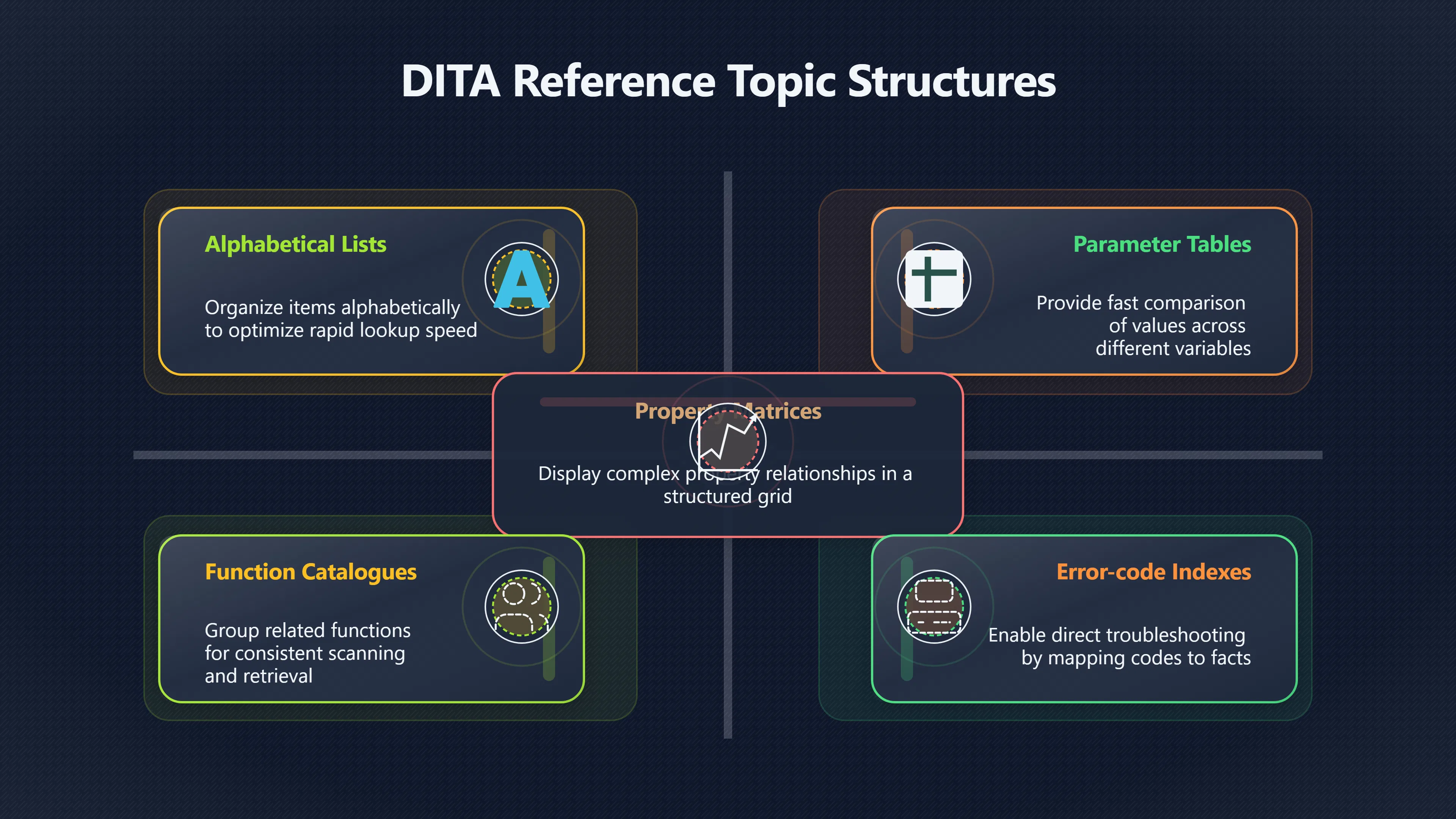
Reference pages are often intentionally organised as:
- Alphabetical lists
- Parameter tables
- Property matrices
- Function catalogues
- Error-code indexes
- Command references
These structures optimise lookup speed rather than continuous reading. DITA specifications explicitly describe reference information as data that is often “looked up” rather than memorised.[OASIS Open]docs.oasis-open.orgdita reference topicOASIS Open2.2.2.2 Reference topic1 Dec 2010 — The DITA reference document type uses the reference information type. Reference topics are…
The practical consequence is simple: if you find yourself reading ten screens of parameter definitions that are unrelated to your current task, you are probably using the wrong reading strategy.
Why Reference Pages Are Built for Lookup
Many documentation systems deliberately separate reference content from tutorials and how-to guides because users arrive with different goals. Reference material serves the need for certainty and exactness rather than understanding or guided action.[Diátaxis+2Diátaxis]diataxis.frDiátaxisReferenceReference guides are technical descriptions of the machinery and how to operate it. Reference material is information-or…
This explains several common design patterns:
FeatureWhy it ExistsLong parameter tablesFast comparison of valuesStructured field descriptionsConsistent scanningSearchable command listsRapid retrievalError-code indexesDirect troubleshootingAuto-generated API referencesAccuracy and completeness
Diátaxis describes reference documentation as a map of the system: users consult it for facts while working rather than studying it as educational material.[Diátaxis]diataxis.frDiátaxisReferenceReference guides are technical descriptions of the machinery and how to operate it. Reference material is information-or…
Modern API documentation increasingly reinforces this lookup model. Reference sections are often generated directly from machine-readable specifications so developers can retrieve exact endpoint definitions, response fields, or parameter constraints without navigating explanatory prose.[Mintlify]mintlify.comGenerate reference docs from your API specification. If you have an OpenAPI (Swagger) specification, use it to generate your…Read more…
A useful mental shift is to stop asking, “How quickly can I read this page?” and start asking, “How quickly can I extract the fact I need?”
How to Form the Exact Search Question
Reference pages reward specificity.
Readers who open a page and begin scrolling are usually slower than readers who first formulate an exact question.
Weak search question:
- How does authentication work?[youtube.com]youtube.comAPI Documentation and Why it MattersWhat Does an API Technical Writer Do? · API Documentation Best Practices – Full Course ·…
Strong reference search question:
- Which authentication header is required?
- What values are accepted by this parameter?
- Which error code indicates token expiration?
- Is this command available in version 3.2?
The more precise the question, the smaller the search space.
A useful workflow is:
- State the question in one sentence.
- Identify the likely keyword.
- Use page search (
Ctrl+For equivalent). - Jump directly to the matching section.
- Verify nearby conditions and exceptions.
For example, instead of reading an entire API endpoint reference, search for the exact field name, HTTP status code, or configuration option involved in the problem. This converts a ten-minute reading session into a thirty-second lookup.

What to Check Around the Matching Answer
Finding the matching line is often only half the job.
One of the most common speed-related mistakes is stopping at the first matching keyword and ignoring the surrounding context. Reference documentation frequently places critical limitations immediately adjacent to the answer.
After locating a parameter, command, or error code, check:
- Accepted value ranges
- Default values
- Version restrictions
- Deprecated status
- Required dependencies
- Permission requirements
- Related parameters
- Exceptions and edge cases
Consider a configuration parameter that appears to accept a boolean value. A nearby note might reveal that the parameter only applies to enterprise editions, only works after restart, or is ignored under certain conditions.
These details are often located directly above or below the primary entry because reference authors expect readers to arrive through search rather than sequential reading.
The Hidden Risk of Overreading
Reading entire reference sections can create a false sense of productivity.
Research on API documentation quality consistently shows that developers depend heavily on efficient access to relevant information, and poorly organised or difficult-to-scan documentation reduces productivity. Documentation “smells” and presentation problems are reported by practitioners as frequent obstacles to effective work.[arXiv]arxiv.orgAutomatic Detection of Five API Documentation Smells: Practitioners' PerspectivesFebruary 16, 2021…
Overreading introduces several risks:
- Important details become buried among irrelevant facts.
- Working memory fills with information unrelated to the task.
- Readers lose track of the original problem.
- Time is spent acquiring knowledge that may never be used.
The goal is not comprehensive coverage. The goal is accurate retrieval.
A developer troubleshooting a specific HTTP 403 error usually gains more value from finding that single error definition and its neighbouring notes than from reading the entire authentication chapter.

A Faster Reference-Lookup Workflow
For reference-heavy work, a high-speed workflow looks like this:
Identify the task question
- What exact fact is missing?
Search before scrolling
- Use page search, site search, or documentation navigation.
Land on the relevant entry
- Parameter, command, method, field, or error code.
Read locally
- Read the matching item plus nearby warnings, limits, defaults, and examples.
Return to the task
- Apply the information immediately.
This approach aligns with how reference material is designed. Documentation architects increasingly separate factual reference information from explanatory content so users can locate precise answers without reading through broader context.[cloudcannon.com+2blog.sequinstream.com]cloudcannon.comredesigning cloudcannons docs with diataxis lume and pagefindRedesigning CloudCannon's docs with Diátaxis, Lume…4 Feb 2026 — By separating Reference information into its own section on the websit…
For increasing reading speed, the key insight is counterintuitive: the fastest way to use a reference page is often not to read it at all. It is to search it, verify the surrounding constraints, extract the needed fact, and move on.
Amazon book picks
Further Reading
Books and field guides related to Stop Reading Reference Pages Front to Back. Use these as the next step if you want deeper reading beyond the article.
The Linux Command Line
Shows effective use of command references and lookup-oriented material.
UNIX and Linux System Administration Handbook (5th Edition)
Heavy use of factual lookup and reference workflows.

Site Reliability Engineering
Demonstrates targeted retrieval of technical facts and procedures.
Kubernetes: Up and Running: Dive into the Future of Infrastru...
First published 2017. Subjects: Development, Installation, Application software, Software maintenance, Open source software.
eBay marketplace picks
Marketplace Samples
Example marketplace items related to this page. Use the search link to explore similar finds on eBay.




Endnotes
1.
Source: docs.oasis-open.org
Title: dita reference topic
Link:https://docs.oasis-open.org/dita/v1.2/os/spec/archSpec/dita_reference_topic.html
Source snippet
OASIS Open2.2.2.2 Reference topic1 Dec 2010 — The DITA reference document type uses the reference information type. Reference topics are...
2.
Source: docs.oasis-open.org
Link:https://docs.oasis-open.org/dita/v1.0/langspec/reference.html
Source snippet
topics document programming constructs or facts about a product. Examples of reference topics include language elements, class descriptio...
3.
Source: mintlify.com
Link:https://www.mintlify.com/library/api-documentation-guide
Source snippet
Generate reference docs from your API specification. If you have an OpenAPI (Swagger) specification, use it to generate your...Read more...
4.
Source: arxiv.org
Title: arXiv Automatically Extracting Web API Specifications from HTML Documentation
Link:https://arxiv.org/abs/1801.08928
5.
Source: arxiv.org
Link:https://arxiv.org/abs/2102.08486
Source snippet
Automatic Detection of Five API Documentation Smells: Practitioners' PerspectivesFebruary 16, 2021...
Published: February 16, 2021
6.
Source: cloudcannon.com
Title: redesigning cloudcannons docs with diataxis lume and pagefind
Link:https://cloudcannon.com/blog/redesigning-cloudcannons-docs-with-diataxis-lume-and-pagefind/
Source snippet
Redesigning CloudCannon's docs with Diátaxis, Lume...4 Feb 2026 — By separating Reference information into its own section on the websit...
7.
Source: blog.sequinstream.com
Title: we fixed our documentation with the diataxis framework
Link:https://blog.sequinstream.com/we-fixed-our-documentation-with-the-diataxis-framework/
Source snippet
Separating pure technical facts from tutorials and guides makes all your documentation clearer...Read more...
8.
Source: diataxis.fr
Link:https://diataxis.fr/reference/
Source snippet
DiátaxisReferenceReference guides are technical descriptions of the machinery and how to operate it. Reference material is information-or...
9.
Source: oxygenxml.com
Link:https://www.oxygenxml.com/dita/1.3/specs/langRef/technicalContent/reference.html
Source snippet
Oxygen XML EditorreferenceThe reference element defines a top-level container for a reference topic. Reference topics document programmin...
10.
Source: diataxis.fr
Link:https://diataxis.fr/
Source snippet
DiátaxisDiátaxis identifies four distinct needs, and four corresponding forms of documentation - tutorials, how-to guides, technical refe...
11.
Source: diataxis.fr
Link:https://diataxis.fr/how-to-guides/
Source snippet
How-to guidesHow-to guides are directions that guide the reader through a problem or towards a result. How-to guides are goal-oriented.Re...
Additional References
12.
Source: structuredauthoring.net
Link:https://structuredauthoring.net/xml/readings/9_references_and_shortdesc.html
Source snippet
DITA Reference Topics and Short DescriptionsReference topics include a collection of facts. They provide detailed explanatory information...
13.
Source: idratherbewriting.com
Link:https://idratherbewriting.com/specializations/
14.
Source: cs.mcgill.ca
Link:https://www.cs.mcgill.ca/~martin/papers/tse2013a.pdf
Source snippet
McGill School of Computer SciencePatterns of Knowledge in API Reference Documentationby W Maalej · Cited by 266 — We report on a study of...
15.
Source: docs.openedx.org
Link:https://docs.openedx.org/en/open-release-sumac.master/documentors/concepts/content_types.html
Source snippet
edX Diataxis Guide — Latest documentationThe Diataxis framework is an approach to quality in technical documentation and creates a system...
16.
Source: heretto.com
Link:https://www.heretto.com/blog/concept-task-reference
Source snippet
The 3 Core DITA Topic Types ExplainedMaster the 3 core DITA topic types: concept, task, and reference. Learn when to use each for perfect...
17.
Source: youtube.com
Link:https://www.youtube.com/watch?v=39Tt1IkLiQQ
Source snippet
API Documentation and Why it MattersWhat Does an API Technical Writer Do? · API Documentation Best Practices – Full Course ·...
18.
Source: youtu.be
Link:https://youtu.be/ECXtMPx-4uQ
Source snippet
"Docs Community: [https://github.com/python/docs-community](https://github.com/python/docs-community) Our Discourse forum: [https://discuss.python.org/c/documentation/26..."](https://discuss.python.org/c/documentation/26...")...
19.
Source: github.com
Link:https://github.com/evildmp/diataxis-documentation-framework/blob/main/reference-explanation.rst
Source snippet
Explanation and reference both belong to the theory half of the Diátaxis map - they don't contain steps to guide the reader, they contain...
20.
Source: gravitee.io
Title: api documentation done right technical guide
Link:https://www.gravitee.io/blog/api-documentation-done-right-technical-guide
Source snippet
API Documentation Done Right: A Technical Guide29 Oct 2024 — Build API documentation that works. From quick starts to error codes, master...
21.
Source: medium.com
Link:https://medium.com/%40vedran_cindric/11-best-practices-for-writing-api-documentation-8432ba85a56e
Source snippet
dings wherever necessary (usually where different...Read more...
Topic Tree