Within Benchmarks
Why Fiction Often Feels Faster to Read
Fiction often runs faster because its words and sentence patterns can demand less slow, word-by-word processing than many factual texts.
On this page
- How word length changes reading pace
- Why genre is not the same as difficulty
- Comparing novels, reports, manuals, and legal text
Page outline Jump by section
Introduction
When adults compare their reading speed, one number rarely tells the whole story. The same reader may move quickly through a novel yet slow down substantially when reading a report, textbook chapter, technical manual, or legal document. Research on reading rates consistently finds that fiction is read faster on average than non-fiction. A large review of 190 studies estimated average adult silent reading speeds of about 260 words per minute for fiction and 238 words per minute for non-fiction. Importantly, this gap does not mean fiction is always easy or non-fiction is always difficult. Instead, it reflects differences in how the text is constructed and how readers process it.[Ghent University Bibliography]biblio.ugent.beGhent University Bibliography How many words do we read per minute?A review and meta…by M Brysbaert · 2019 · Cited by 847 — The average oral reading rate (based on 77 studies and 5965 participants) is…
 Understanding why fiction often feels faster helps put reading-speed benchmarks into context. It also prevents a common mistake: assuming that a slower pace automatically reflects weaker reading ability.
How Word Length Changes Reading Pace
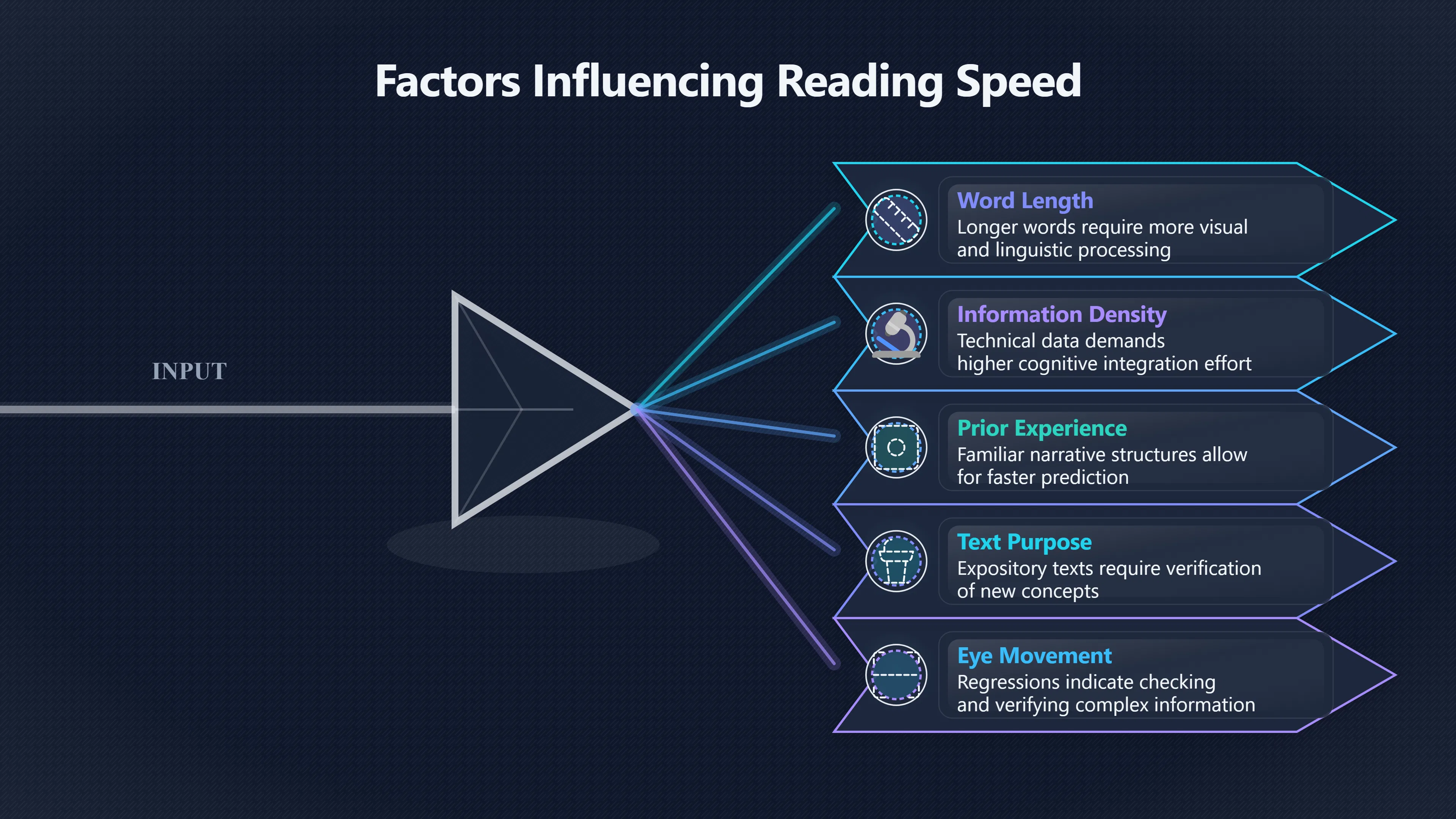
One of the strongest explanations for the fiction–non-fiction difference is surprisingly simple: non-fiction tends to use longer words.
Marc Brysbaert’s review of reading-rate research concluded that much of the average speed gap between fiction and non-fiction can be predicted by word length. Non-fiction regularly contains specialised vocabulary, technical terms, abstract concepts, and multi-syllable words that require slightly more visual and linguistic processing. Fiction, by contrast, often relies on shorter, more familiar words used in everyday language.[Ghent University Bibliography]biblio.ugent.beGhent University Bibliography How many words do we read per minute?A review and meta…by M Brysbaert · 2019 · Cited by 847 — The average oral reading rate (based on 77 studies and 5965 participants) is…
Later research examining reading-rate prediction found that average word length substantially improves estimates of how fast people will read a text. In practical terms, texts with shorter average words were associated with markedly faster predicted reading rates than texts containing longer words.[Sage Journals]journals.sagepub.comSage JournalsImproving reading rate prediction with word length…28 Apr 2021 — Previous research in English has suggested that reading…
This does not mean readers consciously stop to analyse every long word. Rather, each slightly more demanding recognition process accumulates over hundreds or thousands of words. A report discussing “organisational restructuring”, “macroeconomic indicators”, or “pharmacological interventions” naturally imposes a different processing burden than a novel describing a character walking into a room.
Why Genre Is Not the Same as Difficulty
A common misconception is that fiction is faster because it is inherently easier. The evidence suggests a more nuanced picture.
Readers often bring extensive prior experience to narrative reading. Stories generally follow characters, goals, conflicts, and sequences of events that people already understand from everyday life. Once readers grasp the situation, they can often predict what kinds of information will come next. That familiarity reduces the need for constant analytical checking.
Many non-fiction texts serve a different purpose. Their goal is often to explain, instruct, persuade, classify, or document. Readers must frequently evaluate new information, connect ideas across sections, and verify that they understand unfamiliar concepts. The slower pace comes not only from the language itself but from the cognitive task being performed.[EPC NTNU]epc.ntnu.edu.twEPC NTNUevidence from eye movements during science‐text readingJanuary 19, 2022 — by YC Jian · 2022 · Cited by 95 — readers show different eye move- ment patterns for reading narrative and expository…
This distinction explains why some fiction can be slower than some non-fiction. A dense literary novel filled with unusual language may require more effort than a clearly written newspaper article. Genre influences reading speed, but it does not determine it.
What Eye-Movement Research Reveals
Researchers often study reading through eye tracking, which records where readers look, how long they fixate on words, and when they move backwards through a text.
Studies comparing narrative and expository texts have found differences in reading behaviour. Readers tend to show more forward-moving patterns when reading narrative material, while expository texts are associated with more regressions—eye movements that return to earlier words or sentences for clarification. These backward movements are a sign that readers are checking, integrating, or verifying information.[PMC]pmc.ncbi.nlm.nih.govPMCThe Influence of Text Genre on Eye Movement Patternsby M Markevich · 2025 — Readers tended to use regressive patterns more often with expository and poetic texts, while forward patterns…
Eye-tracking research also shows that reading behaviour changes according to the structure and purpose of the text. Expository texts often require readers to build conceptual relationships rather than simply follow an unfolding sequence of events. That extra integration work can slow reading even when individual sentences are not especially difficult.[CentAUR]centaur.reading.ac.ukEye movements of deaf students in expository versus narrative…March 18, 2022 — by N Gómez-Merino · 2022 · Cited by 11 — The eff…
In other words, fiction often permits a smoother visual path through the page, whereas factual texts more frequently trigger rereading and checking.
Comparing Novels, Reports, Manuals, and Legal Text
The contrast becomes clearer when looking at common reading situations.
Text typeTypical processing demandsLikely effect on speedNovel or narrative fictionFollowing characters and eventsOften fastestMagazine feature or general-interest articleMix of narrative and informationModerateBusiness report or academic textNew concepts, evidence, terminologySlowerTechnical manualPrecise instructions and reference useOften much slowerLegal text or contractHigh precision, dense wording, frequent rereadingSlowest
A reader might comfortably read a thriller at more than 300 words per minute while slowing dramatically when reviewing tax guidance, engineering documentation, or contract language. The change reflects the task, not a sudden change in reading skill.[Ghent University Bibliography]biblio.ugent.beGhent University Bibliography How many words do we read per minute?A review and meta…by M Brysbaert · 2019 · Cited by 847 — The average oral reading rate (based on 77 studies and 5965 participants) is…
Legal and technical documents are especially slow because readers cannot safely rely on gist alone. Small wording differences may change meaning, so careful rereading becomes part of the job.
What This Means for Reading-Speed Benchmarks
The fiction–non-fiction gap is a reminder that reading speed is not a fixed personal trait. Research suggests that average adult fiction reading is somewhat faster than average adult non-fiction reading, and much of that difference can be explained by characteristics of the text itself, particularly word length and information density.[Ghent University Bibliography]biblio.ugent.beGhent University Bibliography How many words do we read per minute?A review and meta…by M Brysbaert · 2019 · Cited by 847 — The average oral reading rate (based on 77 studies and 5965 participants) is…
For anyone trying to increase reading speed, the practical lesson is straightforward: compare like with like. A reading rate achieved on a fast-moving novel should not be treated as the benchmark for technical reports or study materials. Realistic expectations depend on what you are reading and what level of understanding the task requires.
A slower pace on demanding factual material is often evidence of appropriate reading behaviour rather than a sign that something is wrong. The fastest useful reading speed is the one that matches the complexity of the text and preserves comprehension.[Ghent University Bibliography]biblio.ugent.beGhent University Bibliography How many words do we read per minute?A review and meta…by M Brysbaert · 2019 · Cited by 847 — The average oral reading rate (based on 77 studies and 5965 participants) is…
Amazon book picks
Further Reading
Books and field guides related to Why Fiction Often Feels Faster to Read. Use these as the next step if you want deeper reading beyond the article.
How to Read a Book
Rating: 4.0/5 from 41 Google Books ratings
Discusses adapting reading methods to different genres.
Proust and the Squid
Explains cognitive processes behind reading different text types.

eBay marketplace picks
Marketplace Samples
Example marketplace items related to this page. Use the search link to explore similar finds on eBay.


Endnotes
1.
Source: biblio.ugent.be
Title: Ghent University Bibliography How many words do we read per minute?
Link:https://biblio.ugent.be/publication/8647789
Source snippet
A review and meta...by M Brysbaert · 2019 · Cited by 847 — The average oral reading rate (based on 77 studies and 5965 participants) is...
2.
Source: journals.sagepub.com
Link:https://journals.sagepub.com/doi/10.1177/17470218211017100
Source snippet
Sage JournalsImproving reading rate prediction with word length...28 Apr 2021 — Previous research in English has suggested that reading...
3.
Source: pubmed.ncbi.nlm.nih.gov
Link:https://pubmed.ncbi.nlm.nih.gov/33910411/
Source snippet
reading rate prediction with word length...by M Brysbaert · 2021 · Cited by 10 — Previous research in English has suggested that reading...
4.
Source: epc.ntnu.edu.tw
Title: EPC NTNUevidence from eye movements during science‐text reading
Link:https://www.epc.ntnu.edu.tw/File/Archive/0D-5F-2B-FC-AE-B5-CF-8F-F2-D1-63-B9-1B-99-04-4D.pdf
Source snippet
January 19, 2022 — by YC Jian · 2022 · Cited by 95 — readers show different eye move- ment patterns for reading narrative and expository...
Published: January 19, 2022
5.
Source: pmc.ncbi.nlm.nih.gov
Title: PMCThe Influence of Text Genre on Eye Movement Patterns
Link:https://pmc.ncbi.nlm.nih.gov/articles/PMC12641876/
Source snippet
by M Markevich · 2025 — Readers tended to use regressive patterns more often with expository and poetic texts, while forward patterns...
6.
Source: centaur.reading.ac.uk
Link:https://centaur.reading.ac.uk/104163/1/Accepted%20version%20March%202022.pdf
Source snippet
Eye movements of deaf students in expository versus narrative...March 18, 2022 — by N Gómez-Merino · 2022 · Cited by 11 — The eff...
Published: March 18, 2022
7.
Source: journals.sagepub.com
Link:https://journals.sagepub.com/doi/10.1177/07319487241309895
Source snippet
Reading Comprehension Processes of...4 Jan 2025 — In the analysis of eye movement, researchers can [measure]({{ 'measure/' | relative_url }}) students' process of identify...
Additional References
8.
Source: reader.ku.edu
Link:https://reader.ku.edu/sites/reader/files/2024-01/How%20many%20words%20do%20we%20read%20per%20minute%20%281%29.pdf
Source snippet
175 to 300 wpm; for fiction the range is 200 to 320 wpm. Reading rates in other...Read more...
9.
Source: skepticalinquirer.org
Link:https://skepticalinquirer.org/2018/07/speed-reading-fact-or-fiction/
Source snippet
tching all the words, typically about 50 percent faster than their normal rate.Read more...
10.
Source: researchgate.net
Title: Research Gate(PDF) How many words do we read per minute?
Link:https://www.researchgate.net/publication/335174808_How_many_words_do_we_read_per_minute_A_review_and_meta-analysis_of_reading_rate
Source snippet
A review...15 Aug 2019 — We estimate that the average silent reading rate for adults in English is 238 words per minute (wpm) for non-fi...
11.
Source: medium.com
Title: read faster using science use these 3 tips bd94605f3faf
Link:https://medium.com/%40axel.em.casas/read-faster-using-science-use-these-3-tips-bd94605f3faf
Source snippet
Read Faster Using Science (Use These 3 Tips)Well, 300 words per minute (wpm). Brysbaert (2019) found that this figure is cited across stu...
12.
Source: academia.edu
Link:https://www.academia.edu/70380155/Eye_movements_and_mental_imagery_during_reading_of_literary_texts_with_different_narrative_styles
Source snippet
escriptive” style texts render environments dissociated from human action.Read more...
13.
Source: accruva.app
Link:https://accruva.app/blog/speed-reading-science/average-reading-speed-wpm-benchmarks/
Source snippet
on Brysbaert's 2019 meta-analysis of 190 studies and 17,887...Read more...
14.
Source: researchgate.net
Title: (PDF) How many words do we read per minute?
Link:https://www.researchgate.net/publication/332380784_How_many_words_do_we_read_per_minute_A_review_and_meta-analysis_of_reading_rate
Source snippet
A review...by M Brysbaert · Cited by 846 — We estimate that the average silent reading rate for adults in English is 238 word per minute...
15.
Source: reddit.com
Title: Reading Fiction Faster than Non-Fiction?
Link:https://www.reddit.com/r/books/comments/azfxld/reading_fiction_faster_than_nonfiction/
Source snippet
r/booksHere's an interesting one for you all. So far this year I've read nine books, which breaks down to three non-fiction and six ficti...
16.
Source: gwern.net
Title: How many words do we read per minute?
Link:https://gwern.net/doc/psychology/linguistics/2019-brysbaert.pdf
Source snippet
A review and...For silent reading of English non-fiction most adults fall in the range of 175–300 wpm; for fiction the range is. 200–320...
17.
Source: domcorvasce.com
Title: how to estimate reading time
Link:https://domcorvasce.com/posts/how-to-estimate-reading-time/
Source snippet
Domenico CorvasceMar 8, 2025 — Accordingly to a paper released in 2019 [1] the average reading speed for adult English speakers is 238 WP...
Topic Tree