Within Myths
Should You Really Silence Your Inner Voice?
The inner voice is not just wasted time; it often helps readers hold meaning together when sentences get difficult.
On this page
- What subvocalisation really means
- Why phonological coding supports comprehension
- When suppressing the inner voice backfires
Page outline Jump by section
Introduction
Many speed-reading systems present subvocalisation—the experience of hearing words internally while reading—as a bottleneck that must be eliminated. The underlying promise is simple: if you stop “saying” words in your head, you can read far faster. The problem is that this advice often confuses two different things. Skilled readers do not usually recreate full spoken speech while reading, but they do activate sound-based representations of language. Those representations help hold words and ideas in working memory, connect sentences together, and support comprehension when texts become difficult. Research on reading and working memory consistently suggests that the inner voice is not merely wasted time. In many situations, especially when material is complex, it is part of the machinery that makes understanding possible.[PubMed+2WIRED]pubmed.ncbi.nlm.nih.govPub Med How Do We Read, and Can Speed Reading Help?by K Rayner · 2016 · Cited by 530 — The prospect of speed reading–reading at an increased speed without any loss of comprehension…

Should You Really Silence Your Inner Voice?
The popular speed-reading claim starts from an intuitive observation: spoken language is slower than reading. If reading depended on mentally pronouncing every word at speech speed, then eliminating that process would seem to remove a major limitation.
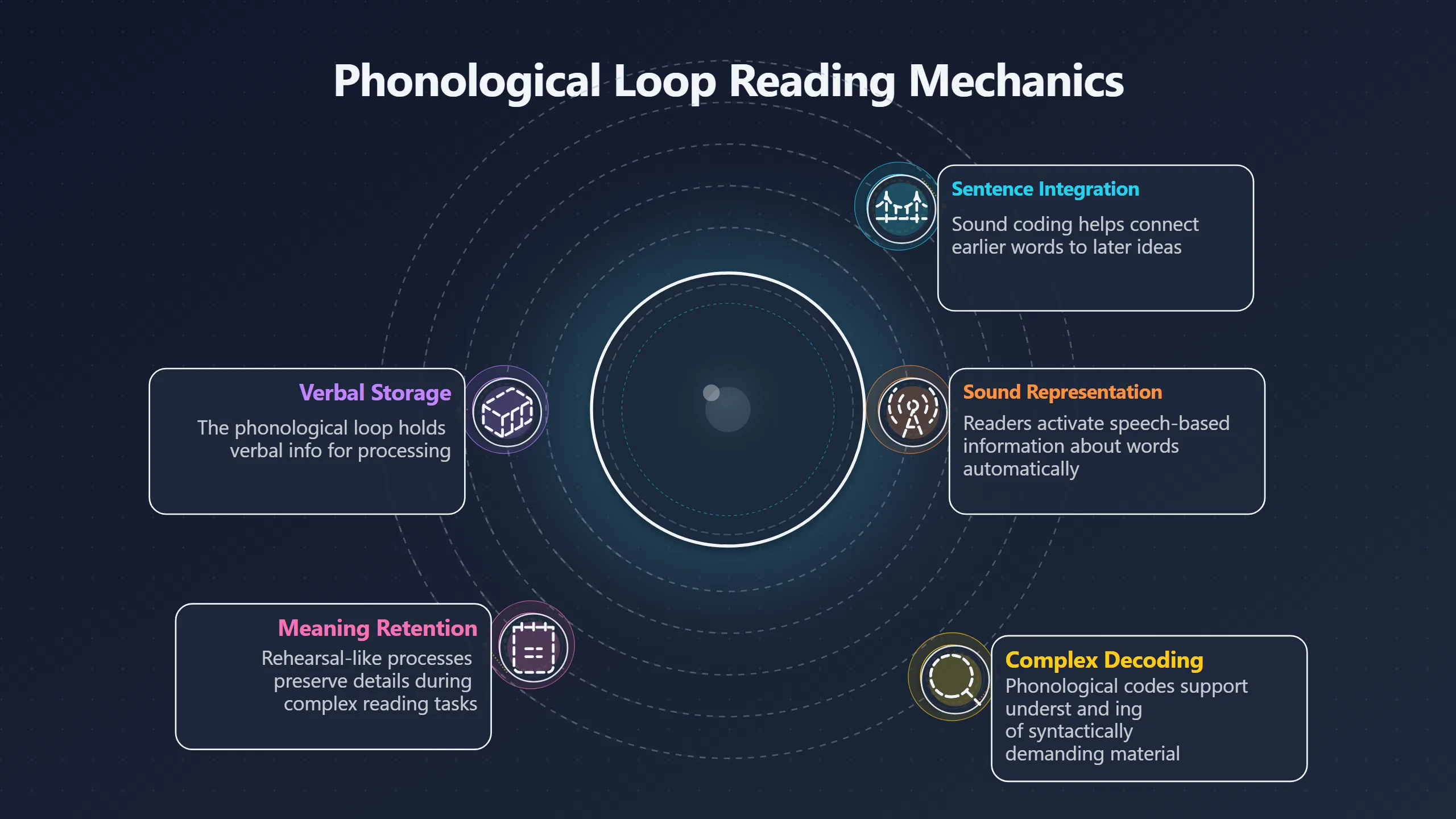
However, reading researchers have long argued that this framing oversimplifies what happens during skilled reading. The sound-related activity that occurs during reading is often better understood as phonological coding—the activation of speech-based information about words—rather than the conscious simulation of speaking them aloud. Readers use this information rapidly and automatically as they connect spelling, pronunciation, grammar, and meaning.[WIRED+2Wikipedia]wired.comBasic calculations based on the properties of eyes and texts indicate that an average reading speed is around 280 words per minute, a val…
This distinction matters because the argument against subvocalisation often treats all sound-linked processing as unnecessary. Yet decades of research on reading indicate that phonological information remains deeply integrated into skilled literacy rather than serving merely as a beginner’s crutch.[WIRED+2PMC]wired.comBasic calculations based on the properties of eyes and texts indicate that an average reading speed is around 280 words per minute, a val…
What Subvocalisation Really Means
Subvocalisation is commonly defined as silent internal speech that accompanies reading. It can involve a subjective sense of hearing words internally and may be associated with subtle activation of speech-related systems even when no audible speech occurs.[Wikipedia]WikipediaOpen source on wikipedia.org.
Importantly, not all readers experience it in exactly the same way. Some report a vivid internal voice, while others experience a less conscious form of phonological processing. The critical point is that reading typically engages language systems that encode sound-related information even when readers are moving through text silently and efficiently.[PMC]pmc.ncbi.nlm.nih.govInner Speech during Silent Reading Reflects the Reader's…by R Filik · 2011 · Cited by 115 — The current study suggests that inner s…
This helps explain why attempts to eliminate the inner voice completely often prove difficult. Research on reading suggests that phonological activation is not a detachable habit layered on top of comprehension. Instead, it is intertwined with the way literate adults recognise and interpret written language.[WIRED]wired.comBasic calculations based on the properties of eyes and texts indicate that an average reading speed is around 280 words per minute, a val…
Why Phonological Coding Supports Comprehension
The strongest case for retaining some level of inner speech emerges when reading places heavy demands on working memory.
Holding Meaning Across a Sentence
Understanding a sentence is not simply a matter of decoding one word after another. Readers must retain earlier words and phrases long enough to integrate them with later information. This challenge becomes greater when sentences contain multiple clauses, embedded structures, exceptions, or delayed conclusions.
Research on working memory has repeatedly linked phonological storage and rehearsal mechanisms to sentence comprehension. The phonological loop—a component of working memory proposed by Alan Baddeley and Graham Hitch—allows verbal information to remain active long enough for readers to combine ideas into a coherent meaning.[The Decision Lab]thedecisionlab.comThe Decision LabPhonological LoopThe phonological loop is the part of working memory that holds and processes verbal and auditory informa…
Studies examining complex sentence comprehension have found meaningful relationships between phonological short-term memory capacity and the ability to understand syntactically demanding material. When readers must keep linguistic information active while processing new input, sound-based coding becomes particularly useful.[PMC]pmc.ncbi.nlm.nih.govComplex Sentence Comprehension and Working Memory in…by JW Montgomery · 2008 · Cited by 429 — This study investigated the associati…
Bridging Earlier and Later Ideas
Consider a sentence such as:
“The proposal that the committee reviewing the policy submitted after months of debate eventually approved was later challenged.”
To understand the sentence, the reader must maintain several linguistic elements simultaneously while waiting for the main structure to resolve. Sound-linked representations help keep these elements accessible during processing.
Subvocalisation is therefore not primarily about hearing a narration. Its value often lies in maintaining verbal information long enough for the reader to connect earlier concepts with later ones. Researchers have argued that phonological coding provides a flexible and durable format for integrating information across phrases, sentences, and larger passages.[Wikipedia]WikipediaOpen source on wikipedia.org.
Supporting Memory During Reading
Reading comprehension depends not only on understanding a sentence in the moment but also on retaining enough information to build a mental model of the text.
Working-memory research shows that verbal information is often preserved through rehearsal-like processes associated with inner speech. Readers who can efficiently maintain verbal representations generally have an advantage when tasks require remembering details, following arguments, or tracking relationships between ideas.[PMC+2The Decision Lab]pmc.ncbi.nlm.nih.govPMCInner Speech: Development, Cognitive Functionsby B Alderson-Day · 2015 · Cited by 1124 — One way of interpreting this evidence is to think that the phonological loop primarily func…
This becomes especially important in academic reading, legal documents, technical manuals, philosophy, and scientific writing, where key information may need to remain active across several paragraphs before its significance becomes clear.

When Suppressing the Inner Voice Backfires
The strongest evidence against blanket anti-subvocalisation advice comes from studies that interfere with phonological processing.
Researchers often use a technique called articulatory suppression, in which participants repeat an irrelevant sound while performing another task. Because the repetition occupies speech-related resources, it reduces the ability to use normal subvocal rehearsal mechanisms.
Across many language tasks, disrupting phonological processing tends to impair performance when verbal information must be maintained or integrated. Reading comprehension is particularly vulnerable when texts require readers to remember and combine information across larger units of meaning.[Wikipedia]WikipediaOpen source on wikipedia.org.
The practical consequence is that suppressing the inner voice may produce the illusion of faster reading while reducing the reader’s ability to:
- Track complex arguments.
- Detect ambiguities.
- Integrate information across sentences.
- Retain important details.
- Make accurate inferences from the text.[PubMed+2Association for Psychological Science]pubmed.ncbi.nlm.nih.govPub Med How Do We Read, and Can Speed Reading Help?by K Rayner · 2016 · Cited by 530 — The prospect of speed reading–reading at an increased speed without any loss of comprehension…
This tradeoff is often hidden because speed is easy to measure whereas deep comprehension is harder to assess.
Why Simple Texts and Difficult Texts Are Different
One reason the anti-subvocalisation message persists is that it can appear to work under limited conditions.
When readers skim familiar material, headlines, emails, or straightforward narrative passages, they can often reduce conscious awareness of their inner voice without obvious consequences. Much of the meaning can be inferred from context, prior knowledge, and prediction.[ResearchGate]researchgate.netResearch Gate How Do We Read, and Can Speed Reading Help?It is unlikely that readers will be able to double or triple their reading speeds.Read more…
Complex texts create a different situation. Technical writing, dense non-fiction, mathematical explanations, legal language, and literary prose often contain information that cannot be guessed from context alone. In these cases, phonological coding becomes more valuable because the reader must hold precise wording and relationships in mind.
Research reviews on speed reading repeatedly conclude that gains in speed are accompanied by losses in comprehension when the goal is thorough understanding rather than gist extraction. The more demanding the material, the more costly those losses become. The Guardian+3PubMed+3Association for Psychological Science[pubmed.ncbi.nlm.nih.gov]pubmed.ncbi.nlm.nih.govPub Med How Do We Read, and Can Speed Reading Help?by K Rayner · 2016 · Cited by 530 — The prospect of speed reading–reading at an increased speed without any loss of comprehension…
The Real Reading Bottleneck
The myth behind many anti-subvocalisation programmes is the assumption that reading speed is capped by the rate of speech. Reading research suggests otherwise.
Skilled readers typically process text faster than spoken language while still activating phonological information. The brain does not need to simulate full speech in real time to benefit from sound-based coding. The crucial mistake is equating phonology with overt speaking. Researchers have argued that readers use phonological representations because they are useful for comprehension, not because they are trapped at conversational speaking speeds.[WIRED]wired.comBasic calculations based on the properties of eyes and texts indicate that an average reading speed is around 280 words per minute, a val…
As a result, attempts to eliminate the inner voice entirely may remove a tool that supports understanding without delivering the dramatic speed increases often promised by commercial speed-reading systems.
A Better View of the Inner Voice
For readers interested in increasing reading speed, the more evidence-based goal is not to eradicate subvocalisation but to use it flexibly.
When skimming for a general overview, the inner voice may become less prominent because comprehension demands are lower. When reading a difficult argument, learning unfamiliar material, or studying for retention, stronger phonological involvement can be beneficial because it helps maintain and organise meaning.[PubMed+2Association for Psychological Science]pubmed.ncbi.nlm.nih.govPub Med How Do We Read, and Can Speed Reading Help?by K Rayner · 2016 · Cited by 530 — The prospect of speed reading–reading at an increased speed without any loss of comprehension…
The key insight is that the inner voice is not merely a relic of beginner reading. In complex comprehension, it often functions as part of the cognitive infrastructure that allows words to remain connected long enough to become understanding.[PMC+2PMC]pmc.ncbi.nlm.nih.govPMCInner Speech: Development, Cognitive Functionsby B Alderson-Day · 2015 · Cited by 1124 — One way of interpreting this evidence is to think that the phonological loop primarily func…
Amazon book picks
Further Reading
Books and field guides related to Should You Really Silence Your Inner Voice?. Use these as the next step if you want deeper reading beyond the article.
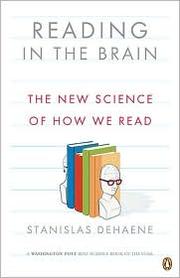


Language at the Speed of Sight
Directly addresses how skilled readers process language and sound.

Endnotes
1.
Source: wired.com
Link:https://www.wired.com/2017/01/make-resolution-read-speed-reading-wont-help
Source snippet
Basic calculations based on the properties of eyes and texts indicate that an average reading speed is around 280 words per minute, a val...
2.
Source: Wikipedia
Link:https://en.wikipedia.org/wiki/Subvocalization
3.
Source: pmc.ncbi.nlm.nih.gov
Title: PMCInner Speech: Development, Cognitive Functions
Link:https://pmc.ncbi.nlm.nih.gov/articles/PMC4538954/
Source snippet
by B Alderson-Day · 2015 · Cited by 1124 — One way of interpreting this evidence is to think that the phonological loop primarily func...
4.
Source: pmc.ncbi.nlm.nih.gov
Link:https://pmc.ncbi.nlm.nih.gov/articles/PMC3198452/
Source snippet
Inner Speech during Silent Reading Reflects the Reader's...by R Filik · 2011 · Cited by 115 — The current study suggests that inner s...
5.
Source: pmc.ncbi.nlm.nih.gov
Link:https://pmc.ncbi.nlm.nih.gov/articles/PMC4684953/
Source snippet
Complex Sentence Comprehension and Working Memory in...by JW Montgomery · 2008 · Cited by 429 — This study investigated the associati...
6.
Source: researchgate.net
Link:https://www.researchgate.net/publication/23190459_Complex_Sentence_Comprehension_and_Working_Memory_in_Children_With_Specific_Language_Impairment
Source snippet
Complex Sentence Comprehension and Working Memory...This study investigated the association of 2 mechanisms of working memory (phonologi...
7.
Source: researchgate.net
Title: Research Gate(PDF) Does speed-reading training work, and if so, why?
Link:https://www.researchgate.net/publication/367560632_Does_speed-reading_training_work_and_if_so_why_Effects_of_speed-reading_training_and_metacognitive_training_on_reading_speed_comprehension_and_eye_movements
Source snippet
Feb 1, 2023 — From the perspective of reading psychology, it seems quite unlikely that speed‐reading training can indeed have such effect...
8.
Source: researchgate.net
Title: Research Gate How Do We Read, and Can Speed Reading Help?
Link:https://www.researchgate.net/publication/290492746_So_Much_to_Read_So_Little_Time_How_Do_We_Read_and_Can_Speed_Reading_Help
Source snippet
It is unlikely that readers will be able to double or triple their reading speeds.Read more...
9.
Source: researchgate.net
Link:https://www.researchgate.net/publication/269798226_Inner_Speech_Active_Part_of_Working_Memory_Phonological_Loop_Inactive_in_Dementia
Source snippet
Inner Speech, Active Part of Working Memory Phonological...7 Mar 2026 — PDF | On Jan 1, 2011, Maryam Atabati published Inner Speech, Act...
10.
Source: researchgate.net
Link:https://www.researchgate.net/publication/384201631_Inner_Speech_and_Speed_Reading_An_Analysis_of_Written_Texts_Internalization
Source snippet
a series of inner speech uses such as subvocalization, literal translation...Read more...
11.
Source: researchgate.net
Title: 264988471 Phonological Coding During Reading
Link:https://www.researchgate.net/publication/264988471_Phonological_Coding_During_Reading
Source snippet
(PDF) Phonological Coding During Reading25 Aug 2014 — phonological codes aid comprehension and bolster short-term memory, the inner voice...
13.
Source: Wikipedia
Title: Speed reading
Link:https://en.wikipedia.org/wiki/Speed_reading
Source snippet
Speed readingSubvocalization: sounding out each word internally, as reading to oneself. This is the slowest form of reading. · Auditor...
14.
Source: pubmed.ncbi.nlm.nih.gov
Title: Pub Med How Do We Read, and Can Speed Reading Help?
Link:https://pubmed.ncbi.nlm.nih.gov/26769745/
Source snippet
by K Rayner · 2016 · Cited by 530 — The prospect of speed reading--reading at an increased speed without any loss of comprehension...
15.
Source: psychologicalscience.org
Title: speed reading
Link:https://www.psychologicalscience.org/publications/speed_reading.html
Source snippet
Association for Psychological ScienceSo Much to Read, So Little Time: How Do We...Jan 13, 2016 — The report shows there is no quick and...
16.
Source: encyclopedia.pub
Link:https://encyclopedia.pub/entry/33862
Source snippet
Subvocalization | Encyclopedia MDPINov 10, 2022 — Subvocalization, or silent speech, is the internal speech typically made when reading...
17.
Source: thedecisionlab.com
Link:https://thedecisionlab.com/reference-guide/psychology/phonological-loop
Source snippet
The Decision LabPhonological LoopThe phonological loop is the part of working memory that holds and processes verbal and auditory informa...
18.
Source: theguardian.com
Title: speed reading claims discredited by new report
Link:https://www.theguardian.com/books/2016/jan/29/speed-reading-claims-discredited-by-new-report
Source snippet
BooksJan 29, 2016 — Readers 'should be wary of promises to increase speed with no cost to comprehension', say researchers...
19.
Source: pmc.ncbi.nlm.nih.gov
Link:https://pmc.ncbi.nlm.nih.gov/articles/PMC3463948/
Source snippet
by V Gaillard · 2012 · Cited by 17 — The present study investigated the consciousness-control relationship by suppressing the possibil...
20.
Source: pmc.ncbi.nlm.nih.gov
Link:https://pmc.ncbi.nlm.nih.gov/articles/PMC4211933/
Source snippet
coding during reading - PMC - NIHby M Leinenger · 2014 · Cited by 170 — phonological codes aid comprehension and bolster short-term memor...
21.
Source: youtube.com
Link:https://www.youtube.com/watch?v=DGDkTyOt7gQ
Source snippet
ofessor discovered the secret to SPEED READING - it's simple...
22.
Source: howjournalcolombia.org
Link:https://www.howjournalcolombia.org/index.php/how/article/view/791
Source snippet
Inner Speech and Speed Reading: An Analysis of Written...by FLG Cobo · 2024 · Cited by 2 — The study reveals that learners start to inte...
23.
Source: wires.onlinelibrary.wiley.com
Link:https://wires.onlinelibrary.wiley.com/doi/10.1002/wcs.1544
Source snippet
speech - Langland‐Hassan - 202118 Sept 2020 — There is evidence that inner speech plays a variety of cognitive roles, from enabling abstr...
Additional References
24.
Source: merriam-webster.com
Link:https://www.merriam-webster.com/dictionary/inner
Source snippet
INNER Definition & Meaning3 days ago — 1. a: situated farther in the inner bark b: being near a center especially of influence the inne...
25.
Source: readingrockets.org
Link:https://www.readingrockets.org/topics/phonological-and-phonemic-awareness
Source snippet
Phonological and Phonemic AwarenessPhonological awareness is the ability to recognize and manipulate the spoken parts of words, including...
26.
Source: englelab.gatech.edu
Link:https://englelab.gatech.edu/articles/1998/working-memory-and-comprehension.pdf
Source snippet
loop in language comprehension. Both views agree that the phonological loop is only required when sentences are long and syntac- tically...
27.
Source: reddit.com
Link:https://www.reddit.com/r/books/comments/oet3ym/the_false_promise_of_speed_reading_why_you_should/
28.
Source: washingtonbeerblog.com
Link:https://washingtonbeerblog.com/speed-reading-myths-what-science-says-about-reading-faster-even-after-a-couple-of-beers/
Source snippet
Speed reading programs tell you to eliminate subvocalization (the internal voice reading along). It has been found...Read more...
29.
Source: mindbrained.org
Title: the phonological loop our inner ear and inner voice and its role in reading
Link:https://www.mindbrained.org/2021/08/the-phonological-loop-our-inner-ear-and-inner-voice-and-its-role-in-reading/
Source snippet
The Phonological Loop (our “inner ear” and “inner voice”)...2 Aug 2021 — Experimental cognitive psychologists have been investigating th...
30.
Source: mindbrained.org
Title: our minds eyes and ears the phonological loop and how it helps us to read
Link:https://www.mindbrained.org/2024/02/our-minds-eyes-and-ears-the-phonological-loop-and-how-it-helps-us-to-read/
Source snippet
THE PHONOLOGICAL LOOP AND HOW IT HELPS US...6 Feb 2024 — It is called the Phonological Loop because phonological means that it is relate...
31.
Source: erikamagyarosi.com
Link:https://erikamagyarosi.com/en/was-ist-speed-reading
Source snippet
Was ist Speed Reading und warum solltest du dich dafür...Reducing Subvocalization: That inner voice in your head that reads along with you?...
32.
Source: studylab.app
Title: Speed Reading for Students: Does It Actually Work?
Link:https://studylab.app/blog/speed-reading-for-students-does-it-actually-work-science-based-answer
Source snippet
(...5 Dec 2025 — The Subvocalization Myth. Many speed reading programs target subvocalization (that inner voice reading along) as the en...
33.
Source: baos.pub
Title: the myth of speed reading why faster isnt better cd8bb57b7420
Link:https://baos.pub/the-myth-of-speed-reading-why-faster-isnt-better-cd8bb57b7420
Source snippet
That inner voice helps most readers with comprehension, especially for complex material. Studies...Read more...
Topic Tree