Within Rereading
How Much Should You Reread After Zoning Out?
When attention slips, targeted recovery can restore meaning faster than rereading whole paragraphs or pages from the start.
On this page
- Finding where attention broke
- Rereading only the missing span
- Avoiding full page restarts
Page outline Jump by section
Introduction
When attention drifts during reading, many people respond by restarting the paragraph or even the entire page. It feels safe, but it is often unnecessary. In most cases, comprehension breaks at a specific point, not across everything that came before. The fastest way to recover is usually to identify where attention was lost, reread only the missing span, and then continue. Research on eye movements and reading comprehension shows that regressions are a normal repair mechanism, but effective readers tend to use them selectively rather than repeatedly restarting large sections of text.[PubMed]pubmed.ncbi.nlm.nih.govThe function of these "regressions" is still largely unknownThe function of regressions in reading: backward eye…by RW Booth · 2013 · Cited by 134 — Standard text reading involves frequent…
 For readers trying to increase reading speed, the goal is not to avoid looking back. The goal is to make the smallest useful correction. A targeted recovery preserves reading flow, reduces wasted time, and helps prevent the habit of turning every lapse in attention into a full-page restart.
Finding Where Attention Broke
The first step after zoning out is determining whether comprehension actually failed and, if so, where.
Many readers assume that if they cannot remember the last few sentences clearly, they must return to the top of the page. In practice, attention lapses often have a clear starting point. You may remember the general argument up to a certain sentence and then notice a gap afterwards. That boundary is usually where recovery should begin.
A useful question is:
What is the last point I clearly understood?
If you can answer that question, you have already narrowed the repair area. Instead of rereading everything, return only to the last idea that remains stable in memory.
Eye-tracking research shows that readers naturally make regressions when comprehension difficulties arise, but those regressions are often directed towards specific locations that need reprocessing rather than random backward scanning.[MDPI]mdpi.comWe distinguish two types of these movements (regressions). One type consists of relatively large…Read more…
Consider this example:
- You are reading a history chapter.
- Halfway through a paragraph, your mind wanders.
- At the end of the paragraph, you realise you no longer know why a political decision was made.
If you still remember the beginning of the explanation but not the transition that followed, the recovery point is the transition—not the start of the page.
Rereading Only the Missing Span
Once the break point is identified, reread the smallest section that can restore continuity.
This approach works because comprehension depends on linking ideas together. If the chain breaks in one location, rebuilding that link is often enough to recover the whole structure.
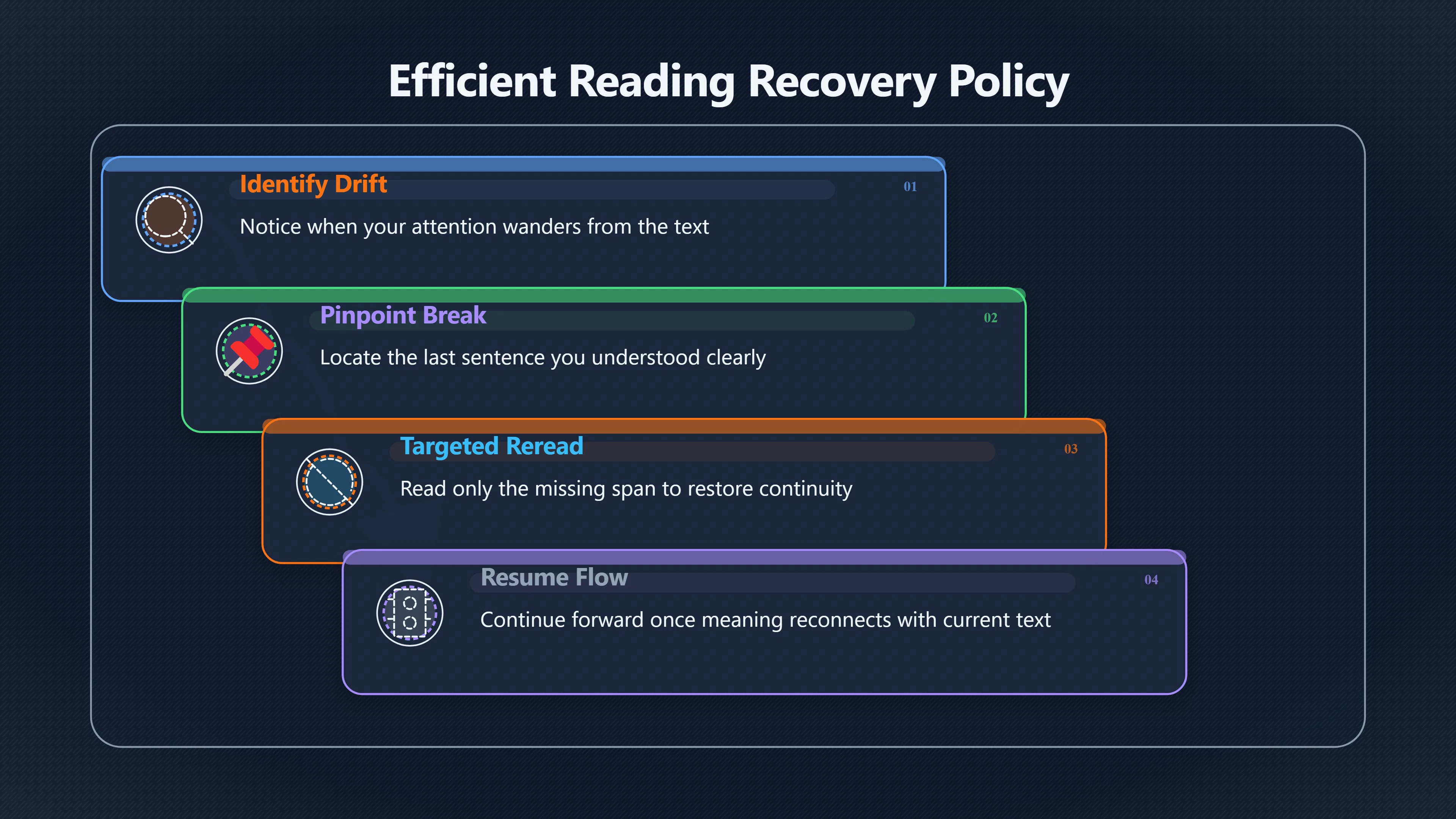
A practical method is:
- Locate the last sentence you understood confidently.
- Reread from that point.
- Stop as soon as the text becomes familiar and meaningful again.
- Continue forward immediately.
Notice that the objective is not certainty. The objective is restored understanding.
Research suggests that regressions serve a genuine rereading function that helps readers reprocess information and update their understanding. However, the benefit comes from revisiting the relevant text, not from repeatedly reviewing large amounts of already-understood material.[PubMed]pubmed.ncbi.nlm.nih.govThe function of these "regressions" is still largely unknownThe function of regressions in reading: backward eye…by RW Booth · 2013 · Cited by 134 — Standard text reading involves frequent…
For example:
- If attention drifted for two sentences, reread those two sentences.
- If a single definition was missed, return to the definition.
- If a reference became unclear, locate the reference and continue.
The repair should match the size of the problem.
Why Full-Page Restarts Feel Safer Than They Are
Restarting a page creates a powerful feeling of control. The reader knows that nothing has been skipped because everything is being read again.
The difficulty is that most of the rereading is devoted to material that was already understood. The time investment grows quickly while the amount of new information recovered remains small.
This can create a misleading sense of productivity. Familiar text feels easier to process on a second pass, and that ease can be mistaken for improved comprehension. The result is a cycle in which readers restart large sections not because they need the information again but because rereading reduces uncertainty.
When attention lapses are treated this way, readers often begin to distrust their ability to recover efficiently. A brief loss of focus becomes a signal to start over rather than a small problem requiring a small correction.
A Faster Recovery Policy
Instead of making a decision based on anxiety, use a fixed rule.
When you notice that attention has drifted:
- Do not immediately restart the page.
- Identify the last clear idea.
- Return only to that point.
- Read forward until meaning reconnects.
- Continue.
This policy removes guesswork. Rather than asking, “Should I start over?”, you ask, “What information is actually missing?”
The difference may seem small, but it changes the purpose of rereading. The goal becomes repairing comprehension rather than seeking reassurance.
Studies of reading behaviour consistently show that eye movements reflect ongoing comprehension processes and that regressions are often triggered by specific processing difficulties. Skilled reading is therefore not a perfectly straight movement through text; it is an efficient system of detecting problems and making targeted corrections when necessary.[ResearchGate+2EyeLogic]researchgate.netResearchGate(PDF) Eye Movements as Reflections of Comprehension…In this article, we discuss the use of eye movement data to assess mom…
When a Larger Reread Is Actually Justified
Not every attention lapse can be fixed with a short regression.
A broader reread may be worthwhile when:
- You cannot identify the last point you understood.
- Several paragraphs depend on information that was missed.
- The text contains a complex argument with multiple linked steps.
- You discover a misunderstanding that changes the meaning of everything that follows.
In these cases, the problem is not a brief lapse but a genuine breakdown in comprehension.
Even then, it helps to be deliberate. Decide how far back you need to go and why. Avoid drifting into repeated restarts that revisit more text than necessary.

Avoiding the Habit of Restarting
The most common mistake after zoning out is assuming that lost attention invalidates everything just read.
Usually it does not.
Attention failures tend to be local. Understanding before the lapse often remains intact. Treating every distraction as a reason to restart trains the reader to overcorrect. Treating it as a repair problem encourages a more efficient response.
A useful mindset is that reading is not a test of perfect concentration. It is a process of maintaining meaning. When meaning is lost, recover the missing link and move on.
For increasing reading speed, that principle is crucial. The reader who can quickly identify the break point and repair it with a short regression will usually progress faster than the reader who repeatedly returns to the beginning of the page whenever concentration briefly slips.
Amazon book picks
Further Reading
Books and field guides related to How Much Should You Reread After Zoning Out?. Use these as the next step if you want deeper reading beyond the article.
How to Read a Book
Rating: 4.0/5 from 41 Google Books ratings
Offers practical methods for recovering and maintaining comprehension.
eBay marketplace picks
Marketplace Samples
Example marketplace items related to this page. Use the search link to explore similar finds on eBay.


Endnotes
1.
Source: mdpi.com
Link:https://www.mdpi.com/2411-5150/3/3/35
Source snippet
We distinguish two types of these movements (regressions). One type consists of relatively large...Read more...
2.
Source: researchgate.net
Link:https://www.researchgate.net/publication/228625379_Eye_Movements_as_Reflections_of_Comprehension_Processes_in_Reading
Source snippet
ResearchGate(PDF) Eye Movements as Reflections of Comprehension...In this article, we discuss the use of eye movement data to assess mom...
3.
Source: mdpi.com
Title: 2226 471X
Link:https://www.mdpi.com/2226-471X/9/12/360
Source snippet
Tracking Adults' Eye Movements to Study Text...by G Andreou · 2024 · Cited by 3 — The aim of this review is to examine and analyze the c...
4.
Source: mdpi.com
Link:https://www.mdpi.com/1995-8692/15/4/26
Source snippet
Hence eye tracking may potentially be a useful tool.Read...
5.
Source: researchgate.net
Link:https://www.researchgate.net/publication/355138336_The_Relation_between_Reading_Performance_and_Eye_Movement_Parameters_of_High-Skilled_and_Low-Skilled_Readers
Source snippet
skilled readers, and the average number of regressions. into AOI was 43.6... Eye-tracking methods have become a valuable tool for readin...
6.
Source: researchgate.net
Link:https://www.researchgate.net/publication/230658181_The_function_of_regressions_in_reading_Backward_eye_movements_allow_rereading
Source snippet
ue their memory for previously read words.Read more...
7.
Source: researchgate.net
Link:https://www.researchgate.net/publication/386156337_Tracking_Adults%27_Eye_Movements_to_Study_Text_Comprehension_A_Review_Article
Source snippet
(PDF) Tracking Adults' Eye Movements to Study Text...Nov 14, 2024 — Five studies in this review investigated eye movements as indicators...
8.
Source: researchgate.net
Title: (PDF) Regressions during Reading
Link:https://www.researchgate.net/publication/334364752_Regressions_during_Reading
Source snippet
May 20, 2026 — Three experiments examine the role of previously read text in sentence comprehension and the control of eye movements duri...
Published: May 20, 2026
9.
Source: pubmed.ncbi.nlm.nih.gov
Title: The function of these “regressions” is still largely unknown
Link:https://pubmed.ncbi.nlm.nih.gov/22886737/
Source snippet
The function of regressions in reading: backward eye...by RW Booth · 2013 · Cited by 134 — Standard text reading involves frequent...
10.
Source: eyelogicsolutions.com
Title: Eye Logic Blog
Link:https://www.eyelogicsolutions.com/blog-how-eye-tracking-is-transforming-reading-research/
Source snippet
Blog - How Eye Tracking is Transforming Reading Research13 May 2025 — Eye tracking offers a way to observe how readers interpret sentence...
Published: May 2025
11.
Source: pmc.ncbi.nlm.nih.gov
Link:https://pmc.ncbi.nlm.nih.gov/articles/PMC6235565/
Source snippet
by JR Folk · 2018 · Cited by 8 — This paper describes how to design materials to distinguish between regressions caused by comprehensi...
12.
Source: pmc.ncbi.nlm.nih.gov
Link:https://pmc.ncbi.nlm.nih.gov/articles/PMC12641876/
Source snippet
by M Markevich · 2025 — Successful reading comprehension depends on many factors, including text genre. Eye-tracking studies indicate...
13.
Source: pmc.ncbi.nlm.nih.gov
Link:https://pmc.ncbi.nlm.nih.gov/articles/PMC7888242/
Source snippet
Cognitive Model of Regressive Eye Movements during...by AF Weiss · 2020 · Cited by 7 — In this article we present a new eye movement con...
14.
Source: pmc.ncbi.nlm.nih.gov
Link:https://pmc.ncbi.nlm.nih.gov/articles/PMC12409514/
Source snippet
the rereading effect of digital reading through eye...by Y Xu · 2025 — This study aimed to investigate the differences in eye movement c...
15.
Source: pmc.ncbi.nlm.nih.gov
Link:https://pmc.ncbi.nlm.nih.gov/articles/PMC5290069/
Source snippet
by A Koornneef · 2016 · Cited by 28 — In an eye-tracking experiment we examined the risky reading hypothesis, in which long saccades a...
16.
Source: frontiersin.org
Link:https://www.frontiersin.org/journals/psychology/articles/10.3389/fpsyg.2025.1576247/full
Source snippet
Assessing the rereading effect of digital reading through...by Y Xu · 2025 — The goal of this study is to investigate the differences in...
17.
Source: frontiersin.org
Link:https://www.frontiersin.org/journals/education/articles/10.3389/feduc.2023.1077882/full
Source snippet
Eye movements are stable predictors of word reading...by A Strandberg · 2023 · Cited by 14 — Regression analysis revealed that eye movem...
Additional References
18.
Source: instagram.com
Link:https://www.instagram.com/reel/DSfVPG7Dp5M/
Source snippet
Frequent rereaders show 43% higher retention than single...REREADING MEANS DEMANDING FULL COMPREHENSION if you constantly reread sentenc...
19.
Source: papers.ssrn.com
Link:https://papers.ssrn.com/sol3/papers.cfm?abstract_id=5405257
Source snippet
Eye Movements in Reading Go from Easy to...by AT Lopes Rego — One prevailing hypothesis is that regressions reflect comprehension proces...
20.
Source: studenttheses.universiteitleiden.nl
Link:https://studenttheses.universiteitleiden.nl/access/item%3A2629036/view
Source snippet
eye movements to predict reading skills in childrenIn the present eye tracking study, we collected eye movements of school-aged children...
21.
Source: blog.cognifit.com
Title: does your mind drift while reading cognitive science explains why
Link:https://blog.cognifit.com/does-your-mind-drift-while-reading-cognitive-science-explains-why/
Source snippet
Cognitive Science...22 Jan 2026 — Even short lapses in attention can disrupt understanding, forcing readers to go back and reread sectio...
22.
Source: readlite.in
Link:https://readlite.in/concepts/regressions-reading/
Source snippet
Regressions in Reading: Why Your Eyes Jump Back (And...Feb 14, 2026 — Your eyes jump backward about 10-15% of the time while reading...
23.
Source: readlite.in
Title: What Eye-Tracking Research Reveals About Reading
Link:https://readlite.in/concepts/eye-tracking-reading-research
Source snippet
regression tells us something about what's happening in the reader's mind. This makes eye tracking one of the most powerful tools in cogn...
24.
Source: reddit.com
Title: I can read, but I do not absorb information
Link:https://www.reddit.com/r/GetStudying/comments/15zevpo/i_can_read_but_i_do_not_absorb_information_am_i/
Source snippet
Am I stupid?I am reading a textbook, and it really is abundant to me how I can read through a paragraph explaining something and have som...
25.
Source: utupub.fi
Link:https://www.utupub.fi/bitstream/handle/10024/190693/Reading%20Research%20Quarterly%20-%202023%20-%20M%20zi%20re%20-%20Using%20Eye%20Tracking%20Measures%20to%20Predict%20Reading%20Comprehension.pdf?sequence=1
Source snippet
We administered three widely used reading compre- hension...Rea...
26.
Source: facebook.com
Link:https://www.facebook.com/groups/737822921661972/posts/1172137578230502/
Source snippet
l a single thing Do you guys deal with this problem?Read more...
27.
Source: getnook.net
Title: Why Do I Keep Rereading the Same Line?
Link:https://getnook.net/blog/why-do-i-keep-rereading-same-line
Source snippet
How to Stop - Nook30 Jan 2026 — You read the same sentence three times and nothing sticks. It's called regression. Here's why your brain...
Topic Tree