Within Paper Preview
Why starting cold makes papers feel slower
Previewing gives unfamiliar terms, methods, and results a context, so difficult sections are easier to place and reread less.
On this page
- How premature detail slows comprehension
- Why context makes technical sections easier
- When rereading still remains useful
Page outline Jump by section
Introduction
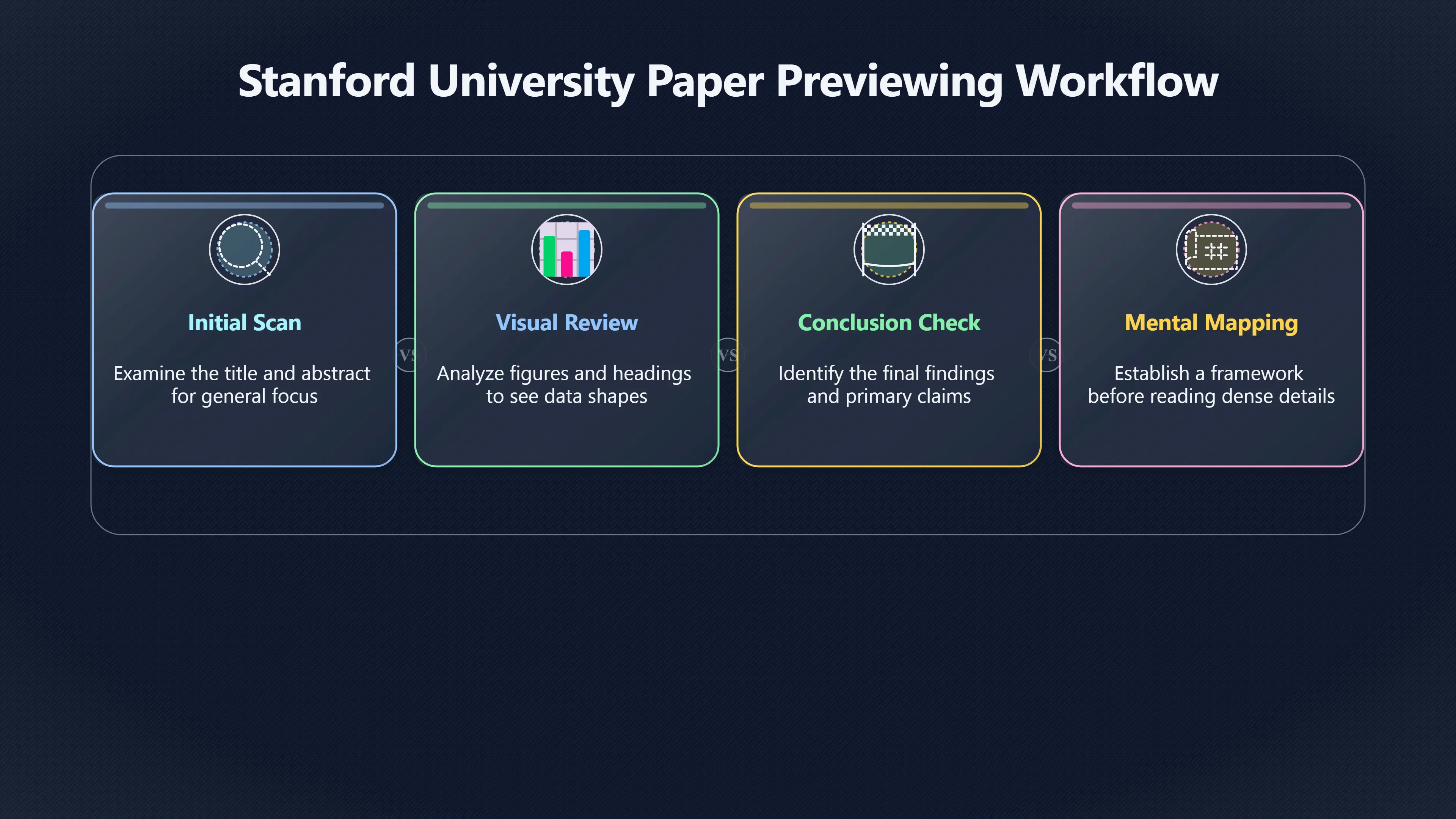
Many readers assume that rereading difficult sections is an unavoidable part of working through research papers. In reality, a significant amount of rereading happens because the reader encounters technical details before understanding the paper’s central question, approach and conclusions. Previewing a paper first—by examining the title, abstract, figures, headings and conclusions—creates a mental framework that helps later details make sense on the first pass. Academic reading guides consistently recommend this approach because it allows readers to orient themselves before tackling dense material, reducing the need to repeatedly backtrack through the text.[Stanford University+2Science]web.stanford.eduI also de- scribe how to use this method to do a literature…Read more…
 For readers seeking greater reading speed, the benefit is not merely faster skimming. The real gain comes from avoiding unnecessary rereading caused by confusion, misplaced attention and lack of context.
Why Starting Cold Makes Papers Feel Slower
Research papers are unusual documents. They often contain unfamiliar terminology, specialised methods, statistical analyses and references to prior work. When readers begin at the first paragraph and proceed line by line without first understanding the destination, they are forced to interpret each detail in isolation.
This creates a common pattern:
- A technical term appears.
- The reader struggles to understand why it matters.
- Several pages later, the paper reveals the main finding or purpose.
- The reader returns to earlier sections to reinterpret them.
The result is not one reading of the paper but multiple partial readings of the same material.
Experienced researchers often avoid this trap by first identifying the paper’s core claim and overall structure. The widely cited three-pass method for reading research papers begins with a deliberately shallow overview precisely because understanding the paper’s shape makes later reading more efficient.[Stanford University]web.stanford.eduI also de- scribe how to use this method to do a literature…Read more…
How Premature Detail Slows Comprehension
The main mechanism behind wasted rereading is simple: information is easier to understand when it can be connected to an existing framework.
Educational literature on previewing describes the process as creating a mental map before detailed reading. Readers scan major elements of a text so that incoming information has somewhere to fit. Previewing also activates relevant prior knowledge and establishes a purpose for reading.[NowComment+3Excelsior OWL+3Lumen Learning]owl.excelsior.eduExcelsior OWLPreviewing Text Strategies | Online Reading LabPreviewing involves surveying or scanning a text in order to create a mental…
Without such a framework, readers must continuously answer two questions at once:
- What does this detail mean?
- Why is this detail here?
That dual burden increases cognitive effort. A complicated graph, equation or methodological choice becomes difficult not only because it is technically challenging but because its relevance remains unknown.
Consider a paper describing a new machine-learning model. A reader who immediately dives into the mathematical formulation may spend considerable time deciphering notation. If they first preview the abstract, figures and conclusion, they learn the model’s purpose, the benchmark being improved and the headline result. The same equations are still complex, but they now answer a known question rather than appearing as disconnected symbols.
This shift reduces the need to revisit earlier pages merely to understand their role in the argument.[Dravet Syndrome Foundation+2Paperpile]dravetfoundation.orghow to read a scientific paper partThese sections should highlight the key findings from the study and provide the reader with the general focus of the paper.Read more…
Why Context Makes Technical Sections Easier
Previewing works because context changes how readers process information.
The Research Question Becomes an Anchor
Before reading methods or results, a reader who knows the paper’s central question can evaluate details against that question. Instead of treating every paragraph as equally important, they can distinguish between core evidence and supporting information.
Guides for scientific reading often emphasise identifying the major question early because doing so provides a reference point for interpreting the rest of the paper.[Arc at Duke]arc.duke.eduhow to read and understand a scientific paper a guide for non scientistsBegin by reading the introduction, not the abstract. · 2. Identify the BIG QUESTION. · 3. Summarize the background in five sentences or l…
Figures Stop Looking Like Isolated Data
Many readers repeatedly revisit results sections because they encounter figures before understanding what the authors are trying to demonstrate.
A preview changes this. After seeing the abstract and conclusion, readers already know the broad claim. The figures then become evidence supporting that claim rather than puzzles requiring independent interpretation.
Several scientific-reading guides therefore recommend examining figures and results early in the reading process to establish the paper’s main message before engaging with methodological details.[Paperpile+2Science]paperpile.comHow to read a scientific paper [3 stepsThese are the data—the meat of the study. Try to comprehend the data before reading the captions.Read more…
Terminology Gains Meaning Faster
Unfamiliar terms are particularly likely to trigger rereading. When readers first encounter specialised vocabulary without context, they may pause repeatedly or revisit definitions later.
Previewing helps because terminology is encountered within a known narrative. Even if a precise definition remains unclear, the reader often understands whether the term refers to a method, dataset, measurement or outcome. That partial understanding is frequently enough to maintain reading flow until a deeper examination becomes necessary.
A Concrete Example of the Rereading Cycle
Imagine reading a biomedical paper without previewing.
The introduction discusses several proteins, signalling pathways and prior studies. By page three, the reader has seen dozens of unfamiliar terms but still does not know the study’s principal finding. Later, the discussion section reveals that the key result is that one specific pathway appears to influence disease progression.
At that moment, the reader realises that earlier sections contained the context needed to understand this claim and returns to reread them.
Now consider the same paper after a five-minute preview:
- Read the title and abstract.[dravetfoundation.org]dravetfoundation.orghow to read a scientific paper partThese sections should highlight the key findings from the study and provide the reader with the general focus of the paper.Read more…
- Examine the main figures.
- Read the conclusion.[merriam-webster.com]merriam-webster.comI always start with the abstract, then jump to the figures and the conclusion. This gives me the big…Read more
- Note the study’s central finding.
When the reader later encounters descriptions of proteins and pathways, each detail already has a place in the story. The likelihood of backtracking drops because the reader understands why the information matters before encountering it.
When Rereading Still Remains Useful
Reducing unnecessary rereading does not mean eliminating rereading altogether.
Some forms of rereading remain valuable:
- Complex methods: Statistical procedures, mathematical proofs and experimental designs often require multiple passes regardless of preparation.
- Critical evaluation: Assessing weaknesses, assumptions or reproducibility usually demands closer inspection after an initial understanding has been formed.
- Knowledge building: Experts frequently revisit important papers because their goals have changed, not because the first reading failed.
The key distinction is between productive rereading and corrective rereading.
Productive rereading deepens understanding of material that is already broadly understood. Corrective rereading occurs because the reader lacked enough context during the first pass to interpret what they were reading. Previewing primarily targets the second type.[PMC]pmc.ncbi.nlm.nih.govPMCTen simple rules for reading a scientific paperNIHby MA Carey · 2020 · Cited by 44 — Ten simple rules for reading a scientific paper · Introduction · Rule 1: Pick your reading go…

The Speed Benefit Comes from Fewer False Starts
Readers often think increasing reading speed means moving their eyes faster across the page. With research papers, a more important improvement comes from reducing detours.
Previewing creates a mental map of the paper’s question, structure and findings before close reading begins. Once that map exists, technical details are easier to place, figures become easier to interpret and unfamiliar terminology becomes less disruptive. The reader spends less time wondering why information matters and less time returning to earlier pages to reconstruct the argument.
In practice, this is why a short preview frequently saves far more time than it consumes. A few minutes spent building context can prevent many minutes of unnecessary rereading later. Stanford University+3Excelsior OWL+3advice.writing.utoronto.ca[owl.excelsior.edu]owl.excelsior.eduExcelsior OWLPreviewing Text Strategies | Online Reading LabPreviewing involves surveying or scanning a text in order to create a mental…
Amazon book picks
Further Reading
Books and field guides related to Why starting cold makes papers feel slower. Use these as the next step if you want deeper reading beyond the article.
How to Read a Book
Rating: 4.0/5 from 41 Google Books ratings
Focuses on previewing, analytical reading, and building context before engaging deeply with complex texts.
Deep Work
Supports focused reading and comprehension by reducing distraction and improving concentration on dense material.
Make It Stick
Explains how comprehension, retrieval, and mental frameworks improve learning and reduce inefficient rereading.

How to read a paper
Directly teaches efficient paper-reading strategies, including building context before diving into details.
eBay marketplace picks
Marketplace Samples
Example marketplace items related to this page. Use the search link to explore similar finds on eBay.




Endnotes
1.
Source: web.stanford.edu
Link:https://web.stanford.edu/class/ee384m/Handouts/HowtoReadPaper.pdf
Source snippet
I also de- scribe how to use this method to do a literature...Read more...
2.
Source: owl.excelsior.edu
Link:https://owl.excelsior.edu/orc/what-to-do-before-reading/previewing/
Source snippet
Excelsior OWLPreviewing Text Strategies | Online Reading LabPreviewing involves surveying or scanning a text in order to create a mental...
3.
Source: nowcomment.com
Link:https://nowcomment.com/documents/126618/combined?print=yes
Source snippet
Predicting and PreviewingPreviewing helps students prepare to engage the reading task. (A discussion of previewing fiction when students...
4.
Source: paperpile.com
Title: How to read a scientific paper [3 steps
Link:https://paperpile.com/g/read-scientific-paper/
Source snippet
These are the data—the meat of the study. Try to comprehend the data before reading the captions.Read more...
5.
Source: arc.duke.edu
Title: how to read and understand a scientific paper a guide for non scientists
Link:https://arc.duke.edu/how-to-read-and-understand-a-scientific-paper-a-guide-for-non-scientists/
Source snippet
Begin by reading the introduction, not the abstract. · 2. Identify the BIG QUESTION. · 3. Summarize the [background]({{ 'expertise/' | relative_url }}) in five sentences or l...
6.
Source: pmc.ncbi.nlm.nih.gov
Title: PMCTen simple rules for reading a scientific paper
Link:https://pmc.ncbi.nlm.nih.gov/articles/PMC7392212/
Source snippet
NIHby MA Carey · 2020 · Cited by 44 — Ten simple rules for reading a scientific paper · Introduction · Rule 1: Pick your reading go...
7.
Source: advice.writing.utoronto.ca
Link:https://advice.writing.utoronto.ca/researching/preview/
Source snippet
Previewing | Writing AdviceSpend a few minutes previewing a text before starting to read, in order to orient yourself toward what is impo...
8.
Source: science.org
Title: how seriously read scientific paper
Link:https://www.science.org/content/article/how-seriously-read-scientific-paper
Source snippet
How to (seriously) read a scientific paper21 Mar 2016 — I start by reading the abstract. Then, I skim the introduction and flip through t...
9.
Source: courses.lumenlearning.com
Link:https://courses.lumenlearning.com/englishcomp1/chapter/previewing/
Source snippet
English Composition 1Previewing is a strategy that readers use to recall prior knowledge, set a purpose for reading, and prepare for wh...
10.
Source: dravetfoundation.org
Title: how to read a scientific paper part 2 14 21
Link:https://dravetfoundation.org/how-to-read-a-scientific-paper-part-2-14-21/
Source snippet
These sections should highlight the key findings from the study and provide the reader with the general focus of the paper.Read more...
11.
Source: dictionary.cambridge.org
Link:https://dictionary.cambridge.org/dictionary/english/previewing
Source snippet
English meaning - Cambridge Dictionaryto describe something or be shown before it officially begins: Miller's new play is previewing (=...
12.
Source: dictionary.cambridge.org
Link:https://dictionary.cambridge.org/us/pronunciation/english/how
Source snippet
to pronounce HOW in English - Cambridge Dictionary6 days ago — English pronunciations of how from the Cambridge Advanced Learner's Dictio...
13.
Source: dictionary.cambridge.org
Link:https://dictionary.cambridge.org/us/dictionary/english/how
Source snippet
definition in the Cambridge English Dictionary6 days ago — HOW meaning: 1. in what way, or by what methods: 2. used to ask about someon...
14.
Source: pmc.ncbi.nlm.nih.gov
Link:https://pmc.ncbi.nlm.nih.gov/articles/PMC11288685/
Source snippet
nih.govTitle, abstract and keywords: a practical guide to maximize the...by P Pottier · 2024 · Cited by 66 — Keeping the key terminology...
Additional References
15.
Source: allkindsofminds.org
Link:https://allkindsofminds.org/learning-library/developing-control-over-attention/attending-to-planning-organizing-and-monitoring-what-you-say-or-do/developing-previewing/
Source snippet
Developing PreviewingPreviewing enables students to plan ahead, rather than jumping into a task or activity without thinking. Students wh...
16.
Source: lib.purdue.edu
Link:https://lib.purdue.edu/wp-content/uploads/2024/06/Newest-Scientific-Paper.pdf
Source snippet
to Read a Scientific PaperWhen skimming the paper for the first time, after reading the abstract read the concluding section. It gives mo...
17.
Source: merriam-webster.com
Link:https://www.merriam-webster.com/thesaurus/previewing
Source snippet
PREVIEWING Synonyms: 32 Similar Wordsto view or show in advance of public performance or presentation; The film festival is a great oppor...
18.
Source: schemaapp.com
Link:https://www.schemaapp.com/
Source snippet
Schema App | Control How AI Understands Your BrandSchema App helps you build and govern your semantic data layer using schema markup so A...
19.
Source: etsu.edu
Link:https://www.etsu.edu/teaching/resources/more_resources/schema.php
Source snippet
Schema TheorySchemas (or schemata) are units of understanding that can be hierarchically categorized as well as webbed into complex relat...
20.
Source: reddit.com
Link:https://www.reddit.com/r/psychologystudents/comments/w21iur/what_is_a_schema/
Source snippet
What is a schema?: r/psychologystudentsThis concept keeps coming up in my online psychology class. Can anyone explain what a schema is i...
21.
Source: merriam-webster.com
Link:https://www.merriam-webster.com/dictionary/how
22.
Source: schema.org
Link:https://schema.org/docs/schemas.html
23.
Source: youtube.com
Link:https://www.youtube.com/watch?v=WVv2jWXW0K4
Source snippet
How To Read Research Papers Effectively | Prof. David StucklerEvaluate its relevance to your current task or research. Three Reading Stra...
24.
Source: umbraco.com
Link:https://umbraco.com/knowledge-base/schema-markup/
Source snippet
your page, elements, and how users should see it to the searching tool.Read more...
Topic Tree