Within Myths
Why Looking Back Can Make Reading Better
Looking back while reading can be a useful repair move, not a lazy habit to eliminate for speed.
On this page
- What regressions are in normal reading
- How lookbacks fix ambiguity and missed links
- The risk of forcing the eyes forward
Page outline Jump by section
Introduction
One of the most persistent speed-reading myths is that good readers keep their eyes moving relentlessly forward. In reality, skilled reading often includes brief backward eye movements known as regressions. These lookbacks are not automatically signs of inefficiency. They frequently serve as a repair mechanism that helps readers resolve confusion, recover missed information, and maintain accurate comprehension.
 Research using eye-tracking has repeatedly shown that readers make regressions when sentences become difficult, when ambiguities arise, or when later information conflicts with an earlier interpretation. Rather than representing failure, these movements can be evidence that the reading system is monitoring understanding and correcting mistakes as they occur. The trade-off is important for anyone trying to increase reading speed: eliminating every regression may increase words-per-minute, but it can also remove one of the tools that protects comprehension.[MDPI]mdpi.comRegressions during Readingby AW Inhoff · 2019 · Cited by 74 — Readers occasionally move their eyes to prior text. We distinguish two…
What Regressions Are in Normal Reading
Reading does not involve a smooth left-to-right sweep across the page. The eyes move in rapid jumps called saccades, separated by brief pauses known as fixations. Most saccades move forward, but a proportion move backward to previously read text. These backward movements are called regressions.[MDPI]mdpi.comRegressions during Readingby AW Inhoff · 2019 · Cited by 74 — Readers occasionally move their eyes to prior text. We distinguish two…
Eye-movement researchers have long observed regressions in ordinary reading. They occur in children and adults, in easy and difficult texts, and even among highly skilled readers. Their presence alone does not indicate poor reading ability. What matters is why they occur and how they are used.[PubMed]pubmed.ncbi.nlm.nih.govEye movements during reading in beginning and skilled…by J Justino · 2023 · Cited by 29 — We discuss the differences found in ey…
Research distinguishes between at least two broad kinds of regressions:
- Comprehension-driven regressions, which return to earlier text to reanalyse meaning.
- Oculomotor corrections, which compensate for small targeting errors in eye movement control.[MDPI]mdpi.comRegressions during Readingby AW Inhoff · 2019 · Cited by 74 — Readers occasionally move their eyes to prior text. We distinguish two…
The first type is especially relevant to reading speed. These lookbacks help readers repair understanding when the text becomes difficult or when an earlier interpretation turns out to be wrong.
How Lookbacks Repair Understanding
The value of regressions becomes easiest to see in complex sentences.
Consider a sentence that temporarily encourages one interpretation before revealing that another interpretation is correct. Psycholinguistic studies of ambiguous sentences have repeatedly found that readers often move their eyes back to earlier words when later information forces a reinterpretation. These regressions allow readers to inspect the critical portion of text and rebuild the sentence structure more accurately.[PLOS]journals.plos.orgChildren's and Adults' On-Line Processing of Syntactically…by HSSL Joseph · 2013 · Cited by 61 — Frazier L, Rayner K (1982) Making…
A similar process occurs when readers encounter:
- An unfamiliar term whose meaning depends on earlier context.
- A pronoun whose referent is unclear.
- A sentence containing multiple embedded clauses.
- A contradiction between new information and previous information.
In each case, comprehension depends not merely on seeing words but on connecting them correctly. A regression lets the reader retrieve information directly from the text rather than relying on a potentially faulty memory trace.[ResearchGate]researchgate.netResearchGate(PDF) Eye Movements as Reflections of Comprehension…In this article, we discuss the use of eye movement data to assess mom…
Researchers studying comprehension processes have found that difficult passages and textual inconsistencies increase the likelihood of regressive eye movements. When understanding breaks down, readers do not simply continue forward. They often return to the location where the problem originated.[ResearchGate]researchgate.netResearchGate(PDF) Eye Movements as Reflections of Comprehension…In this article, we discuss the use of eye movement data to assess mom…
Why Ambiguity Often Triggers Regressions
A useful way to think about reading is as a continuous process of prediction and verification. Readers constantly generate expectations about what a sentence means before all information has arrived.
Most of the time those expectations are correct. Sometimes they are not.
Imagine reading:
“While the man hunted the deer ran into the woods.”
Many readers initially interpret “the deer” as the object of “hunted”. When they reach “ran”, that interpretation collapses. The sentence must be reanalysed. Classic eye-tracking studies showed that such ambiguities frequently produce longer reading times and regressions to earlier text.[PLOS]journals.plos.orgChildren's and Adults' On-Line Processing of Syntactically…by HSSL Joseph · 2013 · Cited by 61 — Frazier L, Rayner K (1982) Making…
More recent models of reading likewise treat regressions as part of the reanalysis process. When incoming information conflicts with the reader’s current interpretation, a lookback provides an opportunity to locate and repair the misunderstanding.[PMC]pmc.ncbi.nlm.nih.gova Cognitive Model of Regressive Eye Movements during…by AF Weiss · 2020 · Cited by 7 — In this article we present a new eye movemen…
This means regressions are not random. They often target locations that are most relevant to resolving the problem. Readers appear to look back where useful information is likely to be found rather than simply moving backwards indiscriminately.[SSRN]papers.ssrn.comRegressive Eye Movements in Reading Go from Easy to…by AT Lopes Rego — One prevailing hypothesis is that regressions reflect compr…
The Risk of Forcing the Eyes Forward
Many speed-reading programmes present regressions as wasted motion. The recommendation is straightforward: stop looking back and reading speed will increase.
The advice contains a partial truth. Excessive, repetitive rereading can certainly slow progress. Some readers repeatedly revisit text because of anxiety, distraction, or lack of confidence rather than genuine comprehension needs.
The problem is assuming that all regressions belong in that category.
Eye-movement research indicates that at least some regressions support comprehension directly. When readers encounter inconsistencies, ambiguities, or integration difficulties, backward eye movements become more common. Preventing those movements does not remove the underlying comprehension challenge; it merely removes one method of addressing it.[ResearchGate+2MDPI]researchgate.netResearchGate(PDF) Eye Movements as Reflections of Comprehension…In this article, we discuss the use of eye movement data to assess mom…
This distinction matters because speed and comprehension are not identical goals. A reader who never looks back may finish a page faster while retaining less of its meaning. The apparent gain in speed can therefore conceal a loss in understanding.
Strategic Regressions Versus Habitual Rereading
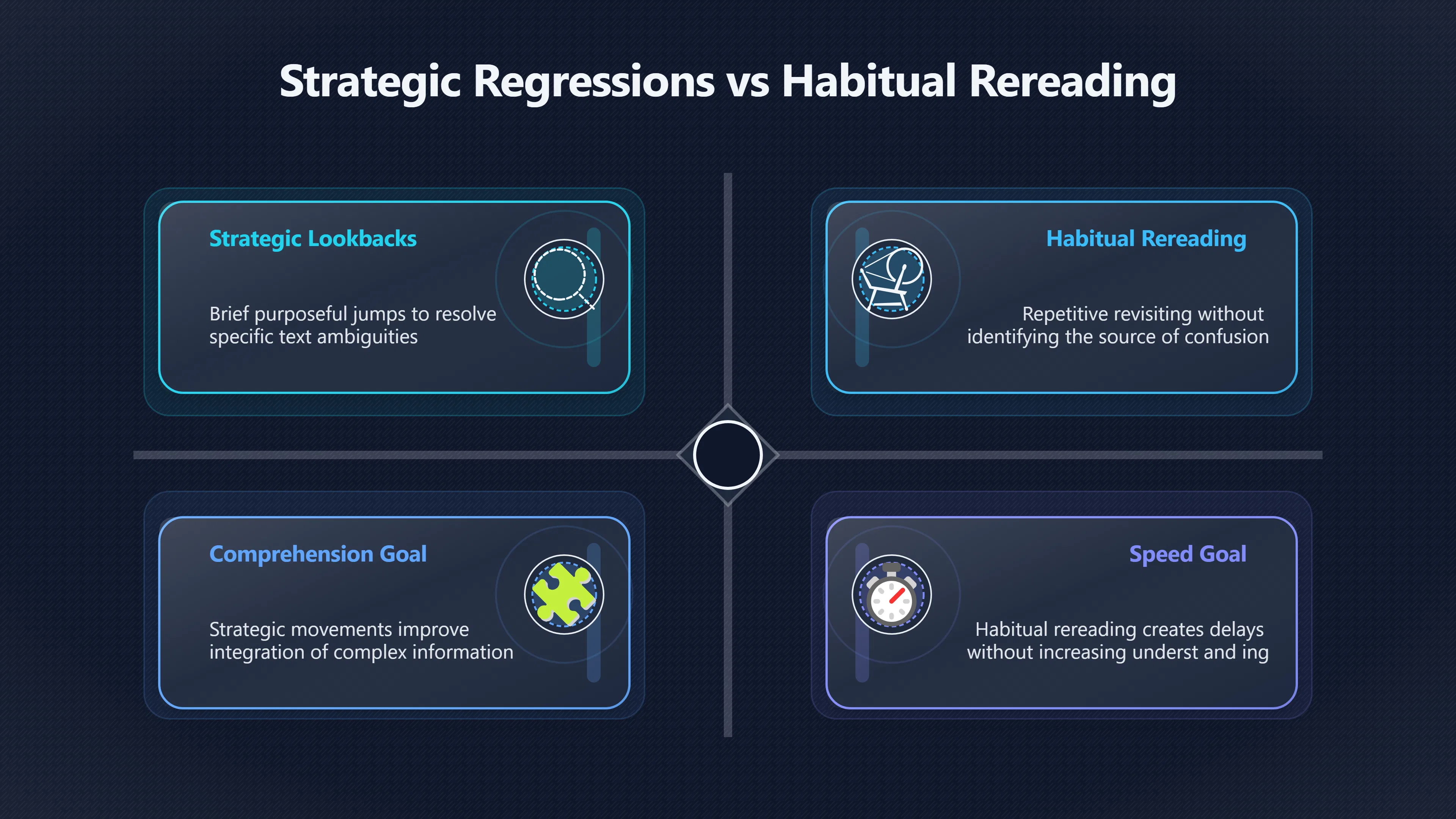
The strongest case for regressions is not that readers should constantly reread. It is that effective readers use lookbacks selectively.
Strategic regressions tend to have several characteristics:
- They occur when comprehension is genuinely uncertain.
- They target a specific earlier phrase or sentence.
- They are brief and purposeful.
- They lead to improved integration of information.
Habitual rereading looks different. The reader may repeatedly revisit material without identifying the source of confusion, creating delays without corresponding gains in understanding.
Research increasingly suggests that eye movements reveal ongoing comprehension monitoring. When regressions occur in response to genuine processing difficulty, they may represent the reading system functioning as intended rather than malfunctioning.[PMC+2PMC]pmc.ncbi.nlm.nih.govRelationships between Eye Movements during Sentence…by K Yagle · 2017 · Cited by 23 — Alternatively, the regression may reflect sel…
For readers seeking greater efficiency, the practical lesson is not to eliminate every lookback. It is to reduce unnecessary rereading while preserving the ability to revisit text when understanding requires it.
Faster Is Not Always Better
The debate over regressions illustrates a broader problem with many speed-reading claims. Reading is not merely the movement of the eyes across text. It is the construction of meaning.
Backward eye movements impose a small time cost. However, they can prevent much larger comprehension failures. A reader who briefly revisits a confusing clause may understand the argument correctly on the first pass through a chapter, while a reader who forces continuous forward motion may need to reread entire sections later.
From that perspective, regressions are often less a sign of inefficiency than a sign of quality control. They allow the reading system to detect errors, revisit crucial information, and repair understanding before misunderstandings accumulate. In demanding material, that ability can be one of the reasons comprehension succeeds at all.[MDPI+2PMC]mdpi.comRegressions during Readingby AW Inhoff · 2019 · Cited by 74 — Readers occasionally move their eyes to prior text. We distinguish two…
Amazon book picks
Further Reading
Books and field guides related to Why Looking Back Can Make Reading Better. Use these as the next step if you want deeper reading beyond the article.
How to Read a Book
Rating: 4.0/5 from 41 Google Books ratings
Emphasises comprehension over raw reading speed.
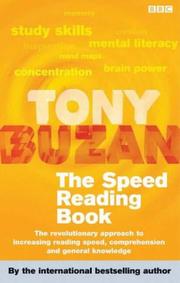
Speed reading
Directly addresses claims about reading speed that moving-window research evaluates.
Endnotes
1.
Source: mdpi.com
Link:https://www.mdpi.com/2411-5150/3/3/35
Source snippet
Regressions during Readingby AW Inhoff · 2019 · Cited by 74 — Readers occasionally move their eyes to prior text. We distinguish two...
2.
Source: researchgate.net
Link:https://www.researchgate.net/publication/228625379_Eye_Movements_as_Reflections_of_Comprehension_Processes_in_Reading
Source snippet
ResearchGate(PDF) Eye Movements as Reflections of Comprehension...In this article, we discuss the use of eye movement data to assess mom...
3.
Source: journals.plos.org
Link:https://journals.plos.org/plosone/article?id=10.1371%2Fjournal.pone.0054141
Source snippet
Children's and Adults' On-Line Processing of Syntactically...by HSSL Joseph · 2013 · Cited by 61 — Frazier L, Rayner K (1982) Making...
4.
Source: pmc.ncbi.nlm.nih.gov
Link:https://pmc.ncbi.nlm.nih.gov/articles/PMC5604484/
Source snippet
Relationships between Eye Movements during Sentence...by K Yagle · 2017 · Cited by 23 — Alternatively, the regression may reflect sel...
5.
Source: papers.ssrn.com
Link:https://papers.ssrn.com/sol3/papers.cfm?abstract_id=5405257
Source snippet
Regressive Eye Movements in Reading Go from Easy to...by AT Lopes Rego — One prevailing hypothesis is that regressions reflect compr...
6.
Source: pmc.ncbi.nlm.nih.gov
Title: PMCCan We ‘Read’ the Eye-Movement Patterns of Readers
Link:https://pmc.ncbi.nlm.nih.gov/articles/PMC5290069/
Source snippet
by A Koornneef · 2016 · Cited by 30 — Novel evidence for the general idea that the eye-movement profile of readers reveals valuable in...
7.
Source: mdpi.com
Link:https://www.mdpi.com/1995-8692/15/4/26
Source snippet
Hence eye tracking may potentially be a useful tool.Read...
8.
Source: pmc.ncbi.nlm.nih.gov
Link:https://pmc.ncbi.nlm.nih.gov/articles/PMC7888242/
Source snippet
a Cognitive Model of Regressive Eye Movements during...by AF Weiss · 2020 · Cited by 7 — In this article we present a new eye movemen...
9.
Source: pubmed.ncbi.nlm.nih.gov
Link:https://pubmed.ncbi.nlm.nih.gov/37126894/
Source snippet
Eye movements during reading in beginning and skilled...by J Justino · 2023 · Cited by 29 — We discuss the differences found in ey...
Additional References
10.
Source: readlite.in
Link:https://readlite.in/concepts/regressions-reading
Source snippet
These regressions aren't mistakes — they're essential comprehension repairs that skilled...Read more...
12.
Source: edubloxtutor.com
Link:https://www.edubloxtutor.com/eye-movements-in-reading/
Source snippet
Return movements occur when we move our eyes from one line of print to the...Read more...
13.
Source: centaur.reading.ac.uk
Title: Cent AURIs children’s reading “good enough”?
Link:https://centaur.reading.ac.uk/43398/3/Preprint_Jan2015.pdf
Source snippet
Links between online...by E Wonnacott · 2016 · Cited by 41 — In this paper we begin to explore this link by recording children's eye mov...
14.
Source: dongsunyim.com
Link:https://www.dongsunyim.com/assets/pdf/csd28139.pdf
Source snippet
Correlation Analysis between Eye Movement Patterns and...by W Parka · 2023 · Cited by 7 — Eye movements of highly skilled and average re...
15.
Source: tandfonline.com
Link:https://www.tandfonline.com/doi/abs/10.1080/02687038.2024.2326407
Source snippet
A preliminary examination of regressive eye movements to...by A Bevelhimer · 2024 · Cited by 1 — Eye-tracking technology provides a mech...
16.
Source: youtube.com
Title: Milliseconds Matter: Understanding How We Read with Eye-Tracking Research
Link:https://www.youtube.com/watch?v=NGTH-Jsufik
Source snippet
Latest Tobii Pro Lab Features | What's New for Researchers in 2022...
17.
Source: youtube.com
Title: How To Speed Read: 2x Faster With NO LOSS In Comprehension
Link:https://www.youtube.com/watch?v=vyW4S2tCyMI
Source snippet
Milliseconds Matter: Understanding How We Read with Eye-Tracking Research...
18.
Source: link.springer.com
Link:https://link.springer.com/article/10.3758/s13423
Source snippet
Regressions during reading: The cost depends on the causeby MA Eskenazi · 2017 · Cited by 31 — The [purpose]({{ 'purpose/' | relative_url }}) of the current study w...
19.
Source: dl.acm.org
Link:https://dl.acm.org/doi/10.1145/3715669.3726844
Source snippet
Children's Reading Comprehension Through...May 25, 2025 — In this paper, we investigate to what extent eye movements recorded during a v...
Published: May 25, 2025
Topic Tree