Within Measure
Did faster reading preserve the logic?
Inference questions test whether a reader understood the logic of a passage, not just its topic or isolated facts.
On this page
- What inference questions add beyond recall
- Examples of why, how, and what follows questions
- How to score inference answers without overcomplicating them
Page outline Jump by section
Introduction
If you are trying to increase reading speed without sacrificing understanding, inference questions are one of the most useful checks available. A reader can often remember names, dates, and facts after a timed reading exercise while still missing the relationships between ideas. Inference questions test whether the logic of the passage survived the faster pace. They ask the reader to connect information, identify causes, predict consequences, or explain reasoning that was implied rather than directly stated. Research on reading comprehension consistently treats inference-making as a core component of genuine understanding, not an optional extra.[NFER+2Keys to Literacy]nfer.ac.ukNFEREffective teaching of inference skills for readingOctober 8, 2009 — by A Kispal · 2008 · Cited by 126 — The ability to make inferences is, in simple terms, the ability to use two or more…
 Within a comprehension-first approach to increasing reading speed, inference questions help answer a simple question: did faster reading preserve the meaning structure of the text, or only its surface details?
What inference questions add beyond recall
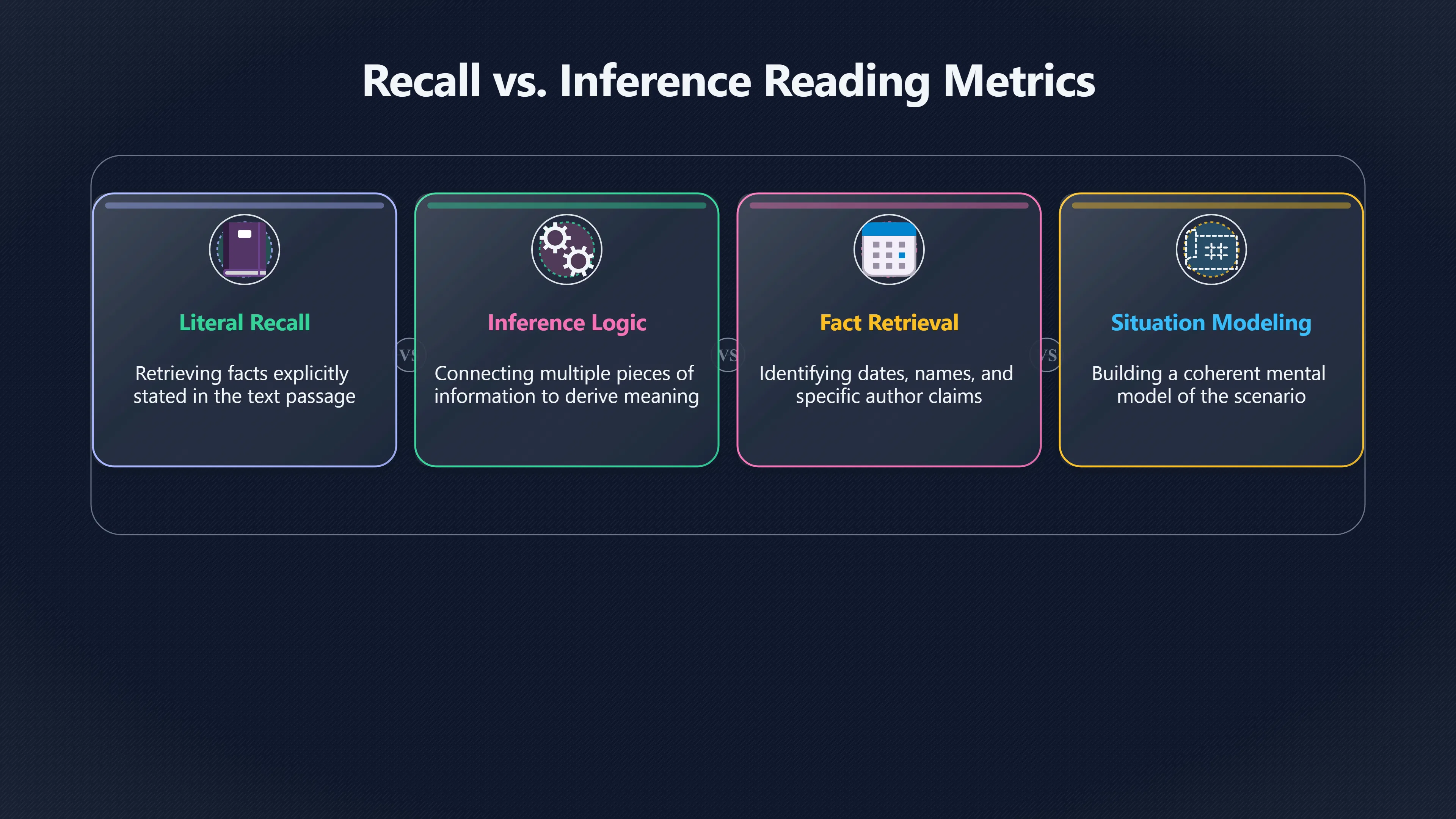
Recall questions and inference questions measure different things.
A recall question asks for information explicitly stated in the text:
- What year did the event occur?
- What were the three reasons given by the author?
- Who proposed the solution?
A reader can often answer these correctly by remembering isolated facts.
An inference question requires the reader to combine pieces of information and derive something that the author implied rather than directly stated. The reader must build a coherent mental model of the passage. Researchers commonly describe inference-making as the process of using information in the text to arrive at a conclusion that is not written explicitly.[NFER+2Keys to Literacy]nfer.ac.ukNFEREffective teaching of inference skills for readingOctober 8, 2009 — by A Kispal · 2008 · Cited by 126 — The ability to make inferences is, in simple terms, the ability to use two or more…
This distinction matters when reading speed increases. Faster reading can sometimes preserve fact recognition while weakening integration between ideas. Studies of reading comprehension repeatedly identify inferencing as a key contributor to deeper comprehension because readers must connect information across sentences and paragraphs rather than process each statement separately.[Frontiers+2PMC]frontiersin.orgferencing Skill and Attentional Control Account for the…by YSG Kim · 2021 · Cited by 6 — A rich body of studies has shown t…
For progress measurement, that means a reader who improves from 220 to 270 words per minute but can no longer answer inference questions has probably gained speed at the expense of comprehension.
Did faster reading preserve the logic?
Inference questions are especially valuable because they reveal whether the reader followed the argument’s internal structure.
Consider a short passage:
A company introduced remote work. Staff turnover fell by 30% over the next year. Managers later expanded the programme.
A recall question might ask:
- By how much did turnover fall?
An inference question might ask:
- Why did managers probably expand the programme?
The answer requires connecting two pieces of information. The text never states the reason directly, but the implication is that managers viewed the reduced turnover as evidence of success.
This kind of reasoning mirrors real-world reading. Authors frequently leave connections unstated because they expect readers to infer them. Research on comprehension suggests that constructing this connected understanding—sometimes called a situation model—is central to successful reading. Inferencing helps readers move beyond remembering sentences and towards understanding the situation those sentences describe.[PMC+2Keys to Literacy]pmc.ncbi.nlm.nih.govTherefore, we tested a reading strategy training…
When testing reading-speed progress, inference questions therefore function as a stress test for comprehension. They reveal whether the reader still understands how ideas fit together after reading more quickly.
Examples of why, how, and what follows questions
The most useful inference questions after a timed reading exercise are usually simple. They do not require elaborate interpretation or literary analysis. Instead, they focus on logical connections within the text.
Why questions
These examine causes, motivations, or reasons.
Examples:
- Why did the researcher change the method halfway through the study?
- Why was the policy unpopular despite initial support?
- Why did the character avoid discussing the issue?
To answer correctly, the reader must connect evidence scattered across the passage.

How questions
These examine mechanisms and relationships.
Examples:
- How did the new technology reduce costs?
- How did the author’s second argument support the first?
- How did the company respond to declining sales?
These questions reveal whether the reader followed the chain of reasoning rather than simply collecting facts.
What follows questions
These test consequences, implications, and predictions.
Examples:
- What is the most likely result if the trend continues?
- What conclusion would the author probably support?
- What problem might arise from the proposed solution?
Such questions are particularly useful for non-fiction because they measure whether the reader understood the direction of the argument. Educational research commonly classifies conclusions, cause-and-effect reasoning, and implied outcomes as inferential comprehension tasks rather than literal recall.[ERIC]files.eric.ed.govERICDifferences in Literal and Inferential ComphensionIn grade 2, there were two literal comprehension and three inferential comprehension questions. for…Read more…
Why inference questions often feel harder
Many readers notice that inference questions become difficult sooner than factual questions when they increase reading speed.
One reason is that inferential questions usually require more information from the passage to be retained and integrated. Research examining comprehension assessment has found that inference questions often place greater demands on memory because readers must connect multiple parts of a text rather than retrieve a single stated fact.[PMC]pmc.ncbi.nlm.nih.govby AN Hua · 2014 · Cited by 52 — Comprehension tests often compare accuracy on inferential versus literal questions and find inferenti…
Another reason is that inference depends partly on background knowledge and reasoning skills. Readers must combine what the text says with what they already know about the topic or situation. Studies of reading comprehension consistently identify inferencing, critical thinking, and knowledge integration as important contributors to understanding.[Taylor & Francis Online+2MDPI]tandfonline.comA critical review was conducted to determine the influence background knowledge has on the reading comprehension of primary school-aged c…
This is why inference scores are often a better early warning signal than recall scores. They tend to decline first when reading becomes too fast for effective comprehension.
How to score inference answers without overcomplicating them
For personal reading-speed tracking, there is little benefit in creating a sophisticated grading system.
A simple three-point scale usually works well:
ScoreDescription2Answer clearly supported by the passage and captures the main inference1Partly correct but incomplete or weakly supported0Incorrect, unsupported, or missing
For example, if a passage suggests that a project was delayed because funding disappeared:
Question: Why was the launch postponed?
- “Funding was withdrawn, making the launch impossible on schedule.” → 2 points
- “The company had some problems.” → 1 point
- “Demand was too high.” → 0 points
This approach keeps scoring practical while still distinguishing genuine understanding from vague guessing.
A useful target is consistency rather than perfection. If a reader can regularly answer most inference questions accurately while maintaining a higher reading speed, that is strong evidence that comprehension is being preserved.

A practical inference check after each timed reading
A simple post-reading routine can be completed in less than two minutes:
- Read the passage under normal timed conditions.
- Write a one-sentence summary.
- Answer one recall question.
- Answer one “why” question.
- Answer one “how” or “what follows” question.
- Record both reading speed and inference score.[bedrocklearning.org]bedrocklearning.orginference in reading comprehension17 Oct 2022 — Explore how teaching inference skills can improve reading comprehension skills for students, boosting attainment across the…
Over time, patterns become visible. Some readers discover that they can increase speed substantially on familiar material without harming inference performance. Others find that their inference accuracy drops sharply beyond a certain pace. That threshold is often more informative than the words-per-minute number itself.
For measuring progress in reading speed, inference questions provide a direct check on whether faster reading preserved the relationships, causes, implications, and logic that give a text its meaning. A higher speed is only a meaningful improvement when those connections remain intact.
Amazon book picks
Further Reading
Books and field guides related to Did faster reading preserve the logic?. Use these as the next step if you want deeper reading beyond the article.
How to Read a Book
Rating: 4.0/5 from 41 Google Books ratings
Focuses on analytical reading, reasoning, and preserving meaning beyond surface recall.
The Knowledge GAP
Highlights knowledge-building and deeper comprehension rather than fact recall.

Language at the Speed of Sight
Explains how readers process text and why comprehension succeeds or fails.
Understanding and Teaching Reading Comprehension
Directly addresses inference-making and comprehension assessment.
eBay marketplace picks
Marketplace Samples
Example marketplace items related to this page. Use the search link to explore similar finds on eBay.


Endnotes
1.
Source: nfer.ac.uk
Title: NFEREffective teaching of inference skills for reading
Link:https://www.nfer.ac.uk/media/1aafth05/edr01.pdf
Source snippet
October 8, 2009 — by A Kispal · 2008 · Cited by 126 — The ability to make inferences is, in simple terms, the ability to use two or more...
Published: October 8, 2009
2.
Source: pmc.ncbi.nlm.nih.gov
Link:https://pmc.ncbi.nlm.nih.gov/articles/PMC4753814/
Source snippet
Therefore, we tested a reading strategy training...
3.
Source: pmc.ncbi.nlm.nih.gov
Title: PMCOn the Dynamics of Inferential Behavior while Reading
Link:https://pmc.ncbi.nlm.nih.gov/articles/PMC11117665/
Source snippet
by Y Yoo · 2024 · Cited by 2 — Inference plays a key role in reading comprehension. This study examines changes in inferential behavio...
4.
Source: files.eric.ed.gov
Title: ERICDifferences in Literal and Inferential Comphension
Link:https://files.eric.ed.gov/fulltext/ED243090.pdf
Source snippet
In grade 2, there were two literal comprehension and three inferential comprehension questions. for...Read more...
5.
Source: pmc.ncbi.nlm.nih.gov
Link:https://pmc.ncbi.nlm.nih.gov/articles/PMC9754047/
Source snippet
Inferential narrative comprehension ability of young school...by MF Westerveld · 2021 · Cited by 17 — Comprehension questions were ca...
6.
Source: pmc.ncbi.nlm.nih.gov
Link:https://pmc.ncbi.nlm.nih.gov/articles/PMC4196386/
Source snippet
by AN Hua · 2014 · Cited by 52 — Comprehension tests often compare accuracy on inferential versus literal questions and find inferenti...
7.
Source: mdpi.com
Link:https://www.mdpi.com/2227-7102/14/3/225
Source snippet
Critical Thinking in Reading Comprehension: Fine Tuning...by D Paige · 2024 · Cited by 68 — Two indicators of critical thinking, inducti...
8.
Source: mdpi.com
Link:https://www.mdpi.com/2227-7102/15/6/654
Source snippet
Inferential Reading Skills in High School: A Study on...by A Nadalini · 2025 · Cited by 9 — This study investigates reading behavior by...
9.
Source: keystoliteracy.com
Title: making inferences to support comprehension
Link:https://keystoliteracy.com/blog/making-inferences-to-support-comprehension/
Source snippet
8 Oct 2024 — Helping students understand when information is implied in text (not directly stated) will improve their inferencing ability...
10.
Source: frontiersin.org
Link:https://www.frontiersin.org/journals/psychology/articles/10.3389/fpsyg.2021.709944/full
Source snippet
ferencing Skill and Attentional Control Account for the...by YSG Kim · 2021 · Cited by 6 — A rich body of studies has shown t...
11.
Source: tandfonline.com
Link:https://www.tandfonline.com/doi/full/10.1080/02702711.2021.1888348
Source snippet
A critical review was conducted to determine the influence background knowledge has on the reading comprehension of primary school-aged c...
12.
Source: files.eric.ed.gov
Link:https://files.eric.ed.gov/fulltext/EJ1266300.pdf
Source snippet
ERICby C Hall · 2020 · Cited by 119 — The primary [purpose]({{ 'purpose/' | relative_url }}) of this study was to expand the research base on inference instruction for midd...
13.
Source: study.com
Link:https://study.com/academy/lesson/reading-comprehension-literal-inferential-evaluative.html
Source snippet
Reading Comprehension | Inferential, Literal & EvaluativeInferential comprehension requires the reader to look beyond what is read in the...
14.
Source: bedrocklearning.org
Title: inference in reading comprehension
Link:https://bedrocklearning.org/literacy-blogs/inference-in-reading-comprehension/
Source snippet
17 Oct 2022 — Explore how teaching inference skills can improve reading comprehension skills for students, boosting attainment across the...
Additional References
15.
Source: researchgate.net
Link:https://www.researchgate.net/publication/354445160_Inferential_narrative_comprehension_ability_of_young_school-age_children_on_the_autism_spectrum
Source snippet
Inferential narrative comprehension ability of young school-...3 Feb 2026 — Comprehension questions were categorized into factual and in...
16.
Source: researchgate.net
Link:https://www.researchgate.net/publication/366864136_A_SCOPING_REVIEW_OF_INFERENTIAL_READING_COMPREHENSION_RESEARCH_IN_THE_PRESENT_DECADE
Source snippet
A scoping review of inferential reading comprehension...4 Jan 2023 — Inferential comprehension has had a notable role in reading compreh...
17.
Source: infonomics-society.org
Link:https://infonomics-society.org/wp-content/uploads/Primary-School-Inference-Making-Strategies-From-Research-to-[Practice
Source snippet
Primary School Inference Making StrategiesIn light of this research, teaching students the skills and cues needed to make inferences lead...
18.
Source: susanfitzell.com
Link:https://susanfitzell.com/teaching-higher-order-comprehension-2/
Source snippet
Teaching Fact vs Opinion for Reading ComprehensionAs students advance in their studies, reading progresses from simple recall and recitat...
19.
Source: aclanthology.org
Link:https://aclanthology.org/2025.bea-1.31.pdf
Source snippet
e language model to generate inference-making questions for a reading comprehension assessment...
20.
Source: researchgate.net
Link:https://www.researchgate.net/publication/371290077_Inferencing_in_Reading_Comprehension_Examining_Variations_in_Definition_Instruction_and_Assessment
Source snippet
ResearchGate(PDF) Inferencing in Reading Comprehension: Examining...2 Jun 2023 — Inferencing is an important and complex process require...
21.
Source: researchgate.net
Link:https://www.researchgate.net/publication/7710922_Assessing_children%27s_inference_generation_What_do_tests_of_reading_comprehension_measure
Source snippet
facilitating the deeper understanding and integration of knowledge...
22.
Source: school-page.com
Title: Explore how AI can help generate diverse
Link:https://www.school-page.com/articles/balanced-question-types-factual-inferential-critical-thinking
Source snippet
Balanced Question Types: Factual, Inferential, and Critical...Learn to create comprehensive reading assessments using Factual, Inferenti...
23.
Source: lexialearning.com
Link:https://www.lexialearning.com/blog/3-types-of-reading-comprehension-compared-inferential-literal-and-evaluative
Source snippet
3 Types of Reading Comprehension Compared - Lexia9 Feb 2026 — Using inferential comprehension, students can bridge their literal understa...
24.
Source: pure.eur.nl
Link:https://pure.eur.nl/ws/portalfiles/portal/174198957/Training_Inference_Making_Skills_Using_a_Situation_Model_Approach_Improves_Reading_Comprehension.pdf
Source snippet
Therefore, we tested a reading...
Topic Tree