Within Self Test
Can your quiz spot fake fast reading?
Good follow-up questions test main ideas, links between points, and conclusions rather than isolated facts.
On this page
- Why factual recall is not enough
- Question types that test real understanding
- Using a 70 to 80 percent comprehension threshold
Page outline Jump by section
Introduction
A reading-speed test is easy to game. Someone can race through a passage, remember a handful of isolated facts, and post an impressive words-per-minute score while missing the argument, the relationships between ideas, or the author’s conclusion. That is why the quality of the comprehension quiz matters as much as the timing itself.
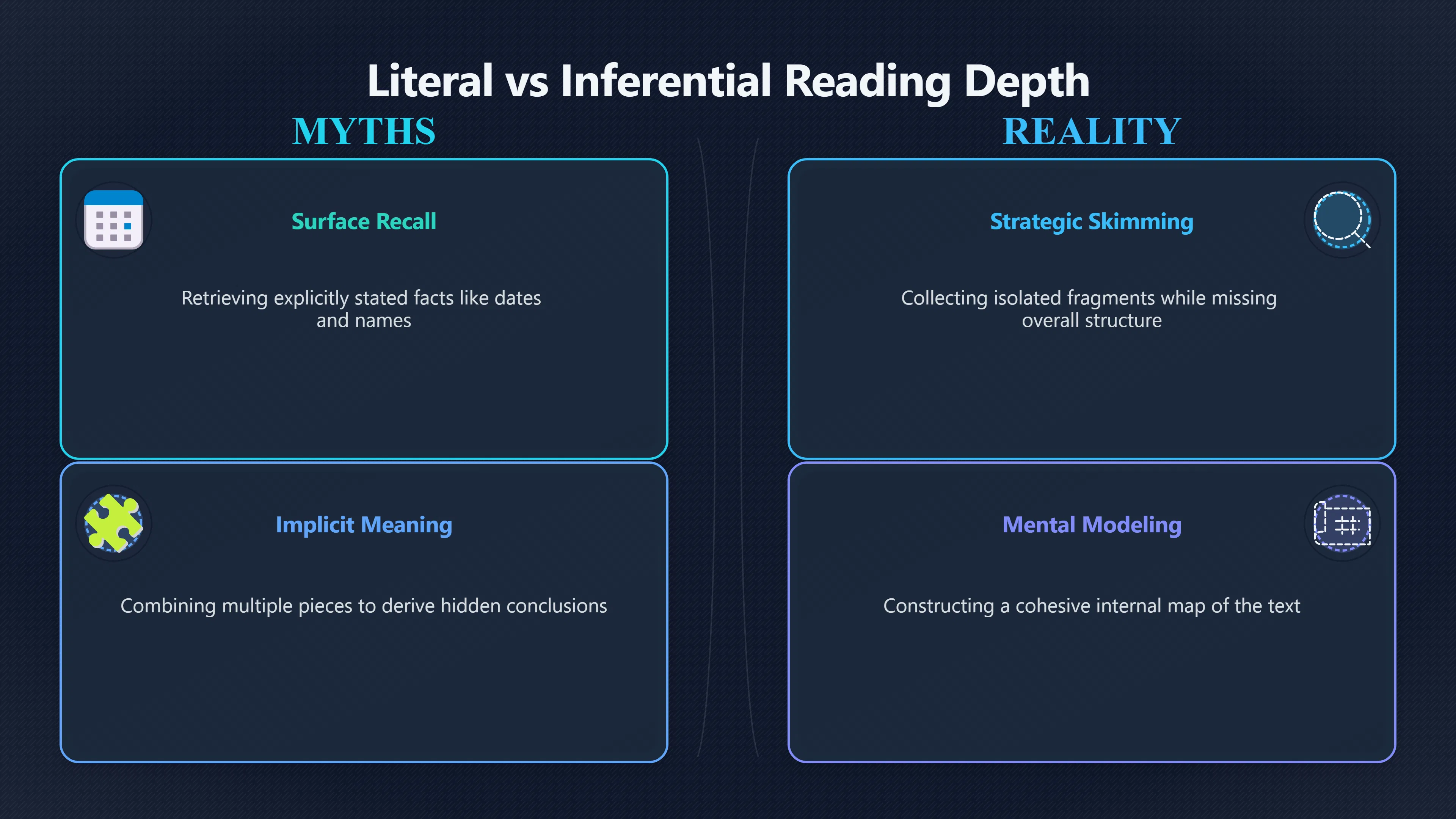
 The best comprehension questions are designed to expose skimming. Instead of asking readers to retrieve a single detail, they require readers to connect information across the text, identify the main point, draw inferences, and explain how one idea leads to another. Research on reading comprehension consistently distinguishes between literal recall and deeper inferential understanding, with inference-making recognised as a central component of genuine comprehension.[NFER]nfer.ac.ukNFEREffective teaching of inference skills for readingOctober 8, 2009 — by A Kispal · 2008 · Cited by 126 — The ability to make inferences is, in simple terms, the ability to use two or more…
Why factual recall is not enough
A common mistake in reading-speed tests is relying on questions that can be answered from one memorable sentence.
For example, after a 1,200-word article, a quiz might ask:
- What year did the event occur?
- What was the name of the company?
- How many participants were involved?
A reader who skimmed strategically may answer all three correctly despite understanding very little of the passage as a whole.
Reading researchers often distinguish between literal comprehension and inferential comprehension. Literal questions test information explicitly stated in the text. Inferential questions require readers to combine information, recognise implications, and construct meaning beyond individual sentences.[Lexia+2study.com]lexialearning.comLexia3 Types of Reading Comprehension ComparedLexia9 Feb 2026 — Explore the three main levels of reading comprehension: literal, inferential, and evaluative. Develop instructional str…
This distinction matters because skimming tends to preserve fragments of information while weakening understanding of structure, causation, and argument. A quiz that relies heavily on factual recall can therefore overestimate comprehension and make a fast reading speed look more effective than it really is.[ERIC]files.eric.ed.govERICDifferences in Literal and Inferential ComphensionIn grade 2, there were two literal comprehension and three inferential comprehension questions. for…Read more…
Question types that test real understanding
The strongest reading-speed assessments mix several kinds of questions. Each targets a different way that superficial reading can fail.
Main-idea questions
Main-idea questions reveal whether the reader understood the passage’s central purpose.
Examples:
- What is the author’s primary argument?
- Which statement best summarises the passage?
- What problem is the text mainly trying to explain?
These questions are difficult to answer correctly if the reader has only collected disconnected facts. Research and educational assessment frameworks consistently treat main-idea identification as a higher-value indicator of comprehension than simple detail recall.[The Hechinger Report+2Gallaudet University]hechingerreport.orgThe Hechinger Report What happens to reading comprehension when studentsThe Hechinger ReportWhat happens to reading comprehension when students…May 26, 2025 — 26 May 2025 — Some researchers say students nee…
A useful test design includes at least one question where several answer choices contain true details but only one captures the overall message.
Cause-and-effect questions
Skimming often preserves events while losing the connections between them.
Questions such as:
- Why did the policy change occur?
- What led to the outcome described in the final section?
- Which factor most influenced the result?
require readers to understand relationships rather than isolated information.
Readers who have merely scanned headings and keywords frequently recognise what happened but struggle to explain why it happened. Cause-and-effect questions exploit that weakness and are therefore effective filters against inflated speed scores.[ERIC]files.eric.ed.govERICDifferences in Literal and Inferential ComphensionIn grade 2, there were two literal comprehension and three inferential comprehension questions. for…Read more…
Inference questions
Inference questions are among the best tools for detecting shallow reading.
An inference requires the reader to combine two or more pieces of information to reach a conclusion that the text does not explicitly state. The National Foundation for Educational Research defines inferencing as using multiple pieces of information from a text to derive an implicit meaning.[NFER]nfer.ac.ukNFEREffective teaching of inference skills for readingOctober 8, 2009 — by A Kispal · 2008 · Cited by 126 — The ability to make inferences is, in simple terms, the ability to use two or more…
Examples include:
- What can be inferred about the author’s view?
- Why was the character likely concerned?
- Which conclusion follows most logically from the evidence presented?
These questions are powerful because a reader cannot answer them by remembering a single sentence. They require construction of a mental model of the text, something that extensive skimming often undermines.[NFER+2Erasmus University Rotterdam]nfer.ac.ukNFEREffective teaching of inference skills for readingOctober 8, 2009 — by A Kispal · 2008 · Cited by 126 — The ability to make inferences is, in simple terms, the ability to use two or more…
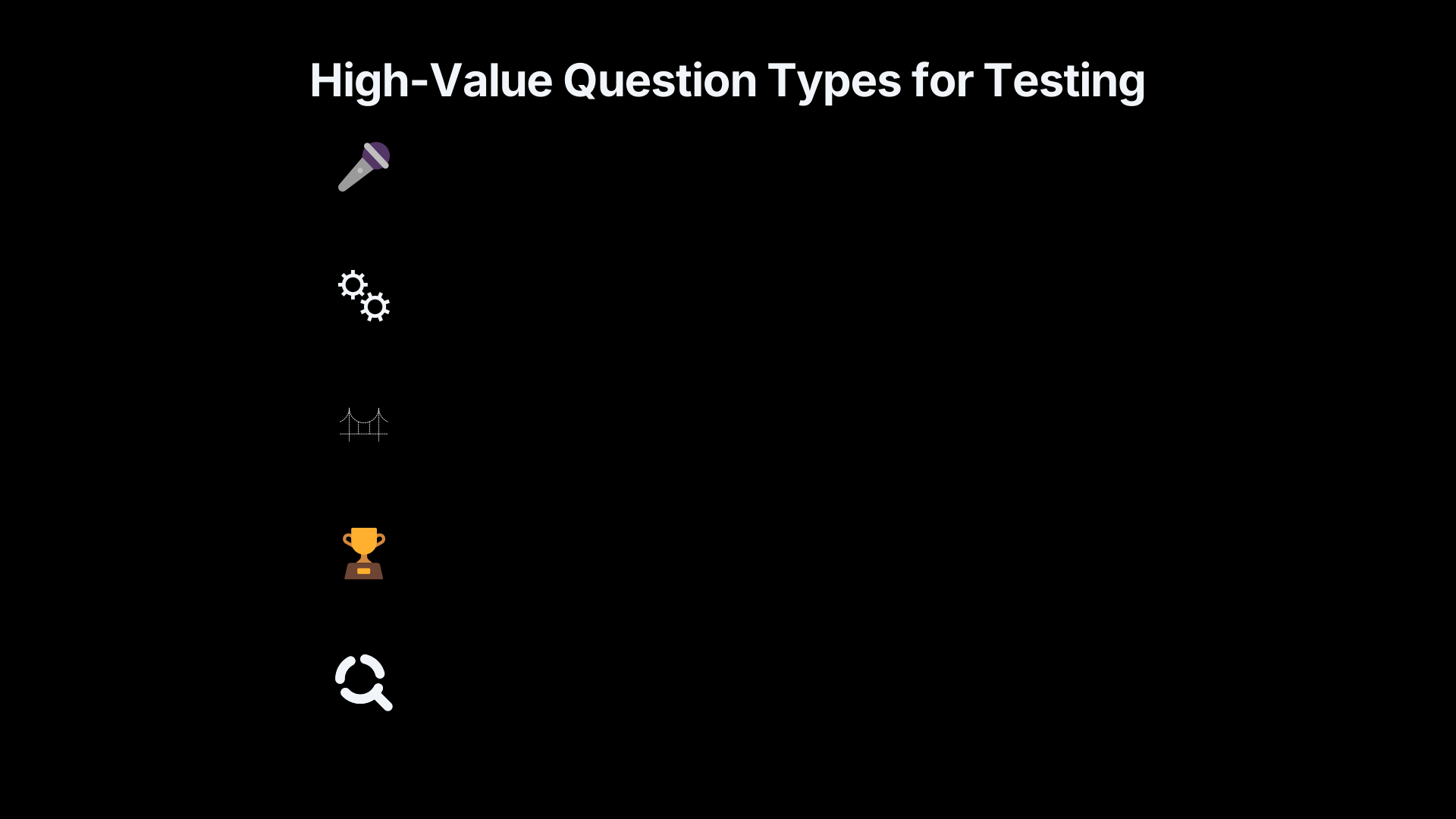
Questions that connect distant parts of the passage
Many weak quizzes focus on information from one paragraph at a time.
A stronger approach asks readers to integrate information from multiple sections:
- How does the example in the introduction support the conclusion?
- Which earlier point best explains the final recommendation?
- What theme links the first and last sections?
Research on both human and machine reading-comprehension assessment shows that questions requiring reasoning across multiple sentences or sections are substantially harder to answer through superficial pattern matching alone.[arXiv]arxiv.orgarXiv What Makes Reading Comprehension Questions Easier?What Makes Reading Comprehension Questions Easier?August 28, 2018…
These questions are particularly useful when evaluating reading speed because they test whether the reader retained the structure of the text rather than isolated fragments.
Conclusion and implication questions
A reader who skims may recognise facts but miss what the facts mean.
Questions targeting conclusions and implications include:
- What is the most reasonable takeaway from the passage?
- Which recommendation would the author most likely support?
- What broader implication follows from the evidence?
Such questions require synthesis rather than retrieval. They measure whether the reader understood the destination of the argument, not just the route taken to reach it.[School Pages]school-page.comExplore how AI can help generate diverseSchool PagesBalanced Question Types: Factual, Inferential, and Critical…Learn to create comprehensive reading assessments using Factua…
Common quiz designs that fail to catch skimming
Several popular comprehension formats give readers too much credit.
Single-detail questions. A reader may answer correctly after noticing only one sentence.
Question order that follows the passage exactly. This allows readers to rely on short-term memory of recent details rather than understanding.
Overuse of names, dates, and numbers. Such information is often easy to recognise even during rapid scanning.
Too few questions. A three-question quiz provides little evidence of comprehension. One lucky guess can substantially distort results.
A comprehension check intended to validate reading speed should deliberately challenge readers to demonstrate understanding across the whole text, not merely recall fragments.[ERIC]files.eric.ed.govERICDifferences in Literal and Inferential ComphensionIn grade 2, there were two literal comprehension and three inferential comprehension questions. for…Read more…
Using a 70 to 80 percent comprehension threshold
A practical reading-speed test needs a pass standard.[wordsrated.com]wordsrated.comreading speed statisticsNov 8, 2021 — Research into the RSVP method showed that, when participants read 7th- to 8th-grade material at a 705 wpm, they had a 70% c…
Many reading-rate studies and speed-reading discussions use a comprehension threshold around 70–80 percent. The logic is straightforward: reading faster is valuable only if understanding remains high enough to make the reading useful. Research reviews discussing accelerated reading methods note that an 80 percent comprehension benchmark is often treated as acceptable, whereas substantially lower levels become increasingly risky for meaningful understanding.[Compass]compass.onlinelibrary.wiley.comCompass Improving reading rates and comprehension?Benefits and…Mar 17, 2021 — While an 80% threshold for comprehension accuracy may be considered appropriate, allowing comprehension to…
For self-testing, a useful rule is:
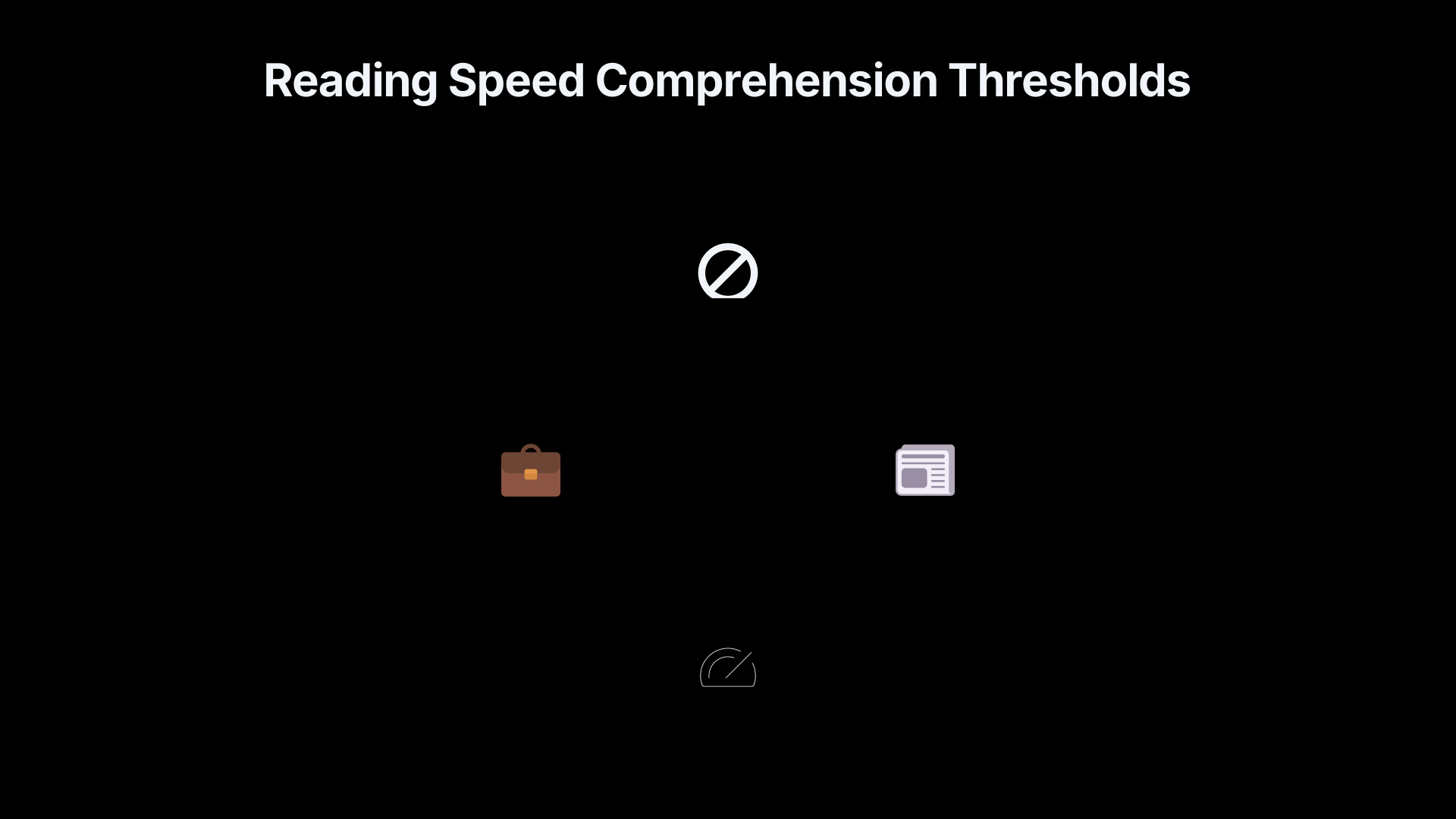
- Below 70% comprehension: speed is probably too high for that material.
- Around 70–80%: acceptable for lighter reading, news, or familiar topics.
- Above 80%: strong evidence that comprehension survived the increased pace.
The exact threshold depends on the purpose. Reading a novel for enjoyment may tolerate some loss of detail. Reading a contract, research paper, or technical report usually requires a higher standard.
The key principle remains the same: a words-per-minute score should only count if comprehension questions demonstrate that the reader understood the text. Without that check, a high speed score may simply be evidence of efficient skimming rather than effective reading.[tandfonline.com+2Compass]tandfonline.comFull article: Testing the Speed-Accuracy Trade-Off in Readingby L Schwalm · 2026 — Purpose. This study investigates whether the natural r…
Amazon book picks
Further Reading
Books and field guides related to Can your quiz spot fake fast reading?. Use these as the next step if you want deeper reading beyond the article.
How to Read a Book
Rating: 4.0/5 from 41 Google Books ratings
Centers on comprehension, analysis, and understanding rather than raw speed.
Reading in the Brain
First published 2009. Subjects: Science, Nonfiction, Psychology, Psychology of Reading, Reading.
The Speed Reading Book
First published 1997. Subjects: Speed reading, Développement d'aptitudes.

The complete idiot's guide to speed reading
First published 2008. Subjects: Nonfiction, Reference, Speed reading.
Endnotes
1.
Source: nfer.ac.uk
Title: NFEREffective teaching of inference skills for reading
Link:https://www.nfer.ac.uk/media/1aafth05/edr01.pdf
Source snippet
October 8, 2009 — by A Kispal · 2008 · Cited by 126 — The ability to make inferences is, in simple terms, the ability to use two or more...
Published: October 8, 2009
2.
Source: study.com
Link:https://study.com/academy/lesson/reading-comprehension-literal-inferential-evaluative.html
Source snippet
Reading Comprehension | Inferential, Literal & EvaluativeInferential comprehension requires the reader to look beyond what is read in the...
3.
Source: files.eric.ed.gov
Title: ERICDifferences in Literal and Inferential Comphension
Link:https://files.eric.ed.gov/fulltext/ED243090.pdf
Source snippet
In grade 2, there were two literal comprehension and three inferential comprehension questions. for...Read more...
4.
Source: gallaudet.edu
Link:https://gallaudet.edu/student-success/tutorial-center/english-center/reading-esl/types-of-reading-comprehension-questions-and-tests/6-types-of-reading-questions/
Source snippet
Gallaudet University6 Types of reading questionsThere are six kinds of reading questions: Comprehension; Detail Questions; Following Dire...
5.
Source: arxiv.org
Title: arXiv What Makes Reading Comprehension Questions Easier?
Link:https://arxiv.org/abs/1808.09384
Source snippet
What Makes Reading Comprehension Questions Easier?August 28, 2018...
Published: August 28, 2018
6.
Source: tandfonline.com
Link:https://www.tandfonline.com/doi/full/10.1080/10888438.2025.2612649
Source snippet
Full article: Testing the Speed-Accuracy Trade-Off in Readingby L Schwalm · 2026 — Purpose. This study investigates whether the natural r...
7.
Source: lexialearning.com
Title: Lexia3 Types of Reading Comprehension Compared
Link:https://www.lexialearning.com/blog/3-types-of-reading-comprehension-compared-inferential-literal-and-evaluative
Source snippet
Lexia9 Feb 2026 — Explore the three main levels of reading comprehension: literal, inferential, and evaluative. Develop instructional str...
8.
Source: hechingerreport.org
Title: The Hechinger Report What happens to reading comprehension when students
Link:https://hechingerreport.org/proof-points-reading-comprehension-main-idea/
Source snippet
The Hechinger ReportWhat happens to reading comprehension when students...May 26, 2025 — 26 May 2025 — Some researchers say students nee...
Published: May 26, 2025
9.
Source: pure.eur.nl
Link:https://pure.eur.nl/ws/portalfiles/portal/174198957/Training_Inference_Making_Skills_Using_a_Situation_Model_Approach_Improves_Reading_Comprehension.pdf
Source snippet
Therefore, we tested a reading...Read more...
10.
Source: school-page.com
Title: Explore how AI can help generate diverse
Link:https://www.school-page.com/articles/balanced-question-types-factual-inferential-critical-thinking
Source snippet
School PagesBalanced Question Types: Factual, Inferential, and Critical...Learn to create comprehensive reading assessments using Factua...
11.
Source: school-page.com
Link:https://www.school-page.com/articles/crafting-effective-reading-comprehension-questions-guide
Source snippet
"Generate questions that require students to identify the main idea and supporting details.Read more...
12.
Source: compass.onlinelibrary.wiley.com
Title: Compass Improving reading rates and comprehension?
Link:https://compass.onlinelibrary.wiley.com/doi/10.1111/lnc3.12408
Source snippet
Benefits and...Mar 17, 2021 — While an 80% threshold for comprehension accuracy may be considered appropriate, allowing comprehension to...
Additional References
13.
Source: researchgate.net
Link:https://www.researchgate.net/publication/354445160_Inferential_narrative_comprehension_ability_of_young_school-age_children_on_the_autism_spectrum
Source snippet
Inferential narrative comprehension ability of young school-...3 Feb 2026 — Comprehension questions were categorized into factual and in...
14.
Source: cognitivetrain.com
Link:https://cognitivetrain.com/reading-speed-by-grade-level/
Source snippet
Reading Speed by Grade LevelAdults (18-50): 250-300 WPM is typical for average adult readers.... ➤ Your WPM (Words Per Minute) and accur...
15.
Source: susanfitzell.com
Link:https://susanfitzell.com/teaching-higher-order-comprehension-2/
Source snippet
Teaching Fact vs Opinion for Reading ComprehensionAs students advance in their studies, reading progresses from simple recall and recitat...
16.
Source: readingrockets.org
Link:https://www.readingrockets.org/topics/about-reading/articles/simple-view-reading
Source snippet
The Simple View of ReadingThe Simple View of Reading is a formula demonstrating the widely accepted view that reading has two basic compo...
17.
Source: fndusa.org
Title: A Strategy to Improve Reading Comprehension Through Inferential Thinking
Link:https://fndusa.org/wp-content/uploads/2015/06/A-Strategy-to-Improve-Reading-Comprehension-Through-Inferential-Thinking.pdf
Source snippet
Family Network on DisabilitiesA-Strategy-to-Improve-Reading-Comprehension-Through-...9 Jun 2015 — This article introduces the Main Idea...
18.
Source: 5staressays.com
Title: speed reading techniques for college students
Link:https://www.5staressays.com/blog/speed-reading-techniques-for-college-students
Source snippet
GuideJan 15, 2026 — Research demonstrates that average trained speed readers achieve 400-700 words per minute with 70-80% comprehension...
19.
Source: researchgate.net
Title: (PDF) How many words do we read per minute?
Link:https://www.researchgate.net/publication/335174808_How_many_words_do_we_read_per_minute_A_review_and_meta-analysis_of_reading_rate
Source snippet
A review...15 Aug 2019 — We estimate that the average silent reading rate for adults in English is 238 words per minute (wpm) for non-fi...
20.
Source: biblio.ugent.be
Title: be How many words do we read per minute?
Link:https://biblio.ugent.be/publication/8647789
Source snippet
A review and meta...by M Brysbaert · 2019 · Cited by 872 — For silent reading of English non-fiction most adults fall in the range of 17...
21.
Source: shanahanonliteracy.com
Title: how important is reading rate
Link:https://www.shanahanonliteracy.com/blog/how-important-is-reading-rate
Source snippet
?Jan 5, 2019 — “The corresponding rate for poor readers at this level is 50 to 70 words per minute. According to one group of scholars, t...
22.
Source: wordsrated.com
Title: reading speed statistics
Link:https://wordsrated.com/reading-speed-statistics/
Source snippet
Nov 8, 2021 — Research into the RSVP method showed that, when participants read 7th- to 8th-grade material at a 705 wpm, they had a 70% c...
Topic Tree