Within Faster Reading
Why Familiar Topics Feel Faster to Read
Readers get faster in familiar subjects because words, concepts, and argument patterns require less effort to process.
On this page
- How known words reduce friction
- Why topic knowledge speeds prediction
- Building fluency within a field
Page outline Jump by section
Introduction
Familiar topics often feel faster to read because the brain is not starting from zero. Known words are recognised more automatically, familiar concepts need less explanation, and predictable argument patterns let the reader anticipate where a sentence or paragraph is going. This does not mean background knowledge magically turns difficult prose into easy prose, or that readers can safely skim everything they know something about. It means that part of reading speed is built before reading begins: in vocabulary, domain knowledge, and repeated exposure to how a field talks.
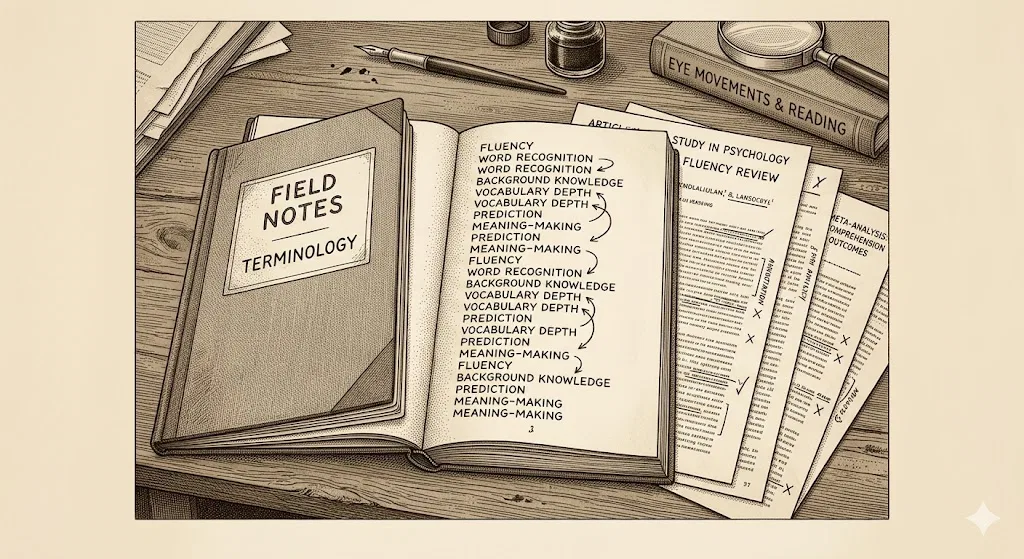
For increasing reading speed, this is one of the most reliable “slow routes to fast reading”. Instead of trying to force the eyes across the page at an artificial pace, the reader reduces the amount of mental work each line demands. Research on fluency, word recognition, vocabulary knowledge, prior knowledge and eye movements all points in the same direction: speed improves when recognition and meaning-making become less effortful.[NICHD+2Frontiers]nichd.nih.govNICHDNational Reading PanelReports of the Subgroups - Fluency - Chapter 3…
How known words reduce friction
A reader who knows a word well does not have to assemble it from scratch. Its spelling, sound, meaning, common uses and likely neighbours are already linked in memory. That is why a sentence full of familiar vocabulary can be read smoothly, while a sentence containing several new technical terms slows the reader even if the grammar is simple.
Reading researchers often describe this as automatic word recognition. The National Reading Panel’s fluency review states that word recognition accuracy is not the endpoint: skilled readers read words “accurately, rapidly and efficiently”, while readers who do not develop fluency continue to read slowly and with effort.[NICHD]nichd.nih.govNICHDNational Reading PanelReports of the Subgroups - Fluency - Chapter 3… A 2023 eye-tracking study in Frontiers in Psychology makes the same mechanism visible: familiar real words produced shorter dwell times and fewer fixations than unfamiliar pseudo-words, showing that the eyes linger when the brain has more work to do.[Frontiers]frontiersin.orgFrontiersFrontiers | A developmental study of eye movements in Hebrew word reading: the effects of word familiarity, word length, and rea…
This matters because reading is not just seeing words; it is holding words in working memory long enough to build meaning. If too much attention is spent identifying vocabulary, less is available for inference, tone, structure and argument. A reader of medicine, law, finance or literary criticism may technically be able to pronounce every word, but still read slowly because key terms do not yet carry instant meaning.
Vocabulary also has layers. Knowing that “margin” can mean a blank space at the edge of a page is not the same as recognising “profit margin”, “margin of error”, “marginal cost” and “margin call” quickly in context. Research on second-language reading is especially clear about this: a meta-analysis of more than 100 studies found a strong relationship between vocabulary knowledge and reading comprehension, with vocabulary knowledge accounting for a substantial share of variation in comprehension outcomes.[Fachportal Pädagogik]fachportal-paedagogik.deOpen source on fachportal-paedagogik.de. For speed, the lesson is practical: breadth helps because fewer words are unknown; depth helps because familiar words become faster to interpret in specialised settings.

Why topic knowledge speeds prediction
Background knowledge speeds reading because it makes the text more predictable. A reader who already knows the basics of inflation, for example, expects references to interest rates, purchasing power, central banks, wages and prices. That reader is not guessing wildly; they are using a mental map. Each new sentence has a place to go.
The classic classroom example is the Recht and Leslie baseball study. Seventh- and eighth-grade pupils read a passage about a baseball inning; those with greater baseball knowledge recalled and retained more, and the ERIC abstract reports that greater subject knowledge improved recall and retention without an interaction between prior knowledge and reading ability.[ERIC]eric.ed.govEJ384774 - Effect of Prior Knowledge on Good and Poor Readers' Memory of Text., Journal of Educational Psychology, 1988… The point for reading speed is not that baseball knowledge is special. It is that domain knowledge supplies ready-made structure: who is doing what, which details matter, and which events are routine rather than surprising.
That structure reduces the number of “micro-pauses” a reader experiences. In an unfamiliar field, the reader repeatedly has to ask: Is this term important? Is this claim ordinary or controversial? Is this paragraph giving background, evidence, exception or conclusion? In a familiar field, many of those decisions happen almost automatically. This is why a software developer may fly through a dense technical blog post but slow down on a short article about tax law, while a tax specialist may do the reverse.
Prior knowledge also helps readers fill gaps. Writers rarely explain every assumption. A football report may mention “pressing high”; a scientific article may refer to a “control group”; a theatre review may call a performance “naturalistic”. When the reader already knows the convention, the phrase is quick. When they do not, the phrase becomes a speed bump.
The useful limit: knowledge helps, but it can also mislead
Background knowledge is a speed builder, not a substitute for reading. It can make comprehension easier, but it can also make a reader overconfident. A familiar topic encourages prediction; prediction is useful when it fits the text, but risky when the author is making a subtle distinction or challenging a common assumption.
This is why the baseball study should not be stretched too far. Timothy Shanahan, a literacy researcher, notes that there is a substantial body of research showing that readers use prior knowledge to understand text, but also cautions that the baseball study was a one-off, used a single specially designed text, and does not prove that strategy instruction or other kinds of reading instruction should be abandoned.[Shanahan on Literacy]shanahanonliteracy.comOpen source on shanahanonliteracy.com. Alfie Kohn has made a sharper criticism, arguing that the study is small, focused on one distinctive topic, and often used to support instructional claims it did not actually test.[National Education Policy Center]nepc.colorado.eduNational Education Policy CenterAlfie Kohn: The *&%$!#! Baseball Study: Why Are Fans of Fact-Focused Teaching Still Citing a Small, Uncon…
For adults trying to increase reading speed, the balanced takeaway is simple: use knowledge as a support, not as permission to stop checking the page. Familiarity should make reading smoother, but it should not turn into automatic agreement. The best readers notice when a text violates their expectations and slow down at that point.
A useful rule is to distinguish between three kinds of difficulty:
- Vocabulary difficulty: the words themselves are unfamiliar.
- Concept difficulty: the words are readable, but the ideas lack a mental framework.
- Argument difficulty: the topic is familiar, but the author is making a precise, surprising or contested claim.
Vocabulary and background knowledge help most with the first two. The third still requires careful reading.
Building fluency within a field
The fastest improvement usually comes from reading clusters of related material, not random difficult texts. A reader who wants to read faster in economics, gardening, history, programming or health research benefits from repeated exposure to the same terms, examples and argument moves. Each encounter makes the next one easier.
This is why field-specific fluency grows unevenly. Someone may be a fast reader of novels but slow with academic articles; quick with football coverage but slow with pensions guidance; fluent in general news but hesitant with scientific papers. That is normal. Reading speed is partly a local skill.
A practical way to build this kind of speed is to move through a field in layers:
- Start with accessible explanations. These build the basic map: key terms, recurring questions, major distinctions and common examples.
- Read several pieces on the same topic close together. Repetition turns new vocabulary into recognisable vocabulary.
- Keep a short list of high-frequency terms. Do not collect every unknown word; focus on words that appear repeatedly and seem to carry the argument.
- Use glossaries, diagrams and summaries before dense texts. Previewing does not replace reading, but it reduces the number of surprises per paragraph.
- Re-read one important text after learning the basics. The second reading is often dramatically faster because the reader now recognises the terrain.
This approach is consistent with the broader fluency evidence. The National Reading Panel found that repeated oral reading with feedback improved reading expertise, and the underlying principle applies beyond school contexts: repeated, meaningful encounters with text reduce effort and increase fluent recognition.[NICHD]nichd.nih.govNICHDNational Reading PanelReports of the Subgroups - Fluency - Chapter 3… The Department for Education’s reading framework also emphasises that vocabulary is vital for comprehension and that pupils need fluency and comprehension alongside word reading.[GOV.UK Assets]assets.publishing.service.gov.ukUK Assets The reading frameworkThe reading framework…
What this means for increasing reading speed
Vocabulary and background knowledge do not create instant speed. They create lower-friction reading. The reader recognises more words at sight, attaches them to richer meanings, predicts what kind of information is likely to come next, and spends less energy deciding what each sentence is doing.
The effect is most noticeable in familiar domains. A person who has read twenty clear articles about nutrition will read the twenty-first faster because words such as “protein”, “calorie deficit”, “glycaemic response” and “randomised trial” no longer require the same effort. A person who reads legal contracts regularly recognises clause patterns that would slow a newcomer. A reader of literary criticism becomes quicker at phrases such as “narrative voice”, “intertextuality” and “unreliable narrator” because they are no longer isolated labels; they belong to a working network of ideas.
For speed building, the strongest habit is therefore not racing the eyes. It is building recognition ahead of time. The more a reader knows about the words, concepts and structures in a field, the more of the page can be processed automatically, leaving attention free for the parts that genuinely deserve it.
Amazon book picks
Further Reading
Books and field guides related to Why Familiar Topics Feel Faster to Read. Use these as the next step if you want deeper reading beyond the article.
How to Read a Book
Rating: 4.0/5 from 41 Google Books ratings
Improves reading effectiveness across domains.
eBay marketplace picks
Marketplace Samples
Example marketplace items related to this page. Use the search link to explore similar finds on eBay.


Endnotes
1.
Source: nichd.nih.gov
Title: NICHDNational Reading Panel
Link:https://www.nichd.nih.gov/sites/default/files/publications/pubs/nrp/Documents/ch3.pdf
Source snippet
Reports of the Subgroups - Fluency - Chapter 3...
2.
Source: assets.publishing.service.gov.uk
Title: UK Assets The reading framework
Link:https://assets.publishing.service.gov.uk/media/664f600c05e5fe28788fc437/The_reading_framework_.pdf
Source snippet
The reading framework...
3.
Source: nac.gov.sg
Link:https://www.nac.gov.sg/
4.
Source: nea.gov.sg
Link:https://www.nea.gov.sg/
5.
Source: nas.gov.sg
Link:https://www.nas.gov.sg/archivesonline/
6.
Source: nhb.gov.sg
Link:https://www.nhb.gov.sg/nationalmuseum/
7.
Source: ns.gov.sg
Link:https://www.ns.gov.sg/web
8.
Source: frontiersin.org
Link:https://www.frontiersin.org/journals/psychology/articles/10.3389/fpsyg.2023.1052755/full
Source snippet
FrontiersFrontiers | A developmental study of eye movements in Hebrew word reading: the effects of word familiarity, word length, and rea...
9.
Source: fachportal-paedagogik.de
Link:https://www.fachportal-paedagogik.de/literatur/vollanzeige.html?FId=eric_ej1342379
10.
Source: eric.ed.gov
Link:https://eric.ed.gov/?id=EJ384774
Source snippet
EJ384774 - Effect of Prior Knowledge on Good and Poor Readers' Memory of Text., Journal of Educational Psychology, 1988...
11.
Source: shanahanonliteracy.com
Link:https://www.shanahanonliteracy.com/blog/prior-knowledge-or-he-isnt-going-to-pick-on-the-baseball-study
12.
Source: nepc.colorado.edu
Link:https://nepc.colorado.edu/blog/baseball-study
Source snippet
National Education Policy CenterAlfie Kohn: The *&%$!#! Baseball Study: Why Are Fans of Fact-Focused Teaching Still Citing a Small, Uncon...
13.
Source: doe.mass.edu
Title: word recognition
Link:https://www.doe.mass.edu/massliteracy/skilled-reading/fluent-word-reading/word-recognition.html
Source snippet
for Early Reading: Automatic Word RecognitionDecember 18, 2020 — All fluent readers can instantly and automatically recognize a large num...
Published: December 18, 2020
14.
Source: frontiersin.org
Link:https://www.frontiersin.org/journals/psychology/articles/10.3389/fpsyg.2021.657573/full
15.
Source: Wikipedia
Link:https://en.wikipedia.org/wiki/Knowledge
16.
Source: Wikipedia
Title: Baseball Study
Link:https://en.wikipedia.org/wiki/Baseball_Study
17.
Source: pmc.ncbi.nlm.nih.gov
Link:https://pmc.ncbi.nlm.nih.gov/articles/PMC8559868/
18.
Source: pmc.ncbi.nlm.nih.gov
Link:https://pmc.ncbi.nlm.nih.gov/articles/PMC3142886/
19.
Source: pmc.ncbi.nlm.nih.gov
Link:https://pmc.ncbi.nlm.nih.gov/articles/PMC8012014/
20.
Source: pmc.ncbi.nlm.nih.gov
Link:https://pmc.ncbi.nlm.nih.gov/articles/PMC4331220/
21.
Source: www1.nichd.nih.gov
Link:https://www1.nichd.nih.gov/publications/pubs/nrp/Documents/report.pdf
22.
Source: pmc.ncbi.nlm.nih.gov
Link:https://pmc.ncbi.nlm.nih.gov/articles/PMC10497962/
23.
Source: pmc.ncbi.nlm.nih.gov
Link:https://pmc.ncbi.nlm.nih.gov/articles/PMC5510944/
24.
Source: dictionary.cambridge.org
Link:https://dictionary.cambridge.org/dictionary/english-spanish/national
25.
Source: dictionary.cambridge.org
Link:https://dictionary.cambridge.org/dictionary/english/national
26.
Source: dictionary.cambridge.org
Link:https://dictionary.cambridge.org/dictionary/english/knowledge
27.
Source: users.cecs.anu.edu.au
Link:https://users.cecs.anu.edu.au/~Tom.Gedeon/pdfs/The%20effect%20of%20subject%20familiarity%20on%20comprehension%20and%20eye%20movements%20during%20reading.pdf
28.
Source: scholars.cityu.edu.hk
Link:https://scholars.cityu.edu.hk/files/71199775/59733616.pdf
29.
Source: epc.ntnu.edu.tw
Link:https://www.epc.ntnu.edu.tw/File/Archive/BB-79-C7-E7-DB-C6-55-31-3C-08-C1-42-0B-0A-DB-47.pdf
30.
Source: nus.edu.sg
Link:https://nus.edu.sg/
31.
Source: nationaljc.moe.edu.sg
Link:https://www.nationaljc.moe.edu.sg/
Additional References
32.
Source: thedyslexiaclassroom.com
Title: When students do not have to devote most of their attention to decoding
Link:https://www.thedyslexiaclassroom.com/blog/from-effortful-decoding-to-automatic-word-reading
Source snippet
From Effortful Decoding to Automatic Word ReadingFebruary 13, 2026 — Automatic word reading matters because it frees cognitive energy...
Published: February 13, 2026
33.
Source: youtube.com
Title: The role of background knowledge in reading comprehension
Link:https://www.youtube.com/watch?v=kLeUFzWTxO4
Source snippet
What is Orthographic Mapping and How is it Built?...
34.
Source: researchgate.net
Link:https://www.researchgate.net/publication/377081451_The_effects_of_segmentation_on_cognitive_load_vocabulary_learning_and_retention_and_reading_comprehension_in_a_multimedia_learning_environment
35.
Source: researchgate.net
Link:https://www.researchgate.net/publication/260342627_What_oral_text_reading_fluency_can_reveal_about_reading_comprehension
36.
Source: researchgate.net
Link:https://www.researchgate.net/publication/360155449_BREADTH_AND_DEPTH-VOCABULARY_KNOWLEDGE_AND_READING_COMPREHENSION_IN_AN_ENGLISH_FIRST_ADDITIONAL_LANGUAGE_CONTEXT
37.
Source: researchgate.net
Link:https://www.researchgate.net/publication/360615911_Using_an_eye_tracker_to_examine_the_effect_of_prior_knowledge_on_reading_processes_while_reading_a_printed_scientific_text_with_multiple_representations
38.
Source: researchgate.net
Link:https://www.researchgate.net/publication/382334813_THE_RELATIONSHIP_BETWEEN_READING_FLUENCY_COMPONENTS_AND_COMPREHENSION_SKILLS_A_DESCRIPTIVE_CORRELATIONAL_STUDY
39.
Source: researchgate.net
Link:https://www.researchgate.net/publication/249134643_A_Review_of_the_National_Reading_Panel%27s_Studies_on_Fluency_The_Role_of_Text
40.
Source: flowfluency.com
Link:https://flowfluency.com/blog/automaticity-and-repeated-reading-unlocking-the-key-to-fluency/
41.
Source: academia.edu
Link:https://www.academia.edu/94664271/Automaticity_of_word_recognition_is_a_unique_predictor_of_reading_fluency_in_middle_school_students
Topic Tree
Follow this branch
Parent topic
Faster ReadingRelated pages 11
- Benchmarks How Fast Do Adults Really Read?
- Dense Texts Why Hard Texts Need Slower Reading
- Inner Voice Should You Silence Your Inner Voice?
- Measure The Reading Speed Test That Actually Helps
- Myths Why Speed Reading Promises Fall Apart
- Phrases Read Phrases, Not Just Words
- Practice Can Rereading Make You Faster?
- Purpose When Should You Slow Down or Skim?
- +3 more in sidebar