Within Passage fit
When rereading turns into repeated struggling
Frequent pauses, frustration, and weak improvement show that a passage is too hard for speed-building rereading.
On this page
- Warning signs during the first reading
- Why harder text does not always build fluency
- How to replace an overloaded passage
Page outline Jump by section
Introduction
A passage chosen for repeated reading should become easier with each rereading. If it does not, the problem is often not effort or motivation but the passage itself. When readers repeatedly stumble over the same text, pause at many words, lose the thread of meaning, or show little improvement after several readings, the passage is probably too difficult for fluency practice. In that situation, rereading can reinforce hesitation and frustration rather than build the automatic word recognition that supports faster reading. Research and instructional guidance consistently recommend fluency work with texts that can already be read accurately, rather than texts that remain a struggle throughout practice.[Reading Rockets]readingrockets.orgReading RocketsFluency: In DepthFluency is the ability to read a text accurately, at a good pace, and with proper expression and comprehe…
 This matters because increasing reading speed is not about forcing readers through harder material. It is about creating enough success that repeated exposure turns effortful word recognition into increasingly automatic recognition. A passage that repeatedly overwhelms the reader works against that goal.[AIM Nexus]nexus.aimpa.orgAIM Nexus Automaticity & FluencyAIM NexusAutomaticity & Fluency - AIM NexusAutomaticity is the ability to implement a skill not only accurately, but with quick, effortle…
Warning signs during the first reading
Many poor-fit passages reveal themselves within the first attempt. You do not usually need multiple sessions to discover that a text is unsuitable for speed-building rereading.
Common warning signs include:
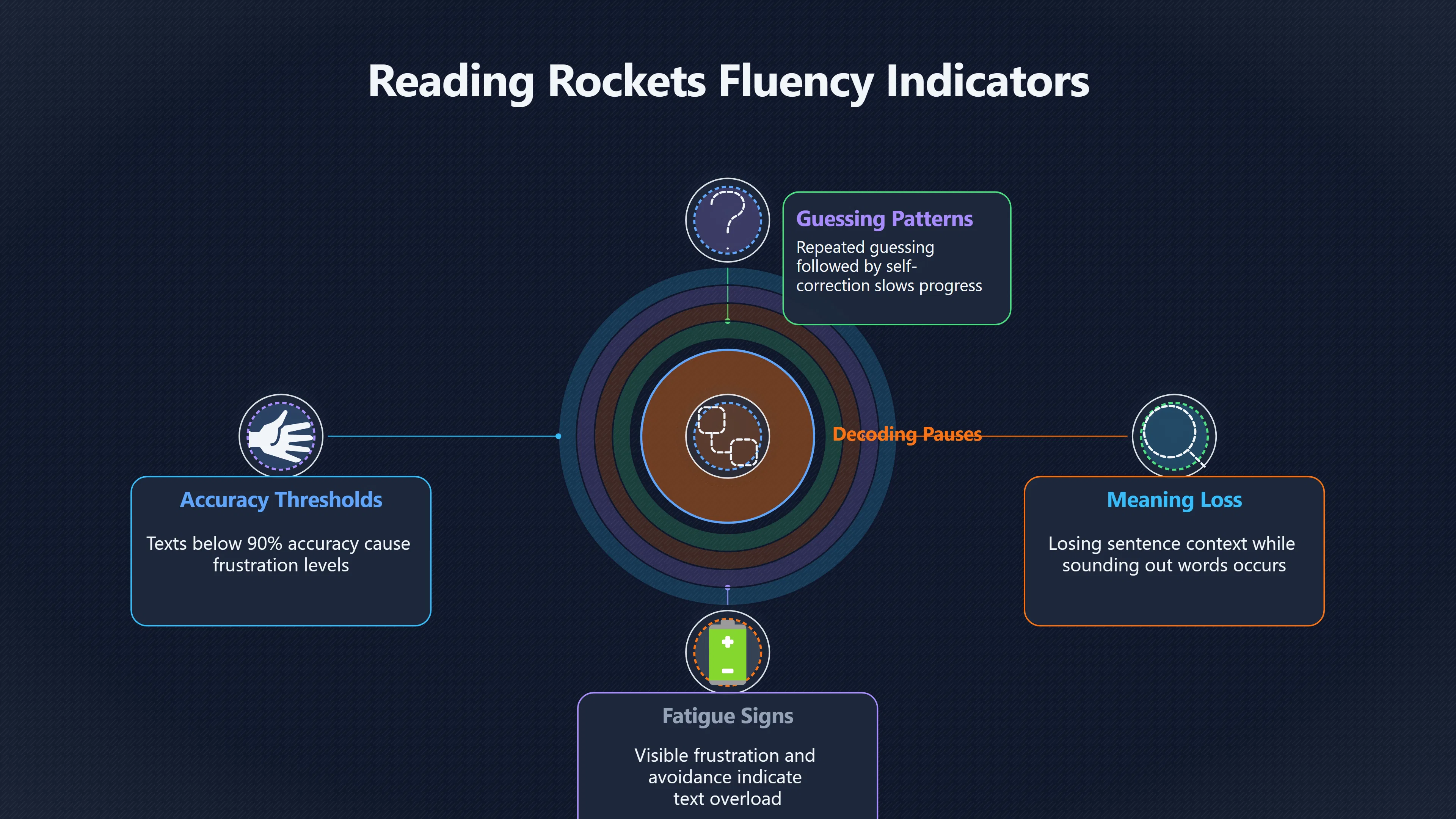
- Frequent stopping to decode individual words.
- Repeated guessing followed by self-correction.
- Long pauses before ordinary words.
- Losing track of sentence meaning while sounding out words.
- Reading so slowly that phrases never develop a natural rhythm.
- Visible frustration, avoidance, or signs of fatigue.
- Inability to explain what the passage was about after reading it.
These behaviours indicate that too much attention is being devoted to basic word identification. Fluency practice works best when readers can devote increasing attention to smoothness, phrasing, and meaning rather than constant decoding.[Reading Rockets]readingrockets.orgReading RocketsFluency: In DepthFluency is the ability to read a text accurately, at a good pace, and with proper expression and comprehe…
Accuracy provides another useful clue. Guidance commonly describes independent-level texts as those read with roughly 95% accuracy or higher and frustration-level texts as those below about 90% accuracy. If errors appear every few lines, the passage may still be workable. If mistakes occur constantly, the text is probably too demanding for rereading practice aimed at increasing speed.[Reading Rockets+2McGraw Hill]readingrockets.orgReading RocketsFluency: In DepthFluency is the ability to read a text accurately, at a good pace, and with proper expression and comprehe…
The improvement test
A useful practical check is to compare the first and second readings.
With a suitable passage, readers often show immediate changes:
- Fewer hesitations.
- Faster recognition of previously difficult words.
- More natural phrasing.
- Better recall of meaning.
If the second reading looks almost identical to the first, the text may be overloaded with unfamiliar vocabulary, complex sentence structures, or decoding demands. Repetition is most effective when it produces noticeable gains after only a small amount of practice.[Reading Rockets+2Reading Rockets]readingrockets.orgReading RocketsTimed Repeated ReadingsTimed repeated readings are an instructional strategy used to improve students' reading fluency. Th…
Why harder text does not always build fluency
A common misconception is that the hardest manageable passage will produce the greatest improvement. Fluency research generally points in the opposite direction.
Automaticity develops when word recognition becomes fast and effortless. When readers encounter too many difficult words, they cannot devote enough mental resources to building speed and expression because all available attention is consumed by decoding.[AIM Nexus+2Reading Rockets]nexus.aimpa.orgAIM Nexus Automaticity & FluencyAIM NexusAutomaticity & Fluency - AIM NexusAutomaticity is the ability to implement a skill not only accurately, but with quick, effortle…
Consider two readers practising repeated reading:[rsisinternational.org]rsisinternational.orgImproving Reading Fluency among Frustration Level…28 Apr 2025 — These studies demonstrated that consistent practice through repeated r…
- Reader A encounters a passage with only a few challenging words and quickly becomes more efficient across rereadings.
- Reader B encounters unfamiliar vocabulary in nearly every sentence and spends each rereading solving the same decoding problems.
Reader A is likely to experience increasing fluency. Reader B may simply repeat the struggle.
This is one reason fluency specialists frequently recommend passages that can already be read with high accuracy. Repeated reading is designed to strengthen automatic recognition and smooth reading, not to serve as primary instruction for large numbers of unknown words.[Reading Rockets+2Reading Rockets]readingrockets.orgReading RocketsTimed Repeated ReadingsTimed repeated readings are an instructional strategy used to improve students' reading fluency. Th…

Difficulty can come from more than vocabulary
Readers sometimes assume that a passage is appropriate because most individual words are familiar. Yet other features can create overload:
- Dense technical terminology.
- Long, multi-clause sentences.
- Unfamiliar subject matter.
- Heavy use of abstract language.
- Frequent proper names or specialised labels.
Even skilled readers often become less fluent when reading texts filled with unfamiliar concepts. A passage may therefore be a poor choice for fluency work despite appearing straightforward at first glance.[Reading Rockets]readingrockets.orgReading RocketsFluency: In DepthFluency is the ability to read a text accurately, at a good pace, and with proper expression and comprehe…
When repeated errors become the lesson
One hidden risk of an overloaded passage is that practice time becomes error practice.
Repeated reading is effective partly because readers encounter the same words multiple times and gradually recognise them more efficiently. However, if a reader repeatedly misreads, guesses, or stalls at numerous locations, those inefficient patterns can dominate the practice session. Instead of rehearsing fluent reading, the reader rehearses struggle. Fluency interventions therefore commonly include immediate correction and guidance while keeping text difficulty within a manageable range.[Landmark Outreach+2Reading Rockets]landmarkoutreach.orgLandmark Outreach Fluency Interventions at the Text and Passage LevelsLandmark OutreachFluency Interventions at the Text and Passage LevelsApril 16, 2025 — 16 Apr 2025 — Repeated reading–having students read…
A simple question helps reveal this problem:
Is the reader practising smooth reading, or practising recovery from mistakes?
If most of the session involves recovering from mistakes, the passage is probably too difficult for speed-building rereading.
How to replace an overloaded passage
Replacing a difficult passage does not mean abandoning challenge altogether. The goal is to reduce overload while preserving enough complexity for growth.
A better replacement often has these characteristics:
- Similar topic or interest level.
- Shorter length.
- More familiar vocabulary.
- Fewer decoding obstacles.
- High first-read accuracy.[faculty.washington.edu]faculty.washington.eduUW Faculty Web ServerReading FluencyAs long as it is at the student's instructional. (90-95% accuracy) or independent (95% + accuracy) re…
- Completion within roughly one to two minutes.
Research-based fluency routines commonly use brief passages that can be reread several times in a single session. When readers can finish the text comfortably and accurately, improvements become easier to notice and measure.[Five from Five]fivefromfive.com.aurepeated readingFive from FiveRepeated Reading6 Oct 2025 — How to do Repeated Reading. Choose a passage that students can read with very few errors. The…
For example, if a reader struggles through a 180-word science passage packed with specialised terminology, a better fluency passage might cover the same topic using simpler language and more familiar sentence structures. The objective is not to lower expectations permanently but to create conditions where repeated reading can actually build automaticity.[Reading Rockets]readingrockets.orgReading RocketsFluency: In DepthFluency is the ability to read a text accurately, at a good pace, and with proper expression and comprehe…
A quick decision rule
A passage is probably a poor fit for fluency rereading when most of the following are true:
- The first reading contains frequent pauses and errors.
- Meaning is difficult to maintain.
- The second reading shows little improvement.
- Frustration increases rather than decreases.
- Practice feels dominated by decoding rather than reading.
When those signs appear, changing the passage is often more productive than demanding additional repetitions. Effective fluency practice should create a visible sense of progress. If rereading repeatedly feels like starting over, the text is likely too difficult for the purpose of increasing reading speed.[Reading Rockets+2Reading Rockets]readingrockets.orgReading RocketsFluency: In DepthFluency is the ability to read a text accurately, at a good pace, and with proper expression and comprehe…
Amazon book picks
Further Reading
Books and field guides related to When rereading turns into repeated struggling. Use these as the next step if you want deeper reading beyond the article.
The fluent reader
Explains how to avoid ineffective rereading and build successful fluency practice.

The Megabook of Fluency
Provides alternative texts and approaches when readers struggle.
Overcoming Dyslexia
Helps explain persistent reading difficulty and intervention needs.
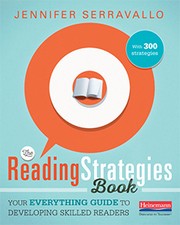
The Reading Strategies Book
Offers replacement strategies when a passage proves too difficult.
eBay marketplace picks
Marketplace Samples
Example marketplace items related to this page. Use the search link to explore similar finds on eBay.


Endnotes
1.
Source: readingrockets.org
Link:https://www.readingrockets.org/reading-101/reading-101-learning-modules/course-modules/fluency/depth
Source snippet
Reading RocketsFluency: In DepthFluency is the ability to read a text accurately, at a good pace, and with proper expression and comprehe...
2.
Source: readingrockets.org
Link:https://www.readingrockets.org/classroom/classroom-strategies/timed-repeated-readings
Source snippet
Reading RocketsTimed Repeated ReadingsTimed repeated readings are an instructional strategy used to improve students' reading fluency. Th...
3.
Source: nexus.aimpa.org
Title: AIM Nexus Automaticity & Fluency
Link:https://nexus.aimpa.org/skill-overviews/automaticity-and-fluency/
Source snippet
AIM NexusAutomaticity & Fluency - AIM NexusAutomaticity is the ability to implement a skill not only accurately, but with quick, effortle...
4.
Source: mheducation.com
Link:https://www.mheducation.com/unitas/school/program/corrective-reading-2008/corrective-reading-independent-instructional-frustrational-reading-levels.pdf
Source snippet
level text (problematic text for the reader, with more than...
5.
Source: readingrockets.org
Link:https://www.readingrockets.org/topics/fluency/articles/fluency-introduction
Source snippet
Fluency: An IntroductionRepeated and monitored [oral reading]({{ 'reading-aloud/' | relative_url }}) improves reading fluency and overall reading achievement. Students who read a...
6.
Source: fivefromfive.com.au
Title: repeated reading
Link:https://fivefromfive.com.au/fluency/evidence-based-fluency-instruction/repeated-reading/
Source snippet
Five from FiveRepeated Reading6 Oct 2025 — How to do Repeated Reading. Choose a passage that students can read with very few errors. The...
7.
Source: landmarkoutreach.org
Title: Landmark Outreach Fluency Interventions at the Text and Passage Levels
Link:https://www.landmarkoutreach.org/strategies/fluency-interventions-text-and-passage-level/
Source snippet
Landmark OutreachFluency Interventions at the Text and Passage LevelsApril 16, 2025 — 16 Apr 2025 — Repeated reading–having students read...
Published: April 16, 2025
8.
Source: readingrockets.org
Title: everything you wanted know about repeated reading
Link:https://www.readingrockets.org/blogs/shanahan-on-literacy/everything-you-wanted-know-about-repeated-reading
Source snippet
Everything You Wanted to Know about Repeated Reading4 Aug 2017 — Silent reading should also take place regularly — I try to provide both...
9.
Source: readingrockets.org
Link:https://www.readingrockets.org/topics/fluency/articles/fluency-instructional-guidelines-and-student-activities
Source snippet
Fluency: Instructional Guidelines and Student ActivitiesThe best strategy for developing reading fluency is to provide your students with...
Additional References
10.
Source: shanahanonliteracy.com
Link:https://www.shanahanonliteracy.com/blog/everything-you-wanted-to-know-about-repeated-reading
Source snippet
Everything You Wanted to Know about Repeated ReadingRepeated reading usually leads to better oral reading performance and reading compreh...
11.
Source: secondstorywindow.net
Link:https://www.secondstorywindow.net/repeated-reading-fluency-strategies/
Source snippet
Repeated Reading Fluency StrategiesLearn how to help your students build and use repeated reading fluency strategies and skills with thes...
12.
Source: faculty.washington.edu
Link:https://faculty.washington.edu/rhudson/National_RF_2008_hudson_HO_revised.pdf
Source snippet
UW Faculty Web ServerReading FluencyAs long as it is at the student's instructional. (90-95% accuracy) or independent (95% + accuracy) re...
13.
Source: rsisinternational.org
Link:https://rsisinternational.org/journals/ijriss/articles/improving-reading-fluency-among-frustration-level-readers-of-grade-5-and-6-pupils-through-repeated-reading-interventions/
Source snippet
Improving Reading Fluency among Frustration Level...28 Apr 2025 — These studies demonstrated that consistent practice through repeated r...
14.
Source: researchgate.net
Link:https://www.researchgate.net/publication/258142912_Developing_Reading_Fluency_With_Repeated_Reading
15.
Source: dyslexiasupportservices.com.au
Link:https://www.dyslexiasupportservices.com.au/pdf_files/RepeatedReading.pdf
Source snippet
This will probably mean reading the same text during the next reading...Read more...
16.
Source: flowfluency.com
Link:https://flowfluency.com/blog/automaticity-and-repeated-reading-unlocking-the-key-to-fluency/
Source snippet
Automaticity and Repeated Reading: Unlocking the Key to...by WRR Matters — The Flow Reading Fluency program integrates repeated reading...
17.
Source: mdsoar.org
Link:https://mdsoar.org/bitstreams/377369d0-b23d-4216-b869-757602ad8638/download
Source snippet
uction resulted in a statistically significant improvement in the...Read more...
18.
Source: devon.gov.uk
Link:https://www.devon.gov.uk/support-schools-settings/ordinarily-available-inclusive-provision/targeted/cognition-and-learning-needs/reading-fluency-and-comprehension/
Source snippet
Reading fluency and comprehension - Support for schools...Reading fluency refers to the ability to read text accurately, smoothly and wi...
19.
Source: youtube.com
Link:http://www.youtube.com/watch?v=P0C7ssPCogM
Source snippet
Running records miscue analysis reading fluency frustration level Running Records: Assessing and Improving Students' Reading Fluency and...
Topic Tree